₹1.03 Lakh Gap: SIP vs Post Office RD on ₹10,000 a Month
SIP vs Post Office RD on ₹10,000 a month: Mint's math shows a ₹1.03 lakh gap in 5 years. Here is what the SIP's extra comes with, and when the 6.7% RD still wins.

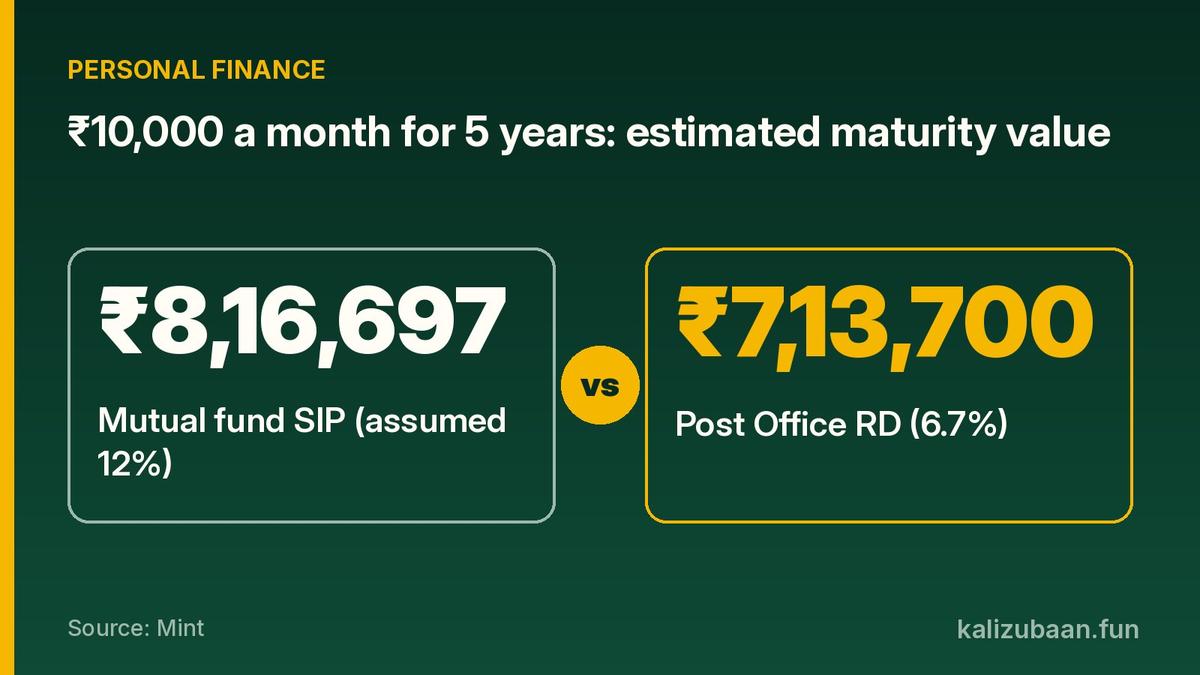
Put away ₹10,000 every month for 5 years and you hand over ₹6,00,000 either way. In a mutual fund SIP at an assumed 12% a year, Mint estimates it grows to ₹8,16,697. In a Post Office RD at 6.7%, it becomes ₹7,13,700.
That ₹1.03 lakh gap is the whole SIP vs Post Office RD debate in one number. The catch: only one of those two figures is promised.
Quick answer
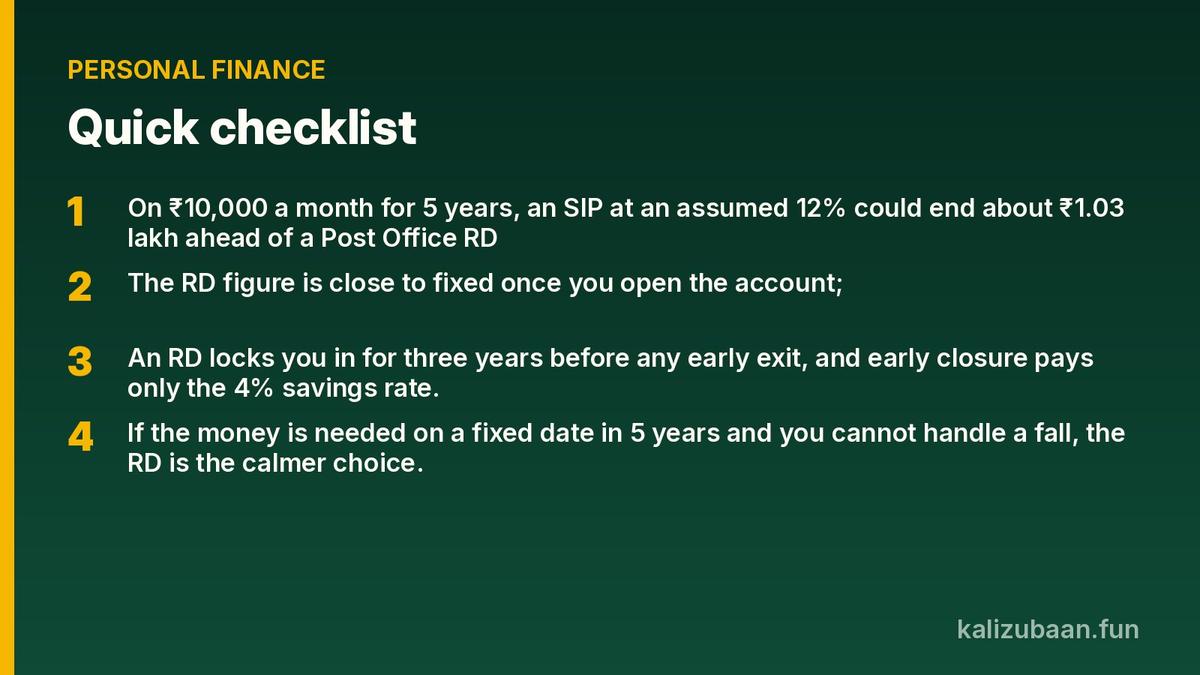
- On ₹10,000 a month for 5 years, an SIP at an assumed 12% could end about ₹1.03 lakh ahead of a Post Office RD at 6.7%.
- The RD figure is close to fixed once you open the account; the SIP figure is an illustration and can come in higher or lower.
- An RD locks you in for three years before any early exit, and early closure pays only the 4% savings rate.
- If the money is needed on a fixed date in 5 years and you cannot handle a fall, the RD is the calmer choice.
This is general education, not financial advice or a recommendation to buy or sell; check with a SEBI-registered adviser before you invest.
How much does ₹10,000 a month become in an SIP vs a Post Office RD?
At Mint's assumptions, an SIP grows ₹6,00,000 to about ₹8,16,697 in 5 years, while a Post Office RD grows it to about ₹7,13,700.
Mint's comparison assumes "an illustrative annualised return of 12%" for the SIP and the RD's current 6.7% rate, compounded quarterly (Mint). The estimated gains are ₹2,16,697 for the SIP and ₹1,13,700 for the RD.
So the SIP earns nearly double the RD's interest on the same deposits. That is the headline most people stop at.
But read the small print. Mint itself says the 12% "is still only an assumption", and that mutual fund returns "are not assured or guaranteed".
Is the Post Office RD rate of 6.7% fixed for 5 years?
Yes, for an account you open now: the maturity value is set by the rate on your opening date, so later rate changes do not alter it.
The government kept small savings rates unchanged for the quarter starting October 1, 2026, the 10th consecutive quarter without a change (Business Standard). For the RD, that means 6.7% a year, compounded quarterly.
Credsir's scheme guide says the maturity amount "is fixed by the date you opened the account" (Credsir). Its own calculation for ₹10,000 a month comes to ₹7,13,658, within a few rupees of Mint's figure.
Source: Mint
What most guides miss: the RD's ₹1,13,700 of interest is the realistic ceiling, but the SIP's ₹2,16,697 is not a floor. Mint's own article flags a serious risk of capital loss over short horizons, and 5 years is short for equity, so the fair comparison is a near-certain ₹7,13,700 against a range of outcomes centred on an assumption.
What are the risks of a mutual fund SIP over just 5 years?
The main risk is that markets fall close to the date you need the money, so the final value can land well below the illustration.
Mint lists fund performance, geopolitical problems and market volatility as factors, and warns of "a serious risk of capital loss in mutual funds, particularly over shorter investment horizons" (Mint).
That does not make SIPs bad. It means the 12% figure is a planning assumption, not a quote.
A related Mint example shows how steady habits matter more than tweaks. A ₹100 daily SIP puts in ₹36,500 a year against ₹36,000 for a ₹3,000 monthly SIP, and the gap in final value comes mostly from that extra ₹500 a year, not from the daily frequency (Mint).
What rules of the Post Office RD should you know before opening one?
The RD runs for 60 monthly deposits, starts at ₹100 a month, and cannot be closed before three years.
Here are the rules that matter most, as laid out in the scheme guide (Calcfolk):
- Deposits: minimum ₹100 a month, in multiples of ₹10, with no maximum. The monthly amount of an account cannot be changed; open a second account to save more.
- Early closure: allowed only after 3 years, and then you earn the Post Office Savings Account rate, not the RD rate.
- Tax: there is no section 80C benefit, and the interest is fully taxable at your slab rate.
- Loan: after one year and 12 deposits, you can borrow up to 50% of the balance.
Credsir adds that the savings rate is currently 4%, and the loan carries interest at 2 percentage points above the RD rate, which makes 8.7% on a 6.7% account (Credsir). Missing deposits also costs a default fee of ₹1 for every ₹100 of the missed instalment, per month.
Which should you pick: SIP or Post Office RD?
Pick the RD for money with a fixed date and no room for loss; pick an SIP for goals that can wait out a bad year or two.
Mint's own conclusion is that "there cannot be a single investment option for everyone", and the choice should depend on goals, horizon and risk tolerance (Mint).
A simple way to split it:
- RD fits: a wedding, fees or a down payment due in exactly 5 years, or a senior citizen who wants capital safety.
- SIP fits: retirement or a child's education that is 10 or more years away, where you can keep investing through dips.
- Both: many families run a small RD for the fixed goal and an SIP for the long one.
If you choose the RD, compare it with other small savings options too. The same notification keeps PPF at 7.1 per cent, NSC at 7.7 per cent and the monthly income scheme at 7.4 per cent (Business Standard).
FAQs
Is SIP better than Post Office RD for 5 years?
An SIP may build more, about ₹1.03 lakh extra on ₹10,000 a month at an assumed 12%, but it is not guaranteed. The RD's 6.7% is fixed for your account, so it suits money you cannot risk.
Can I close a Post Office RD before 5 years?
Only after 3 years. You then get the Post Office Savings Account rate, currently 4%, instead of 6.7%.
Is Post Office RD interest taxable?
Yes. RD interest is taxed at your slab rate, there is no section 80C deduction, and TDS can apply above the threshold.
Can I change my Post Office RD instalment later?
No. The first deposit fixes the monthly amount. To save more, open another RD account.
Expert review: pending.
This article is for education only and is not investment, tax or legal advice.
Related reading
- ₹13,000 Out, ₹3,000 Taxed: SIP vs SWP, Which Is Better?
- 10-Year SIP Ended at -0.13%: Small-Caps Can Still Lose Money
- Only 4 of 37 Flexi-Cap Funds Gave 8%+ SIP Returns in 3 Years
Sources
- Mint: ₹10,000 monthly SIP in a mutual fund vs Post Office RD
- Mint: ₹100 daily vs ₹3,000 monthly SIP in mutual funds
- Business Standard: Interest rates on small savings schemes remain unchanged for Oct-Dec
- Credsir: Post Office RD rules, loan and closure
- Calcfolk: Post Office Recurring Deposit explained
Tagged Topics
Keep reading



Thanks for reading Kali Zubaan
Explore more articles in Personal Finance or return to the main publication feed.


