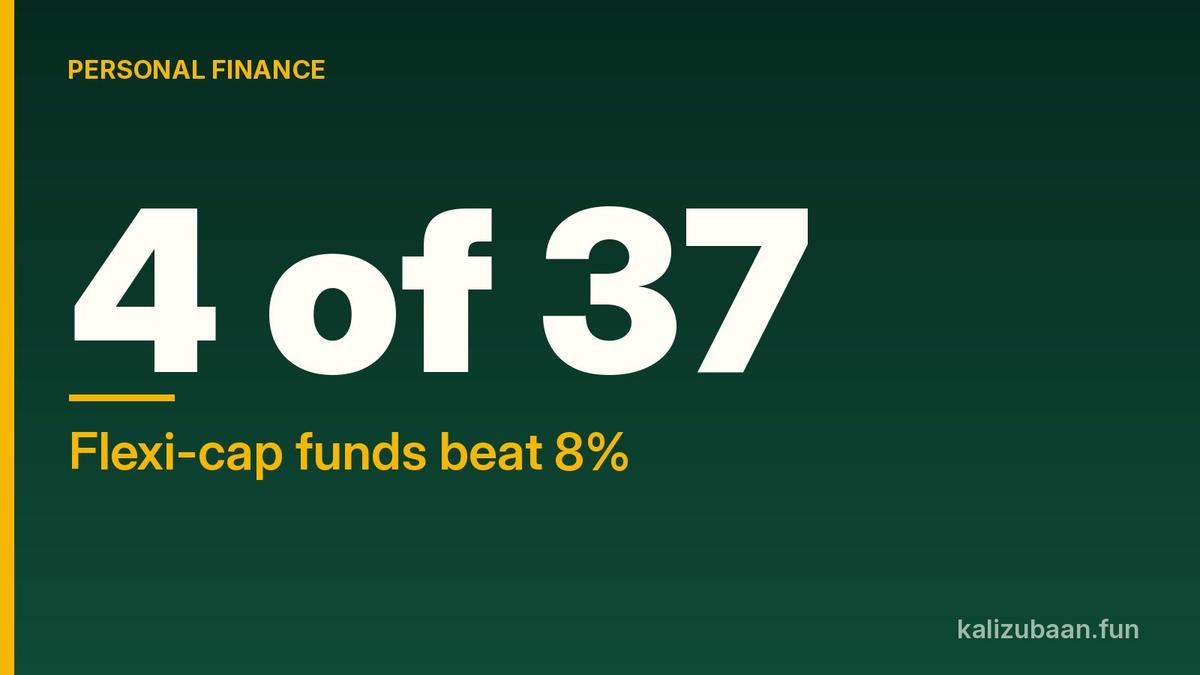
Only 4 of 37 Flexi-Cap Funds Gave 8%+ SIP Returns in 3 Years
Value Research data shows flexi-cap SIP returns ranging from 10.16% to negative 8.42% over three years, and some of the biggest funds trailed small ones. Here is how to check yours.
Two people start a flexi-cap SIP on the same day. Same category, same market, same monthly habit. Three years later, one is sitting on a 10.16% annualised return. The other is looking at a loss of 8.42%.
That is not a made-up extreme. It is the actual range across 37 flexi-cap mutual funds, according to Value Research data reported by Mint. Only four of those funds delivered more than 8% on a three-year SIP.
Quick answer
- Only four of 37 flexi-cap funds gave three-year SIP returns above 8%. Three schemes left investors with losses.
- The top fund, ITI Flexi Cap, returned 10.16%. The bottom one, Samco Flexi Cap, had a negative return of 8.42%.
- Big funds did not win. Parag Parikh Flexi Cap, the largest at ₹1,45,070 crore, returned 4.22%.
- Fund selection matters a lot, even inside one category. Check consistency, portfolio and risk, not just size.
Why this matters now
Mint published this analysis on 22 October, using Value Research returns as of 20 October 2026. Flexi-cap funds are a popular default for SIP investors because they can invest across large-, mid- and small-cap stocks.
That flexibility is the selling point. It is also why two funds in the same category can end up so far apart. Differences in where each fund manager puts the money can lead to very different returns.
The funds that crossed 8%
Only four schemes made it past the 8% mark on a three-year SIP:
- ITI Flexi Cap Fund: 10.16%, with assets under management (AUM) of ₹1,588 crore.
- Bank of India Flexi Cap Fund: 9.09%, with AUM of ₹3,098 crore.
- 360 ONE Flexicap Fund: 8.95%, with AUM of ₹2,246 crore.
- Navi Flexi Cap Fund: 8.12%, managing just ₹286 crore.
Just below the line were Aditya Birla Sun Life Flexi Cap at 7.80%, Bajaj Finserv Flexi Cap at 7.49% and ICICI Prudential Flexi Cap at 7.46%. In total, only eight of the 37 funds gave more than 7%. The other 29 stayed below that.
Bigger fund, smaller return
This is the part that surprises most investors. Several of the category's largest and best-known schemes trailed far behind the small funds at the top.
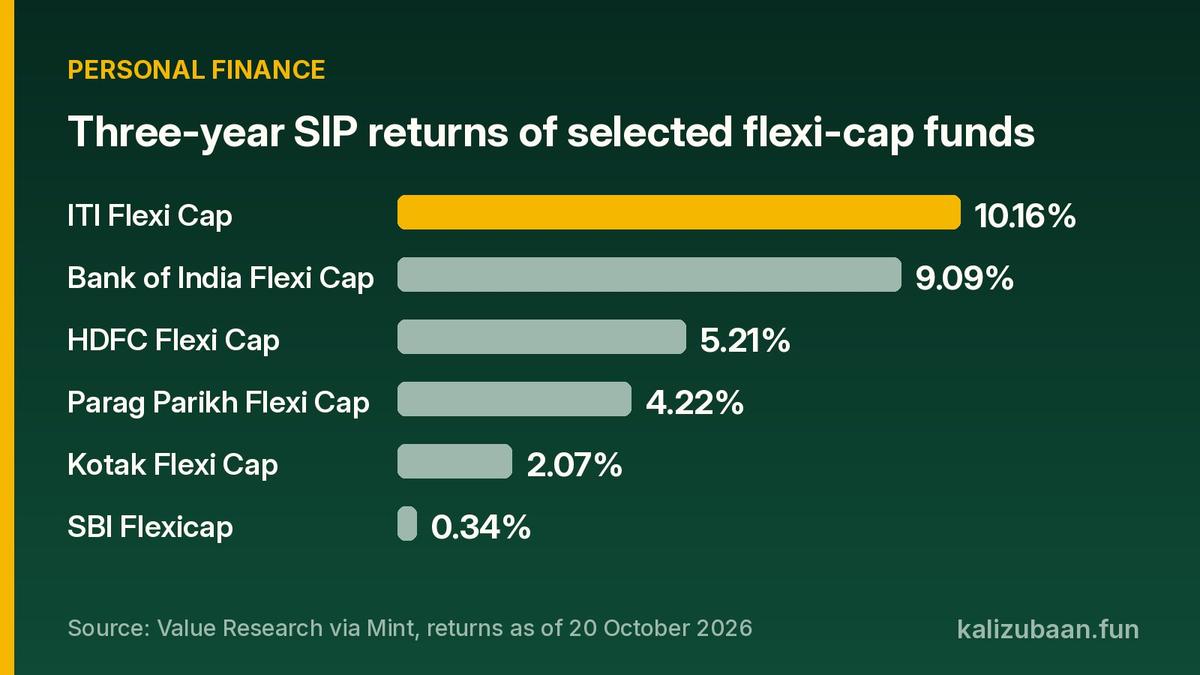
Source: Value Research via Mint, returns as of 20 October 2026
Here is how the big names did:
- Parag Parikh Flexi Cap: 4.22%, with AUM of ₹1,45,070 crore.
- HDFC Flexi Cap: 5.21%, managing ₹1,08,547 crore.
- Kotak Flexi Cap: 2.07%, with AUM of ₹53,087 crore.
- UTI Flexi Cap: 2.36%, managing ₹22,495 crore.
- SBI Flexicap: 0.34%, despite managing ₹22,109 crore.
- Franklin India Flexi Cap: 0.01%, with AUM of ₹18,188 crore.
Put simply, ITI Flexi Cap manages a small fraction of Parag Parikh's money, yet its three-year SIP return was more than double.
The three funds in the red
At the bottom of the table, three schemes gave negative SIP returns over three years:
- Samco Flexi Cap Fund: negative 8.42%, the steepest loss.
- Shriram Flexi Cap Fund: -2.89%.
- NJ Flexi Cap Fund: -1.87%.
If you held one of these, your monthly instalments are currently worth less than what you put in.
What this does and does not tell you
Mint's own conclusion is worth repeating. A larger AUM does not automatically mean better performance, and a smaller fund size does not guarantee higher returns either.
Three years is also a short window for an equity fund. The same Mint team separately reported Edelweiss Mutual Fund data showing that even five-year SIPs in broad market indices sometimes ended negative. For large-caps, the worst five-year rolling SIP return was -3.03%. Short stretches can make good funds look bad, and the other way round.
So a table like this is a starting point for questions, not a buy or sell list.
What to do now
- Find your fund in the list. Check its three-year SIP return against the category range of 10.16% to negative 8.42%.
- Look beyond one period. Compare longer-term consistency, not just one three-year number. Mint advises checking long-term consistency, portfolio composition and risk alongside SIP returns.
- Check what the fund holds. Since flexi-cap funds can move between large-, mid- and small-caps, see how much your fund keeps in each. That mix explains a lot of the gap.
- Don't switch on size alone. Neither a big AUM nor a small one is a reason by itself to pick a fund.
- Think before exiting a loser. Selling after a bad stretch locks in the loss. Decide based on the fund's process and your goal, not just the latest return.
Mistakes to avoid
- Picking the biggest or most famous fund and stopping there. This data shows the largest schemes can trail.
- Chasing the top fund of the last three years. Today's leader may not stay on top.
- Owning three flexi-cap funds that hold similar stocks. That adds paperwork, not diversification.
FAQs
How many flexi-cap funds gave over 8% on a three-year SIP? Only four of 37: ITI, Bank of India, 360 ONE and Navi, according to Value Research data reported by Mint.
Which flexi-cap fund did best and which did worst? ITI Flexi Cap Fund was top at 10.16%. Samco Flexi Cap Fund was at the bottom with a negative 8.42%.
Did Parag Parikh Flexi Cap do badly? It returned 4.22% on a three-year SIP, well below the top four, even though it is the largest fund in the category data.
Should I stop my flexi-cap SIP if my fund is near the bottom? Not automatically. Review its long-term consistency, portfolio and risk first, and speak to a SEBI-registered adviser if you are unsure.
This article is for education only and is not investment, tax or legal advice.
Sources
Tagged Topics
Keep reading

Thanks for reading Kali Zubaan
Explore more articles in Personal Finance or return to the main publication feed.


