₹13,000 Out, ₹3,000 Taxed: SIP vs SWP, Which Is Better?
SIP and SWP are not rivals. A SIP builds your mutual fund corpus; an SWP pays it back out as monthly income, and only the gain in each withdrawal is taxed. Here is how to pick, with sourced examples.

Take ₹13,000 out of a mutual fund through an SWP and you may owe tax on just ₹3,000 of it. That is the worked example Mint uses to show how withdrawals are taxed.
Yet "SIP vs SWP, which is better?" is still one of the most common mutual fund questions in India. The honest answer: you are comparing a deposit slip with an ATM. They do opposite jobs, and most investors end up needing both.
Quick answer
- A SIP puts a fixed amount into a mutual fund at regular intervals to build a corpus. An SWP takes a fixed amount out of a corpus you already have.
- Use a SIP while you are earning and saving. Use an SWP when you need regular income, such as after retirement.
- In an SWP, only the capital gain inside each withdrawal is taxed, not the whole amount, and resident investors face no TDS on it.
- The big SWP risk: withdrawing a fixed amount in a falling market forces you to sell more units, which can drain the corpus faster.
This is general education, not financial advice or a recommendation to buy or sell any fund; check with a SEBI-registered adviser before you invest.
What is the difference between SIP and SWP?
A SIP moves money into a mutual fund on a schedule, while an SWP moves money out of one on a schedule; one builds wealth, the other turns it into cash flow.
Standard Chartered sums it up in one line: a SIP is for "wealth accumulation" and an SWP is for "income generation". Cash flows into the fund with a SIP and out of the fund with an SWP.
Here is how each one works in practice:
- SIP: you might set up a monthly SIP of ₹5,000. On each date, ₹5,000 buys units at that day's NAV, according to Angel One.
- SWP: you might set an SWP of ₹5,000 a month. If the NAV on the withdrawal date is ₹50, the fund redeems 100 units and sends ₹5,000 to your bank.
Neither is a separate product. Both are instructions you attach to a fund you already hold or are buying. Angel One notes that in July 2026 SEBI extended standing instructions for SWPs to mutual fund units held in demat form, so the facility now works for demat holders too.
| Feature | SIP | SWP |
|---|---|---|
| Direction of money | Into the fund | Out of the fund |
| Main purpose | Build a corpus | Regular income |
| Typical user | Salaried, goal-based investor | Retiree or someone living off a corpus |
| When tax applies | Only when you later redeem | On the gain inside every withdrawal |
How does a fixed monthly amount behave when the market falls?
The same market dip that helps a SIP investor hurts an SWP investor, because a fixed rupee amount buys more units in a SIP but sells more units in an SWP.
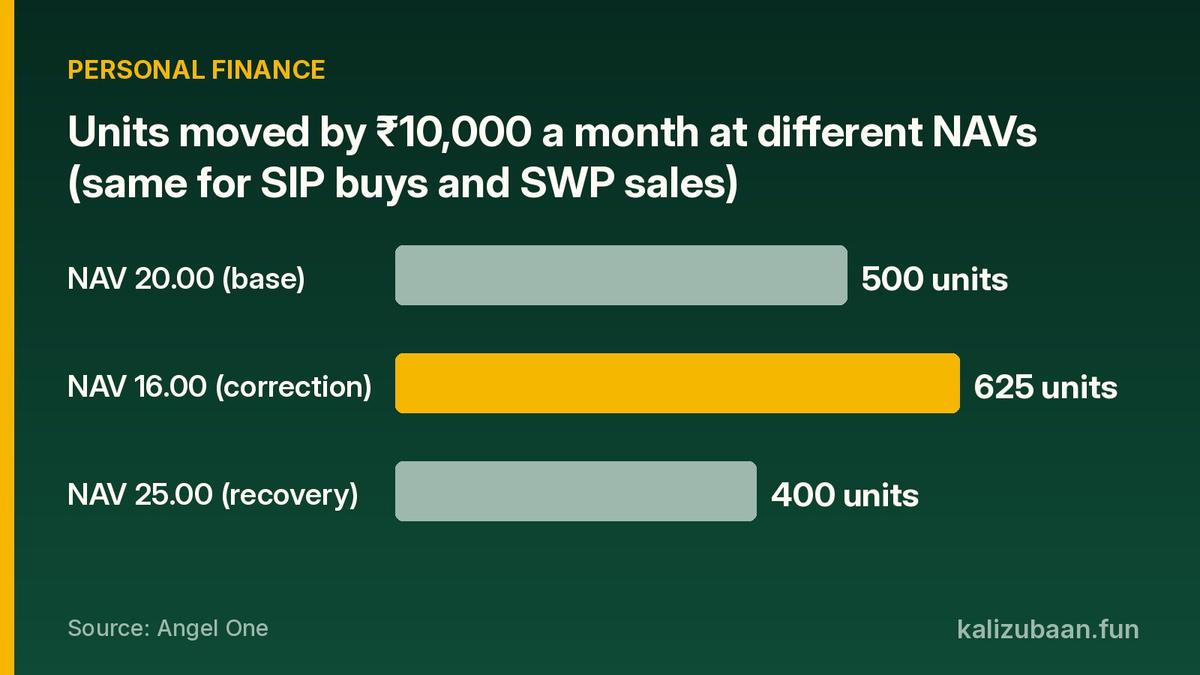
Angel One runs a clean comparison: ₹10,000 a month invested through a SIP versus ₹10,000 a month withdrawn through an SWP, across three NAV levels.
Source: Angel One
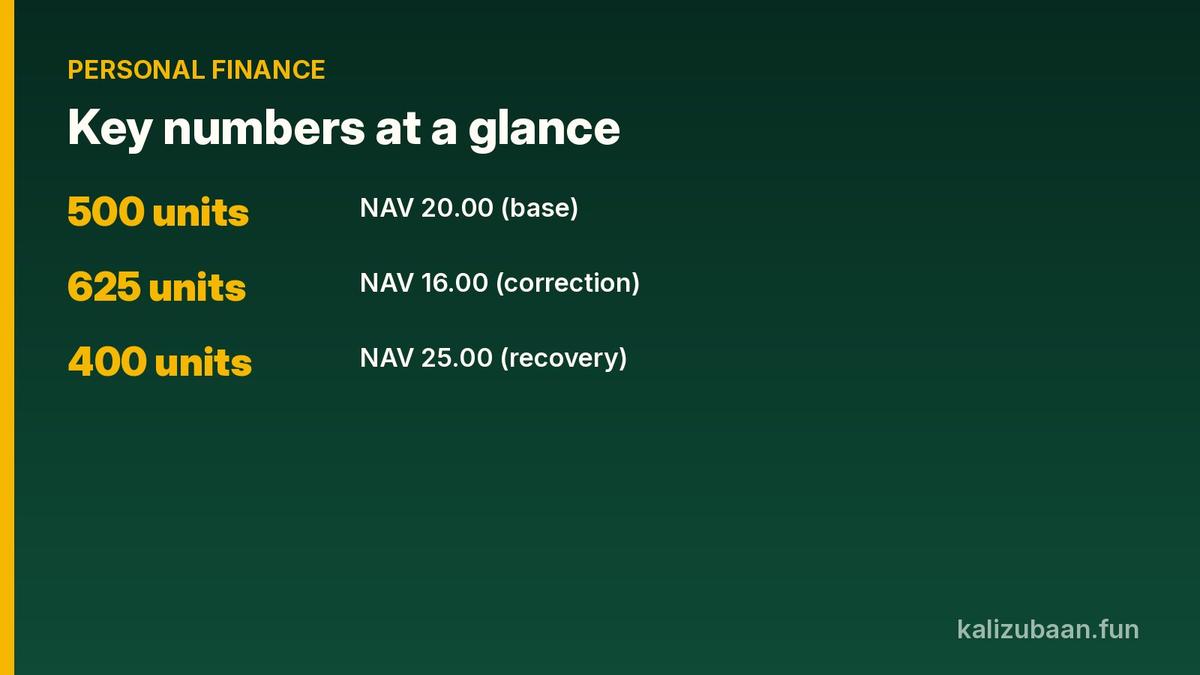
At a NAV of 20.00, ₹10,000 moves 500 units. When the NAV drops to 16.00, the same ₹10,000 moves 625 units. At 25.00, it moves only 400 units.
For the SIP investor, those 625 units in the dip month are a bargain. This is rupee cost averaging. For the SWP investor, those 625 units are gone for good, sold at a low price just to pay the month's bills.
What most guides miss: it is the same 625-unit row in the same table. The averaging that quietly works for you in your SIP years flips against you once you switch to an SWP, so the withdrawal amount you choose matters far more than the fund you choose.
How is an SWP taxed in India?
Each SWP payout is treated as a partial redemption, so only the capital gain in it is taxed; the part that is your own original money comes back tax-free.
Mint explains it with a simple case. An investor puts ₹1,00,000 into a fund at a NAV of ₹100 and gets 1,000 units. Years later the NAV is ₹130, and they start an SWP of ₹13,000.
- First withdrawal: at ₹130, the fund redeems 100 units. They cost ₹10,000, so the gain is ₹3,000. Tax applies only to that ₹3,000.
- Second withdrawal: a month later the NAV is ₹140. To raise the same ₹13,000, the fund redeems only 92.86 units, which cost about ₹9,286. The gain is about ₹3,714.
So the taxable slice changes every month with the NAV. The rate you pay depends on the fund type and how long the redeemed units were held:
- Equity-oriented funds, held 12 months or less: short-term capital gains taxed at 20%.
- Equity-oriented funds, held more than 12 months: long-term capital gains taxed at 12.5% only on gains above ₹1.25 lakh in a financial year.
- Debt funds: gains are taxed at your income tax slab rate, whatever the holding period. Aditya Birla Sun Life Mutual Fund notes this applies to debt funds bought on or after April 2023.
- Hybrid funds: those with more than 65% in equity are taxed like equity funds, per Mint.
Units are sold on a first-in, first-out basis, so the oldest units go first. Over a long SWP, that usually means you start with long-term gains, which carry the lower rate.
Is SWP better than the dividend (IDCW) option for income?
For most investors who want regular income, an SWP is more tax-efficient than the IDCW option, because IDCW payouts are fully taxable at your slab rate while SWP taxes only the gain.
Groww points out that IDCW distributions are taxed at your applicable income tax rate, and a 10% TDS may apply once IDCW receipts from a fund house cross the threshold. SWP withdrawals carry no TDS for resident investors; the full amount lands in your account and you report the gains in your tax return.
There is a control angle too. With IDCW, the fund decides when and how much to pay. With an SWP, you pick the amount and frequency: monthly, quarterly, half-yearly or annually.
Groww also shows how spreading redemptions avoids a single bad exit day. In its example, a ₹50,000 monthly SWP over five months at NAVs between ₹80 and ₹120 withdrew ₹2,50,000 by redeeming 2,553 units. The average redemption price worked out to ₹97.9 per unit.
When should you choose SIP, and when SWP?
Choose a SIP when you have spare income and a goal years away; choose an SWP when you already have a corpus and need it to pay you a steady income.
Standard Chartered says a SIP suits salaried, goal-focused investors with 5+ year horizons. An SWP suits people in the post-retirement phase, or anyone who wants steady income while keeping the rest of the money invested.
A simple way to decide:
- Still earning and saving every month? Start or continue a SIP. Your goal is to build units.
- Have a lump sum but nervous about investing it at once? That is a job for an STP, which moves money gradually from a liquid fund into an equity fund, as Moneycontrol explains.
- Retired or living off savings? Set up an SWP from a corpus you have built, ideally from a lower-volatility fund.
Many families do all three in sequence. Moneycontrol calls them "complementary tools designed for different stages of investing", not competing strategies.
If you are still in the building phase, our look at how a ₹1,000 SIP grows with a 10% step-up shows why starting early matters more than the amount.
How much can you safely withdraw through an SWP?
A safe SWP withdrawal is one that stays at or below the fund's realistic long-term return; withdraw more than that and you start eating into your principal.
Aditya Birla Sun Life Mutual Fund warns plainly that an SWP does not guarantee the corpus will last a lifetime. If withdrawals keep exceeding returns, depletion speeds up, especially when a falling NAV forces more units to be sold.
Standard Chartered suggests using an SWP calculator that weighs four inputs: the withdrawal amount, the expected rate of return, the duration and the starting corpus. It adds that inflation and tax must be factored in for realistic planning.
Three habits help an SWP last:
- Set the withdrawal from the return you can expect, not the income you wish for.
- Review it every year, and trim withdrawals after a bad market year instead of selling extra units at low prices.
- Keep a cushion of a few months' expenses in a liquid fund or savings account, so a market fall does not force a sale.
Groww's step-by-step guide to starting one is short: pick the folio, choose the SWP option, enter amount, frequency and start date, confirm, and review it once a year.

FAQs
Can I run a SIP and an SWP at the same time?
Yes, though usually in different funds. Standard Chartered describes using equity funds for SIPs to build wealth and debt or arbitrage funds for SWPs to draw steady income.
Is the whole SWP withdrawal taxable?
No. Only the capital gain inside each withdrawal is taxed. In Mint's example, a ₹13,000 withdrawal carried a taxable gain of ₹3,000.
Is TDS deducted on SWP withdrawals?
Not for resident individuals. Mint and Groww both note the full amount is credited, and you report the gains in your income tax return.
What happens to an SWP when the market falls?
The fund has to sell more units to pay the same amount. In Angel One's example, ₹10,000 needed 625 units at a NAV of 16.00 versus 500 units at 20.00.
Which is better for a 25-year-old, SIP or SWP?
A SIP, in almost every case, because the goal at that age is to build a corpus. An SWP is meant for drawing income from money you have already built up.
Expert review: pending.
Mutual fund investments are subject to market risks. This article is for education only and is not investment or tax advice; consult a SEBI-registered investment adviser or a qualified tax professional about your own situation.
Related reading
- ₹1,000 SIP for 20 years: how a 10% step-up nearly doubled it
- SIP or mutual fund: which is best in India?
- LTCG on stocks, gold and property explained
Sources
- Mint: SWP taxation explained: why every withdrawal from a mutual fund can have a different tax liability
- Angel One: SIP vs SWP, meaning, differences and how they work
- Standard Chartered India: SIP vs SWP in mutual funds
- Groww: What is SWP in mutual funds
- Aditya Birla Sun Life Mutual Fund: How to generate monthly income from mutual funds
- Moneycontrol: SIP vs STP vs SWP, how these strategies differ
Tagged Topics
Keep reading


Thanks for reading Kali Zubaan
Explore more articles in Personal Finance or return to the main publication feed.


