13.3% vs 13%: SIP or Mutual Fund, Which Is Best in India?
SIP or mutual fund, which is best? A SIP is just a way to buy a mutual fund. DSP's 30-year data shows SIPs earned 13.3% on the Nifty 500 against 13% for a lump sum in India.

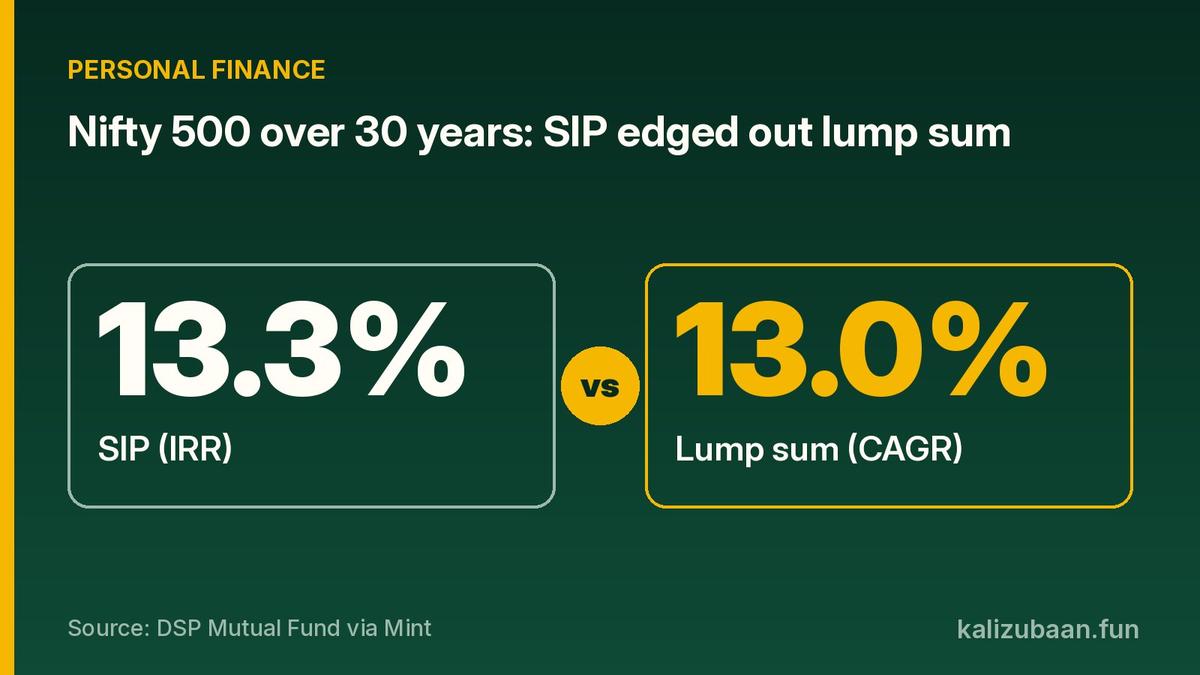
Over 30 years, an Indian investor who drip-fed money into the Nifty 500 through a SIP earned an estimated 13.3% a year. Someone who put the whole amount in at once earned 13%.
That gap is just 0.3 percentage points. In Japan, the same choice was worth 4.4 points. In Brazil, the lump sum won.
So when people search "SIP or mutual fund which is best", the honest answer starts with a correction, then gets to the numbers.
Quick answer
- SIP and mutual fund are not rivals. A mutual fund is the product, and a SIP is one way of paying for it, in fixed instalments.
- The real choice is SIP or lump sum. In India, DSP Mutual Fund's 30-year estimate shows SIPs at 13.3% against 13% for a lump sum on the Nifty 500.
- SIPs did better in six of the 10 markets studied, but lost in Brazil, China, France and Australia.
- If you invest from a monthly salary, a SIP fits. If you already hold a surplus and can stomach swings, a lump sum is a fair option.
This is general education, not a recommendation to buy or sell; check with a SEBI-registered adviser before you invest.
Is a SIP different from a mutual fund?
A SIP is not a separate product; it is a method of investing a fixed amount in a mutual fund scheme at regular intervals, such as once a month.
AMFI, the mutual fund industry body, describes a SIP as an investment methodology in which you invest a fixed amount in a mutual fund scheme periodically instead of making a lump-sum investment, with instalments as small as ₹500 per month (AMFI).
Mirae Asset Mutual Fund puts it even more bluntly. A mutual fund is an investment product, while a SIP is a way of investing in it, so the two cannot be compared (Mirae Asset).
That is why the search query is a little off. You can buy the same equity fund either way. What changes is when your money enters the market.
- Lump sum: you invest the full amount in one go.
- SIP: a fixed amount is debited from your bank account on a set date, every month.
With a SIP, a fixed amount buys more units when the price is low and fewer when it is high. AMFI calls this rupee cost averaging.

SIP or lump sum: which earned more in India?
In India, SIPs earned slightly more than lump sums over 30 years, but the difference was small enough to call it close to a draw.
A 30-year comparison by DSP Mutual Fund found the Nifty 500 delivered an estimated 13.3% a year through SIPs, compared with 13% through lump-sum investing, a difference of 0.3 percentage points (Mint).
Source: DSP Mutual Fund via Mint
The study used total returns in local currencies. It compared the lump-sum CAGR, the yearly compounded growth rate, with the SIP IRR, the yearly return on a series of instalments.
Mint notes the figures are estimates, modelled with a constant long-term dividend yield rather than official total-return histories.
So treat the result as a direction, not a promise. It says both routes built wealth at almost the same pace in India.
Does a SIP always beat a lump sum?
No. SIPs won in six of the 10 markets in the study, and lump sums won in the other four.
Japan showed the widest SIP advantage: the Nikkei 225 returned an estimated 9.9% through SIPs against 5.5% for a lump sum, a 4.4 percentage-point gap (Mint).
South Korea's KOSPI gave 10.8% through SIPs against 8.9% for a lump sum. The US S&P 500 gave 11% through SIPs and 10.2% through a lump sum.
The other side is just as clear. Brazil's Ibovespa returned 16.4% as a lump sum but 14.8% through SIPs, a 1.6-point win for investing at once. China's CSI 300 gave 7.1% as a lump sum and 5.8% through SIPs.
Why the split? A SIP shines when a market falls or goes sideways for long stretches, because each instalment buys cheaper units. A lump sum shines when markets mostly rise, because more money is invested from day one.
What most guides miss: India's 0.3-point SIP edge is tiny next to Japan's 4.4 points, and smaller than the US gap. Over three decades in India, when you invested mattered far less than staying invested, so picking between SIP and lump sum is a smaller decision than picking the right fund and holding it.
Why are Indians still choosing SIPs in record numbers?
Indians are choosing SIPs because most invest from a monthly salary, and SIP money keeps flowing even when markets fall.
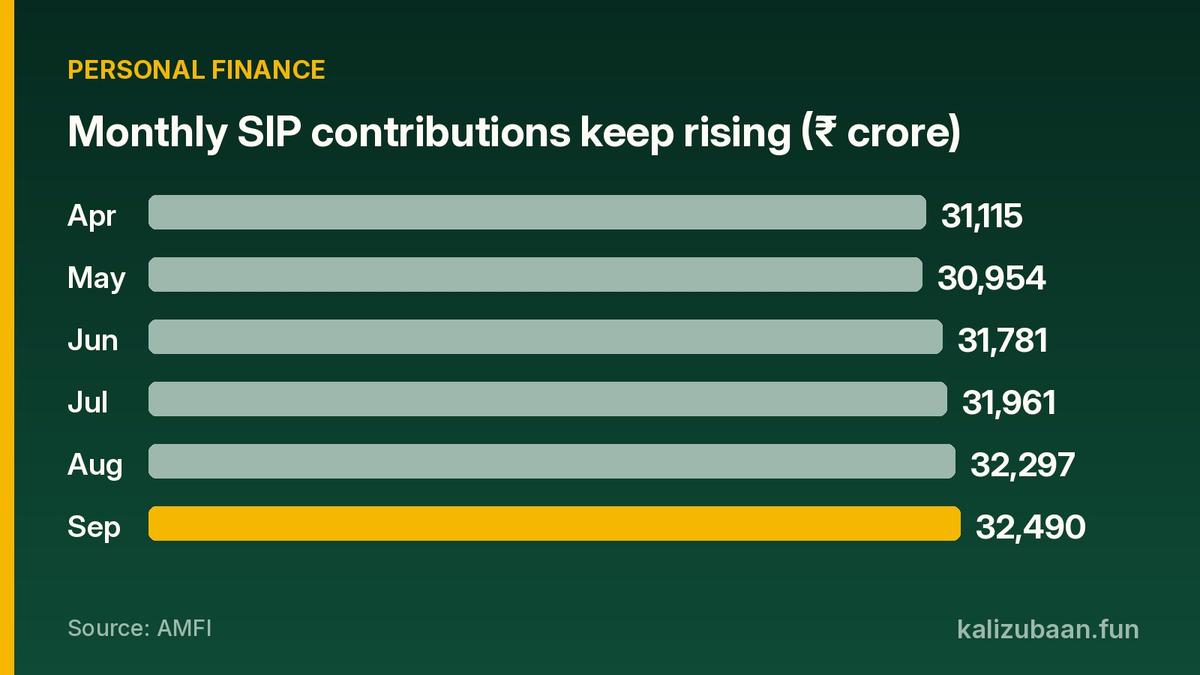
Monthly SIP contributions hit an all-time high of ₹32,490 crore in September, up from ₹32,297 crore in August, even as the overall industry saw net outflows of ₹1.33 lakh crore (Moneycontrol).
Source: AMFI
AMFI's own month-wise table shows contributions rising in every month since May, up to the September record (AMFI).
Moneycontrol adds that about 63 lakh new SIPs were registered in September, and SIP assets stood at ₹17.86 lakh crore.
The record came in a rough month. Equity fund assets fell from ₹39.21 lakh crore in August to ₹37.54 lakh crore in September, Moneycontrol reported, yet SIP money kept coming in.
That is the real strength of a SIP. It takes the timing decision out of your hands.
So which should you choose: SIP or lump sum?
Choose a SIP if you invest from monthly income, and consider a lump sum only if you already have a surplus and can handle a sharp fall soon after investing.
Mint's analysis concludes that neither strategy is universally superior, and that the choice should depend on your cash flows, goals and risk appetite (Mint).
A simple way to decide:
- Salaried, investing every month: a SIP matches your pay cycle and builds the habit.
- Bonus or maturity money in hand: a lump sum puts it all to work at once, if your horizon is long.
- Nervous about a crash right after investing: spread the money out through a SIP instead.
- Short goal, under a few years: equity funds may not suit you either way, whatever the route.
Whichever you pick, the fund matters more than the route. A poor fund through a SIP is still a poor fund.

FAQs
Is SIP better than a mutual fund?
Neither is better, because a SIP is a way of investing in a mutual fund. The fair comparison is SIP versus lump sum, and in India the 30-year gap was only 0.3 percentage points in DSP's estimate.
What is the minimum amount for a SIP?
AMFI says a SIP instalment can be as small as ₹500 per month, and some schemes allow even smaller amounts.
Does a SIP guarantee higher returns than a lump sum?
No. In DSP's study, lump sums beat SIPs in four of the 10 markets, including Brazil and China. Returns are market-linked and not guaranteed.
Can I invest a lump sum and run a SIP in the same fund?
Yes. Most schemes let you make a one-time investment and also register a SIP in the same fund.
Expert review: pending.
This article is for education only and is not investment, tax or legal advice.
Related reading
- ₹32,490 Crore SIP Record as Sensex Falls 16%: Where It Went
- 12–18 Months of Lag: When to Exit an Equity Mutual Fund
- 10-Year SIP Ended at -0.13%: Small-Caps Can Still Lose Money
Sources
Tagged Topics
Keep reading



Thanks for reading Kali Zubaan
Explore more articles in Personal Finance or return to the main publication feed.


