₹2 Lakh Gain, ₹9,375 Tax: LTCG on Stocks, Gold and Property
SBI Research wants LTCG tax on equities scrapped. Until then, here is how long-term gains on shares, mutual funds, gold and property are taxed today, and why the same 12.5% plays out differently.

Say you sold shares this year and booked ₹2 lakh of long-term gains. Your tax bill is not ₹2 lakh times 12.5%. It is ₹9,375, before cess and surcharge.
The reason is a ₹1.25 lakh exemption that only some investments get. Gold doesn't. Property doesn't. Debt funds bought after April 2023 don't even get long-term treatment. With SBI Research now asking the government to scrap LTCG tax on equities altogether, this is a good moment to see exactly where your money stands today.
Quick answer
- Listed shares and equity mutual funds held for more than 12 months pay 12.5% on long-term gains above ₹1.25 lakh a year.
- Physical gold, gold mutual funds and property need more than 24 months to count as long term, then pay 12.5% without indexation and with no ₹1.25 lakh exemption.
- Gold ETFs generally turn long term after 12 months.
- Debt fund units bought on or after 1 April 2023 are taxed at your slab rate however long you hold them.
Why LTCG is in the news
On 12 October, SBI Research said in its Ecowrap report that the government "must seriously look into anchoring hot money flows into equity segment by extending the holding period to say 2-3 years and abolishing the long-term capital gains tax for equity."
The backdrop is heavy foreign selling. BusinessLine reports that foreign portfolio investors pulled ₹44,166 crore out of Indian equities so far in October, taking 2026 withdrawals to ₹3.04 lakh crore. That is far above the ₹1.66 lakh crore recorded in all of 2025.
Keep one thing clear. This is a proposal from a bank's research arm, not a government decision. The Union Budget 2026 kept the 12.5% LTCG rate on listed equities and equity mutual funds unchanged, so today's rules still apply.
Holding periods: when a gain becomes long term
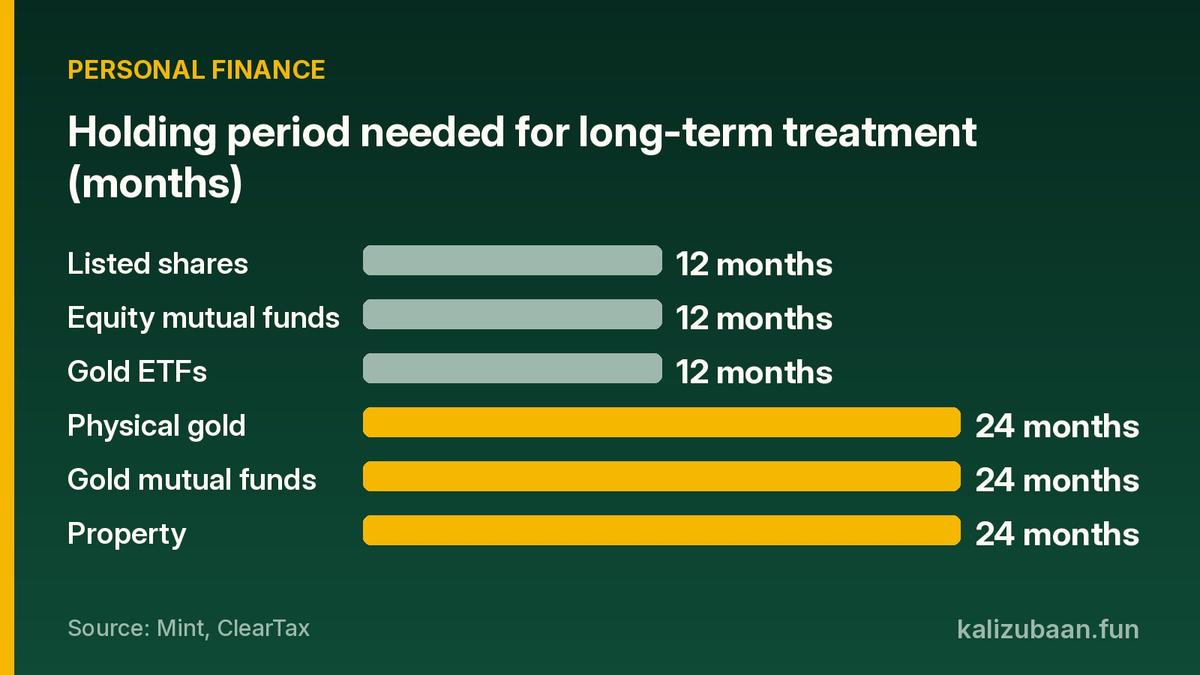
The first question for any sale is how long you held the asset. Cross the line and you move from slab-rate short-term tax to the long-term rules. Here is the minimum holding period for each asset, based on Mint's ClearTax-sourced table.
Source: Mint, ClearTax
Stocks and equity mutual funds
Listed shares qualify as long term when held for more than 12 months. Eligible gains are taxed at 12.5%, and the first ₹1.25 lakh of long-term gains in a tax year is exempt.
Mint's worked example: ₹2 lakh of long-term gains from listed shares means ₹75,000 is taxable at 12.5%. The tax comes to ₹9,375 before cess and surcharge.
Equity-oriented mutual funds follow the same pattern. Units held for more than 12 months generally qualify, and eligible long-term gains above ₹1.25 lakh are taxed at 12.5%.
The catch is that not every fund is equity-oriented. As Mint puts it, investors cannot assume that every mutual fund held for several years gets the same long-term rate.
Debt mutual funds
Debt funds are where many investors get surprised.
- Bought on or after 1 April 2023: gains from specified debt-oriented funds are treated as short-term, irrespective of holding period, and taxed at your slab rate. No indexation is available.
- Bought before 1 April 2023: treatment depends on the holding period and the applicable rules. Eligible long-term gains may be taxed at 12.5% without indexation, subject to transitional provisions.
So a debt fund held for years can still be taxed like salary income, depending on when you bought it.
Gold: physical, ETF or mutual fund
Gold's tax depends on the form you hold it in.
- Physical gold (jewellery, coins, bars) generally becomes long term after more than 24 months. Long-term gains are taxed at 12.5% without indexation under the revised regime.
- Gold ETFs are listed securities and generally qualify as long term after more than 12 months.
- Gold mutual funds generally need a holding period of more than 24 months.
Unlike equity, no form of gold gets the ₹1.25 lakh annual exemption. Short-term gold gains are generally taxed at your slab rate.
Property and the indexation safeguard
Land and buildings generally become long term after more than 24 months. The general LTCG rate is 12.5%, without indexation.
Indexation raises your purchase cost for inflation, which lowers the taxable gain. Losing it can mean a bigger taxable gain on a property that has risen in value over many years.
There is a safeguard. For resident individuals and Hindu undivided families (HUFs) selling land or buildings bought before 23 July 2024, the tax under the new rules cannot exceed what they would have paid under the old 20% rate with indexation. This protection covers only those property sales. It does not bring back indexation for other investments.
Property also gets no ₹1.25 lakh exemption, and properties held for 24 months or less are taxed at your slab rate.
Where this fits in a 10-year plan
Tax is one input, not the whole decision. In a separate Mint piece, Dezerv co-founder Vaibhav Porwal suggests an investor with moderate to high risk appetite might hold about 65% in Indian equities, 5-10% in international equities, 10% in gold and the rest in debt.
He treats gold as a strategic allocation rather than a short-term bet, rebalanced when it drifts from target. Knowing that gold needs more than 24 months for long-term treatment, outside ETFs, helps you time those rebalancing sales.
What to do now
- Check the holding period before you sell. A few extra weeks can move a gain from slab rate to 12.5%.
- Use the ₹1.25 lakh equity exemption each year. It applies to eligible gains on listed shares and equity-oriented funds.
- Check your debt fund purchase dates. Units bought on or after 1 April 2023 are taxed at slab rate regardless of how long you hold them.
- Pick your gold format with tax in mind. ETFs turn long term faster than physical gold or gold mutual funds.
- For older property, compare both calculations. If you bought before 23 July 2024, the safeguard caps your tax at the old indexed amount.
- Don't plan around the SBI proposal yet. It is only a recommendation until the government changes the law.
FAQs
Is LTCG tax on shares being abolished? No. SBI Research has recommended it, but the government has not announced any change. The 12.5% rate continues.
How much LTCG on equity is tax-free? The first ₹1.25 lakh of eligible long-term gains from listed shares and equity-oriented mutual funds in a tax year.
Does gold get the ₹1.25 lakh exemption? No. Gains from gold, in any form, do not get it.
Is indexation still available on property? Not generally. Eligible resident individuals and HUFs selling land or buildings bought before 23 July 2024 can pay the lower of the new tax and the old 20% rate with indexation.
This article is for education only and is not investment, tax or legal advice.
Sources
- Mint: Stocks, mutual funds, gold and property: How LTCG tax differs across asset classes
- BusinessLine: SBI Research calls for scrapping LTCG tax on equities amid record FPI outflows
- Mint: Investing for the next 10 years? Experts explain how much to put in equity mutual funds, gold, debt and global stocks
Tagged Topics
Keep reading

Thanks for reading Kali Zubaan
Explore more articles in Personal Finance or return to the main publication feed.


