80% to 100% Equity: NPS Rules Change From December 1, Explained
The NPS rules change from December 1 drops the A to E code from scheme names and makes apps show every pension fund in your chosen category. Here is what changes and what to check before you pick a scheme.

An NPS scheme in Category A can put 80% to 100% of your money in equity. From December 1, that letter A will no longer appear in the scheme's name.
That is the heart of the NPS rules change from December 1. The risk label moves out of the name and onto the screen, and your app has to show you every pension fund's schemes in the category you pick.
Quick answer
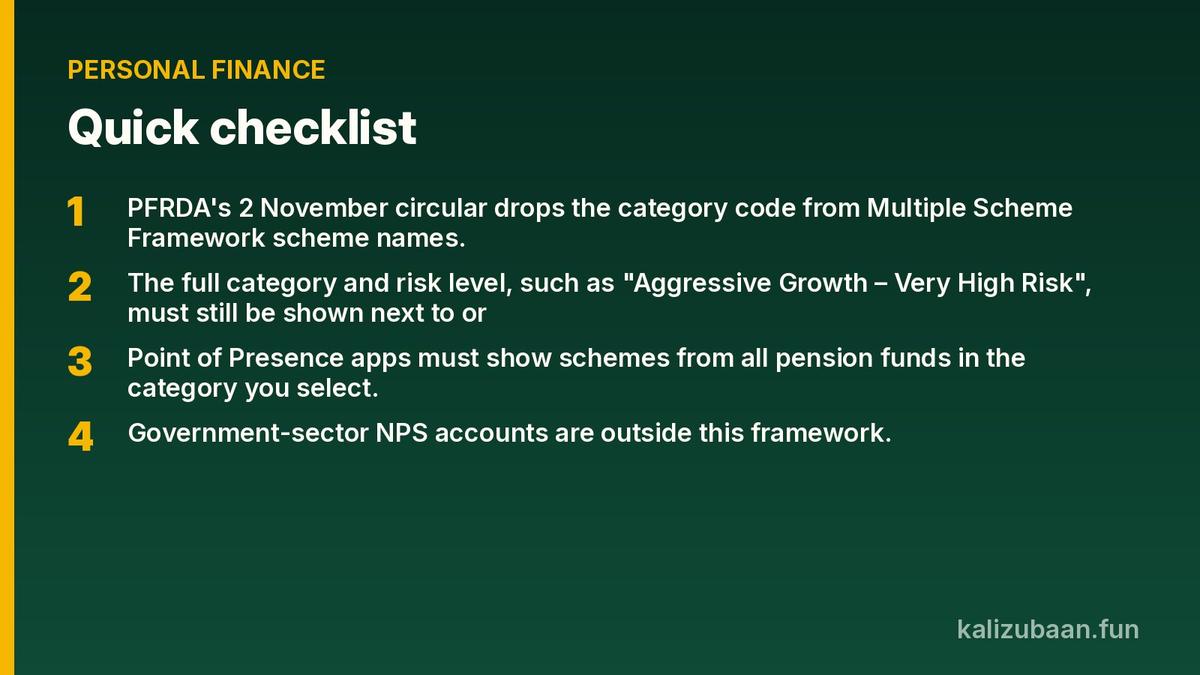
- PFRDA's 2 November circular drops the category code (A to E) from Multiple Scheme Framework (MSF) scheme names. Names become pension fund abbreviation + "NPS" + a unique scheme name.
- The full category and risk level, such as "Aggressive Growth – Very High Risk", must still be shown next to or below the name in ads, brochures and scheme documents.
- Point of Presence (PoP) apps must show schemes from all pension funds in the category you select. Only a pension fund's own app, when you chose it, can show just its own schemes.
- Government-sector NPS accounts are outside this framework.
This is general education, not a recommendation to buy or sell; check with a SEBI-registered or PFRDA-registered adviser before you invest.
What is the NPS rules change from December 1?
It is a set of naming and display rules for NPS schemes that all pension funds, CRAs and PoPs must follow by December 1, 2026.
PFRDA's circular dated November 2 partly modifies its earlier circular of August 28, and the new rules take effect from December 1, 2026 (Economic Times).
The amendment says the 28 August framework must be implemented by all intermediaries by the same date. That covers scheme names, brochures, NPS Scheme Essentials Documents, ads, websites, apps and onboarding journeys (TaxGuru, circular text).
So December 1 is when you should see the new look on every NPS platform at once.
How will NPS scheme names change after December 1?
Scheme names lose the category letter and become pension fund abbreviation + "NPS" + a unique scheme name, with "Tier II" added at the end for Tier II schemes.
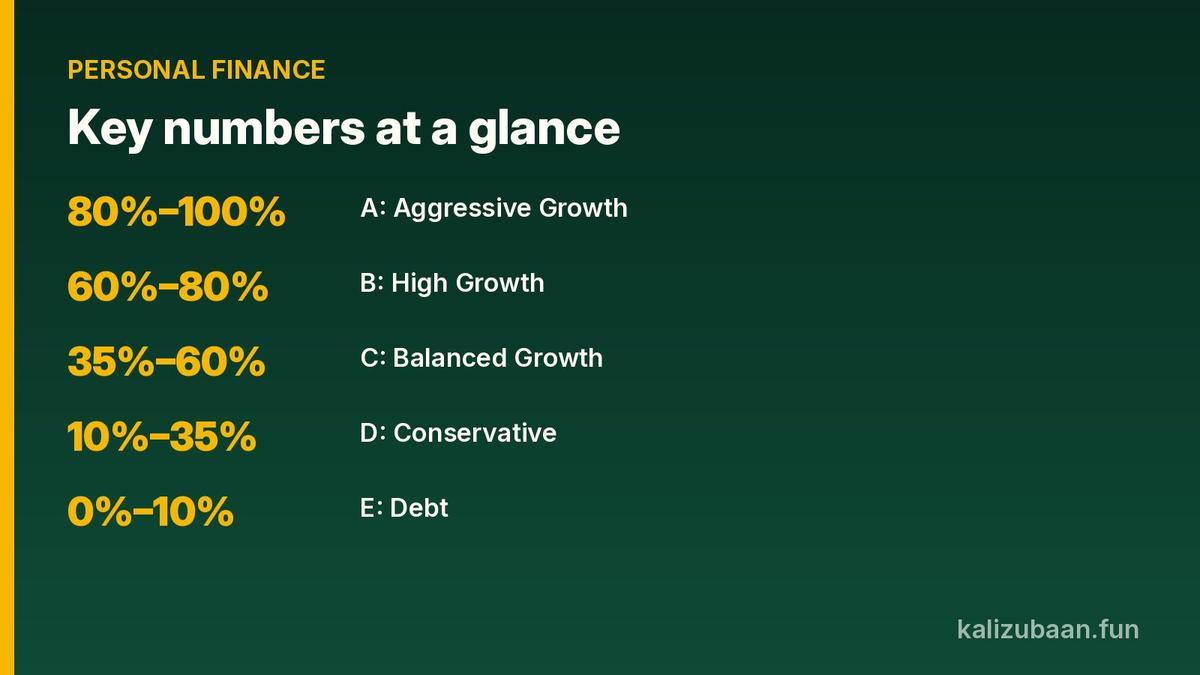
Under the 28 August circular, the format was "Abbreviation of Pension Fund Name + NPS + MSF Category Code + Scheme Name", with Category A for the highest equity exposure and Category E the lowest (Mint). The amendment removes that code.
In practice, a name like "XYZ NPS A Retirement Scheme" becomes "XYZ NPS Retirement Scheme". In ads and literature it must carry the category, for example "Aggressive Growth – Very High Risk", in a smaller font right below or next to the name.
If one pension fund has two schemes in the same category, each must get a distinct name. That matters because a fund can offer up to two schemes per category in each tier.
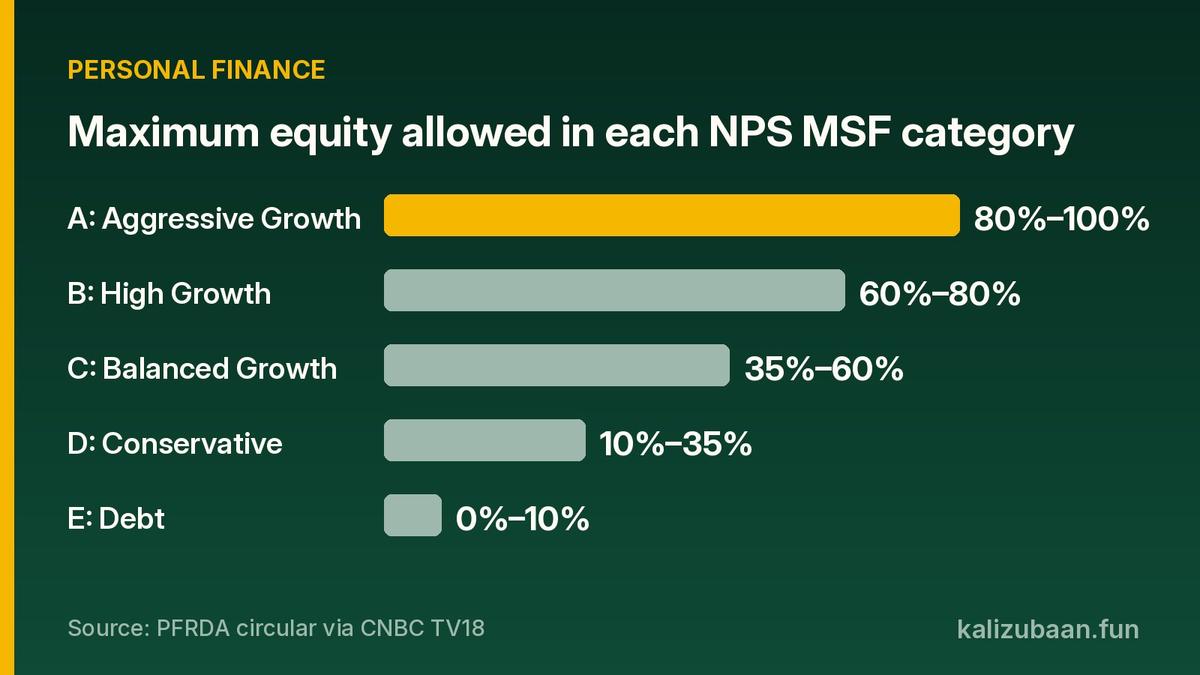
Here is what each category letter stood for, by equity exposure (CNBC TV18):
Source: PFRDA circular via CNBC TV18
What most guides miss: once the letter leaves the name, the category label is your only quick risk signal, and the top label alone hides a 20-point range: an "Aggressive Growth" scheme can hold anywhere from 80% to 100% in equity. With up to two schemes per category across five categories, one pension fund can list up to 10 MSF schemes per tier, so read the label and the asset allocation, not just the name.
What will you see when choosing an NPS scheme on an app?
You will pick a scheme type and category or risk level first, and the app must then show schemes from every pension fund in that category.
PFRDA's own example: if a subscriber selects "Balanced Growth – Medium Risk", the platform should display schemes offered by all pension funds in that category, with the prescribed information to compare and select (Economic Times).
A PoP can still put one pension fund's schemes at the top and even pre-select one. But it cannot hide the rest of the category.
The comparison screen is meant to show the scheme and fund name, launch date, historical returns, benchmark returns, charges, Risk-o-meter and AUM (CNBC TV18).
The same all-funds rule applies on NPS Central and CRA platforms, including interim redirection journeys.
Which platforms can still show only one pension fund?
Only a pension fund that also holds a PoP licence, on its own website or app, when you chose to go there and it runs the onboarding.
The circular calls this an exception to the wider display rule (CNBC TV18). Any other PoP running its own platform must follow the standardised navigation and scheme-selection framework.
The Star NPS platform used by pension funds can also show their schemes to the pension agents they appoint.
The practical point: if you open NPS through a bank or broker app, expect to see more than one fund house. If you see only one, you may be on a fund's own platform.
What should NPS subscribers do before choosing a scheme?
Check your scheme's category and risk label, compare charges and returns across funds in that category, and use your switch requests with care.
- Find your category, not just your name. After December 1, look for the "Growth category" line under the scheme name.
- Compare charges. MSF schemes can charge fund management fees of up to 0.30% of AUM, against around 0.09% for some common schemes (Mint).
- Plan your switches. You can make up to two requests per account in a financial year to change the pension fund, the scheme, or both (Mint).
- Know the lock-in. MSF schemes have a minimum vesting period of 15 years or until the subscriber reaches 60, whichever is earlier.
Switching schemes does not restart your original vesting period. Merging one scheme into another is different: the merged money then follows the target scheme's rules.
What mistakes should you avoid with the new NPS rules?
The biggest mistake is reading the new, simpler names as a sign of lower risk, or picking the top-listed scheme without scrolling.
A PoP is allowed to pre-select a scheme (Mint). The pre-selected one is not necessarily the cheapest or the best fit for you.
Do not chase 100% equity just because it is now easy to find. Active Choice still caps equity at 75%, while MSF high-risk schemes can go up to 100%, and equity markets can be volatile.
If an MSF scheme you hold is wound up and you do not choose a new one, your money moves to the Life Cycle 50 – Moderate (10E/55Y) scheme of the same fund under Tier I. Watch your SMS and email for such notices.
FAQs
Do I need to do anything for the NPS rules change from December 1?
No action is required just because names change. Your money stays in the same scheme; check the new name and category label on your statement or app.
Will my NPS scheme's risk level change after December 1?
The naming rule does not change a scheme's equity mandate. Separately, schemes that spanned more than one category had to be reclassified into a single category under the 28 August circular.
Does this apply to government employees in NPS?
No. The classification framework does not apply to government-sector NPS accounts.
Can my bank's app show only its own pension fund?
Only if it is the pension fund's own platform and you chose it. Other PoP apps must show all pension funds in your selected category.
Expert review: pending.
This article is for education only and is not investment, tax or legal advice.
Related reading
- ₹10 Lakh in NPS at 35? You Can Take Out Only ₹2 Lakh
- ₹99 Is Enough to Start: Gig Workers Are Getting NPS Pensions
- 12–18 Months of Lag: When to Exit an Equity Mutual Fund
Sources
- The Economic Times: NPS rules change from December 1, what subscribers need to know about choosing pension schemes
- The Economic Times: PFRDA clarifies how NPS schemes should be named and displayed on PoP platforms
- TaxGuru: PFRDA amends NPS scheme naming and PoP display rules (circular text)
- Mint: PFRDA revises MSF naming rules, clarifies how PoPs must display pension fund schemes
- CNBC TV18: NPS new rules from Dec 1, PFRDA revises naming and scheme display requirements
- CNBC TV18: NPS schemes get a new classification framework, key changes explained
- Mint: NPS schemes get a new classification, what PFRDA's revised framework means
- Mint: NPS 100% equity option explained
Tagged Topics
Keep reading



Thanks for reading Kali Zubaan
Explore more articles in Personal Finance or return to the main publication feed.