₹10 Lakh in NPS at 35? You Can Take Out Only ₹2 Lakh
Leave NPS early and most of your money goes into an annuity. Here is how NPS exit rules compare with retirement mutual funds, and how to split your savings if you may need cash in your 30s.

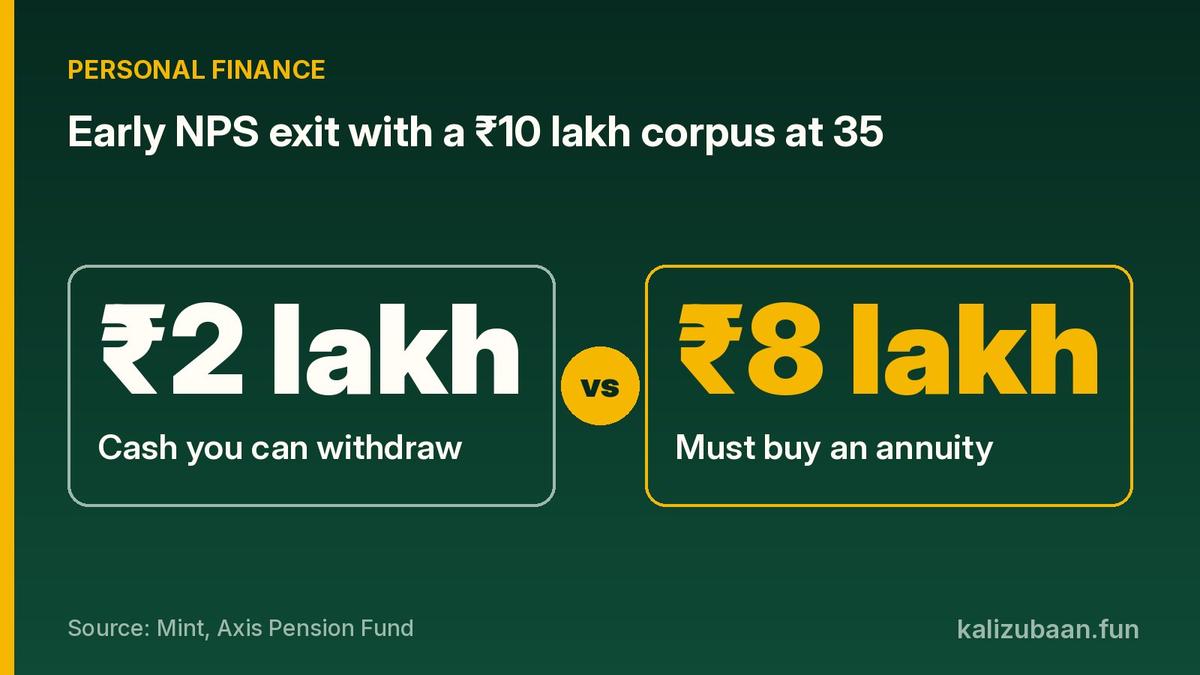
Picture a 35-year-old who has put money into NPS for 10 years and built a ₹10 lakh corpus. Now they need cash for a home down payment.
Under the premature exit rules, they can withdraw only ₹2 lakh. The other ₹8 lakh must buy an annuity.
That one example, shared by Mint, is the whole NPS versus mutual fund debate in a nutshell. It is not only about returns. It is about when you can touch your own money.
Quick answer
- Exit NPS before 15 years and before age 60, and you can usually take out only 20%; at least 80% goes into an annuity (unless the corpus is ₹5 lakh or less).
- After 15 years, a corpus up to ₹8 lakh can be withdrawn fully, and above ₹12 lakh up to 80% can be taken as a lump sum.
- Retirement-focused mutual funds lock you in for five years or until retirement age, whichever is earlier, and then allow full redemption with no annuity.
- Experts suggest using both: NPS for money truly meant for retirement, mutual funds for flexibility.
Why this question matters in your 30s
Your 30s are when big expenses show up. A house, a career break, a child's education, maybe a sabbatical.
Mint's report points out that access to savings can matter as much as returns or tax benefits for young investors. NPS restricts early withdrawals by design. Retirement mutual funds allow full redemption after the lock-in.
If you pick the wrong product for money you may need, you can end up stuck.
What happens if you exit NPS early
Under the NPS All-Citizen Model, leaving before completing 15 years and before age 60 is generally treated as a premature exit.
Sumit Shukla, MD and CEO of Axis Pension Fund, explains the rule. On a premature exit you can withdraw up to 20% of your corpus. At least 80% must go into an annuity.
There is one relief. If your corpus is up to ₹5 lakh, you can withdraw the entire amount.
Source: Mint, Axis Pension Fund
The rules change after 15 years
Things loosen once you complete 15 years. Prithvinath Reddy, CEO and Director of PPFAS Pension, told Mint how it works:
- Corpus up to ₹8 lakh: you can withdraw the entire amount.
- Corpus between ₹8 lakh and ₹12 lakh: up to ₹6 lakh can be withdrawn immediately, and the rest systematically over at least six years.
- Corpus above ₹12 lakh: up to 80% as a lump sum, with at least 20% going to an annuity.
So patience is rewarded. But 15 years is a long time if you started at 25 and need money at 35.
Partial withdrawals: helpful, but limited
NPS does allow some money out before exit, for specific needs.
According to Shukla, after three years you can withdraw up to 25% of your own contributions. Allowed purposes include children's education or marriage, buying a house, medical treatment and certain other needs.
There are limits:
- Up to four partial withdrawals are allowed before age 60.
- There must be a four-year gap between withdrawals.
- The 25% cap applies only to your own contributions, not to the full corpus with returns and employer contributions.
This is the part many people miss. Your NPS statement may show a big number, but the amount you can partially withdraw is calculated on a smaller base.
How retirement mutual funds compare
Retirement-focused mutual funds typically have a lock-in of five years or until the stipulated retirement age, whichever is earlier.
Once the lock-in ends, Shukla says, you can redeem everything. There is no annuity requirement.
One catch: every new investment has its own lock-in. If you invest through a SIP, some units may still be locked even after older ones are free.
Reddy adds a warning. This flexibility puts more responsibility on you to actually keep the money for retirement.
Tax: where NPS pulls ahead, and where it does not
Old tax regime. Eligible personal NPS contributions qualify for deductions under Sections 80CCD(1) and 80CCD(1B).
New tax regime. The main benefit for eligible salaried employees is the employer's contribution under Section 80CCD(2), subject to limits including the 14% salary ceiling.
At exit. The tax exemption currently covers up to 60% of the total corpus. Any extra lump sum is taxable, and annuity income is taxed when you receive it.
Retirement mutual funds do not get these NPS-specific contribution benefits. Gains on redemption are taxed under the capital gains rules for that fund's category.
Shukla's advice is clear. Do not choose NPS only for the tax break, especially if your commitments may change.
How to split your money
Both experts suggest using more than one product instead of betting on one.
- Emergency fund first. Keep it separate from retirement money.
- Separate goal money. Save for a home, higher education or a career break outside NPS.
- NPS as the core. Shukla calls it a good base because of low costs, regulated asset allocation, tax efficiency and long-term discipline.
- Mutual funds for flexibility. A retirement fund can add liquidity after its lock-in.
- Stable base. Reddy suggests EPF and PPF for a steady fixed-income foundation.
If your income is irregular or you have big EMIs, start with a small NPS contribution and raise it later. Reddy's reason is blunt: "Retirement is a financial goal for which no loan will be available when the time comes."
FAQs
Can I withdraw all my NPS money at 35? Usually not. On a premature exit you can take up to 20%, and at least 80% buys an annuity, unless your corpus is ₹5 lakh or less.
How much can I partially withdraw from NPS? Up to 25% of your own contributions after three years, for specified needs, up to four times before age 60 with a four-year gap.
What is the lock-in for retirement mutual funds? Typically five years or until retirement age, whichever is earlier. Each new investment has its own lock-in.
Is NPS tax-free on exit? Up to 60% of the corpus is currently tax-exempt on exit. Extra lump sums and annuity income are taxable.
This article is for education only and is not investment, tax or legal advice.
Sources
Tagged Topics
Keep reading



Thanks for reading Kali Zubaan
Explore more articles in Personal Finance or return to the main publication feed.


