₹9,26,243 vs ₹15,82,800: SIP vs Lumpsum, Which Is Better?
SIP vs lumpsum, which is better? Over 10 years a lump sum in the Sensex beat a ₹5,000 monthly SIP, but rolling Nifty data calls it a coin flip. Here is when each one wins and what to do with a bonus.

Put ₹5,000 a month into the Sensex for 10 years and you invest ₹6,00,000. Business Standard's analysis says that SIP is worth ₹9,26,243 today. The same ₹6,00,000 put in on day one is worth ₹15,82,800.
So the lump sum wins by a mile? Not quite. The same analysis shows the SIP ahead over the last year, and long-run Indian data puts the two almost level. The better choice depends less on the method and more on when your money arrives.
Quick answer
- Neither is better every time. A lump sum tends to win when markets keep rising, because all of the money is invested from the start.
- A SIP tends to win, or lose less, when markets fall or move sideways soon after you start.
- If your money comes from a salary, use a SIP. If you have a large surplus such as a bonus, invest part of it now or spread it over a few months with an STP.
This is general education, not a recommendation to buy or sell any fund; check with a SEBI-registered adviser before you invest.
SIP vs lumpsum: which is better in India?
Over long periods in India, neither SIP nor lumpsum is clearly better; their returns have been close, and the result depends on how the market moved after you invested.
A 30-year study by DSP Mutual Fund found the Nifty 500 returned an estimated 13.3% a year through SIPs against 13% through a lump sum, a gap of just 0.3 percentage points (Mint). Mint's own reading of the data is blunt: investors should not assume a SIP will necessarily earn more than a lump sum.
The global picture is just as mixed. SIPs beat lump sums in six of the 10 major markets in the DSP study. Japan's Nikkei 225 gave 9.9% through SIPs and only 5.5% as a lump sum, while Brazil's Ibovespa went the other way, at 16.4% for a lump sum against 14.8% for SIPs.
A second, India-only test points the same way. BacktestIndia checked 704 rolling windows of Nifty 50 data from March 2002 to December 2025 and called the result a coin flip (BacktestIndia). Over 5-year windows, SIPs won 52.0% of the time and lump sums 46.3%. Over 15-year windows, lump sums edged ahead at 52.3% against 46.7%.
If you want the fund side of this question, our post on whether a SIP or a mutual fund is better explains why a SIP is a way to invest, not a separate product.
When does a lump sum beat a SIP?
A lump sum beats a SIP when the market rises steadily after you invest, because every rupee is working from day one instead of arriving in instalments.
Business Standard ran a ₹5,000 monthly SIP in the Sensex against the same total invested on day one, using closing values to October 21, 2026 (Business Standard). Over 5 years, ₹3,00,000 grew to ₹3,20,892 through the SIP and ₹3,68,642 as a lump sum. Over 20 years, ₹12,00,000 became ₹34,10,833 through the SIP and ₹68,53,098 as a lump sum.
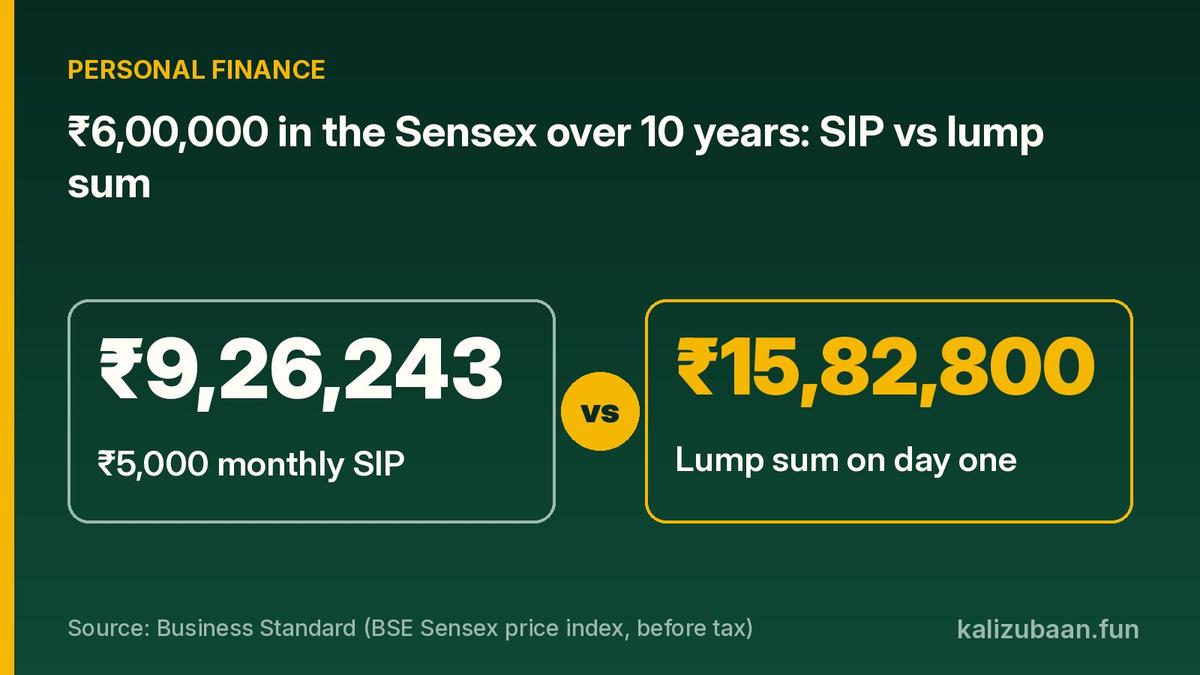
Source: Business Standard (BSE Sensex price index, before tax)
Global research backs this up. A Vanguard study cited by Business Standard found a lump sum beat a three-month staggered plan about 68 per cent of the time, using MSCI World data from 1976 to 2022. Markets tend to rise over time, so cash waiting on the side misses returns.
What most guides miss: the Sensex table and the DSP study are measuring different things. The Sensex table compares final rupee values, and the lump sum's money was invested for the whole period, while the SIP's last instalments had only months to grow. DSP compares annual return rates (IRR against CAGR), which is why its India gap shrinks to 0.3 percentage points. A big rupee gap mostly tells you the lump sum had more time in the market, not that the method was smarter.
That is also why the comparison only matters if you actually have the lump sum. Most salaried people do not have ₹6,00,000 sitting idle on day one.
When does a SIP beat a lump sum?
A SIP beats a lump sum when the market falls or moves sideways soon after you start, because your later instalments buy more units at lower prices.
BacktestIndia's best case for SIPs was the window from December 2007 to November 2012, right through the global financial crisis. A lump sum returned -0.86% a year in that window, while a SIP's XIRR was 9.02% (BacktestIndia). The crash let SIP instalments buy cheap units that recovered later.
Short periods show the same pattern. In the Business Standard Sensex table, ₹60,000 invested over 1 year was worth ₹56,358 through the SIP but only ₹52,259 as a lump sum. Both lost money, but the SIP lost less.
SIPs also protect you from yourself. Moneycontrol notes that most retail investors do not have the stomach for double-digit drawdowns within weeks of investing, and that SIPs remove the urge to time the market (Moneycontrol). FundsIndia charts cited in the same piece show SIP returns becoming reliably positive after the fifth year.
How does rupee cost averaging work in a SIP?
Rupee cost averaging means a fixed SIP amount buys more units when prices are low and fewer when they are high, which can lower your average cost per unit.
ICICI Bank's example uses 600 rupees a month for 6 months while the NAV moves between ₹10 and ₹15 (ICICI Bank). The SIP collects 300 units at an average cost of ₹12 each. The same 3,600 rupees invested at once, at an NAV of ₹15, buys only 240 units.
Note what the example assumes: the price fell after the lump sum went in. If the NAV had kept climbing instead, the lump sum would have bought more units than the SIP. Rupee cost averaging softens bad timing; it does not guarantee a higher return.
ET Money sums up the trade-off well: a SIP needs no market timing and has lower short-term volatility, while a lump sum needs comfort with volatility and matters more on entry timing (ET Money).
What should you do with a bonus or windfall?
With a bonus or windfall, you can invest it all at once if you have a long horizon and can sit through a fall, or spread it over a few months to cut timing risk.
Business Standard describes the middle path, a Systematic Transfer Plan (STP), where the whole amount goes into a liquid or debt fund and fixed instalments move into an equity fund over 3 to 10 months (Business Standard). In its example, ₹12 lakh sits in a liquid fund and ₹2 lakh moves to equity each month for six months. At about 6 per cent, the waiting money earns roughly ₹15,000 before tax.
There is a tax cost to watch. Each STP transfer is a redemption from the debt fund, and gains on debt funds bought on or after April 1, 2023 are taxed at your income slab rate.
The downside of staggering is small but real. In the worst 5 per cent of one-year periods in the Vanguard data, ₹1 lakh invested at once fell to about ₹83,000, while the same money staggered over three months fell to about ₹86,000. Staggering limits the damage in bad years and costs you some return in good ones.
Advisers quoted by Moneycontrol suggest a hybrid: put half the money in upfront and stagger the rest over six months through SIPs (Moneycontrol). If markets rise, the first half benefits at once. If they fall, the later instalments buy cheaper. For how the money comes back out later, see our guide on SIP vs SWP.
How do you choose between SIP and lumpsum?
Choose by where your money comes from, how long you can stay invested and how well you handle a fall, not by which method won in a past table.
- Money from a monthly salary: start a SIP. The method fits the cash flow, and Mint calls SIPs particularly useful for salaried investors (Mint).
- A surplus you will not need for 7 years or more: a lump sum can work. A Wealthy.in co-founder quoted by Moneycontrol says a lump sum can be absolutely fine if you can tolerate short-term volatility and have a real horizon of 7 years and more.
- A surplus but nervous about a fall: use an STP or the half-now, half-later split described above.
- Markets look expensive: Moneycontrol advises checking whether markets trade well above their historical price-to-earnings bands before committing a lump sum.
Small amounts make SIPs easier than ever; some fund houses now accept very small instalments, as covered in our post on Motilal Oswal cutting its minimum SIP. And whichever method you pick, raising the amount each year matters too: see how a step-up changes a SIP's result.

FAQs
Is SIP or lumpsum better for beginners in India?
A SIP usually suits beginners, because it fits a monthly income, needs no market timing and spreads purchases across different market levels. A lump sum suits people who already have a surplus and can handle a fall right after investing.
Does a lump sum always give higher returns than a SIP?
No. A lump sum tends to finish ahead in steadily rising markets, but SIPs have won in falling or sideways markets, and Indian rolling-return data shows the two close to a 50:50 split.
Can I do both SIP and lumpsum in the same mutual fund?
Yes. Many investors run a monthly SIP and add a lump sum when a bonus or windfall arrives, either all at once or through an STP from a liquid fund.
Is an STP better than a lump sum?
Not always. An STP lowers the risk of investing just before a fall, but if the market rises during the transfer period, a lump sum would have done better. Each transfer from a debt fund is also taxable.
Expert review: pending.
This article is for education only and is not investment, tax or legal advice.
Last updated: November 2026. Author: Aditya Sen.
Related reading
- 13.3% vs 13%: SIP or Mutual Fund, Which Is Best in India?
- ₹13,000 Out, ₹3,000 Taxed: SIP vs SWP, Which Is Better?
- ₹500 to ₹100: Motilal Oswal Cuts Minimum SIP and Lumpsum
Sources
- Mint: SIP vs lump sum, global 30-yr data reveals what worked better
- Business Standard: SIP vs Lumpsum, what should investors do in the current sideways market?
- BacktestIndia: SIP vs Lumpsum India, 23-year XIRR rolling returns analysis on Nifty 50
- ICICI Bank: What is SIP investment and how SIP works
- ET Money: SIP vs Lumpsum, key differences
- Moneycontrol: SIP vs lump sum vs STP, what strategy works best
Tagged Topics
Keep reading



Thanks for reading Kali Zubaan
Explore more articles in Personal Finance or return to the main publication feed.