21 Extra Days: ITR Deadline Is November 21 for Audit Cases
CBDT Circular No. 07/2026 moved the AY 2026-27 ITR deadline for audit cases from October 31 to November 21, and the tax audit report to October 21. Here is who must file and what to check.

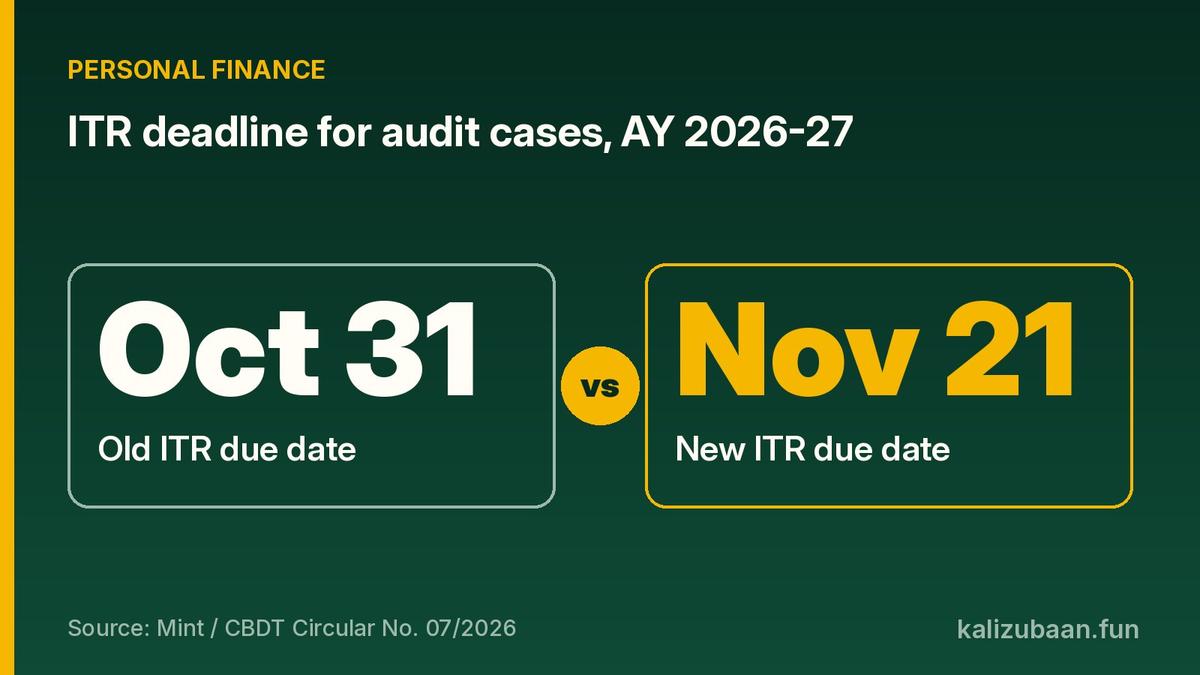
Companies and other audit-covered taxpayers got 21 extra days to file their AY 2026-27 income tax return. The CBDT moved that ITR deadline from October 31 to November 21, 2026.
That is the core of the itr deadline for audit cases november window. The same circular also pushed the tax audit report due date from September 30 to October 21, 2026 (The Economic Times).
Quick answer
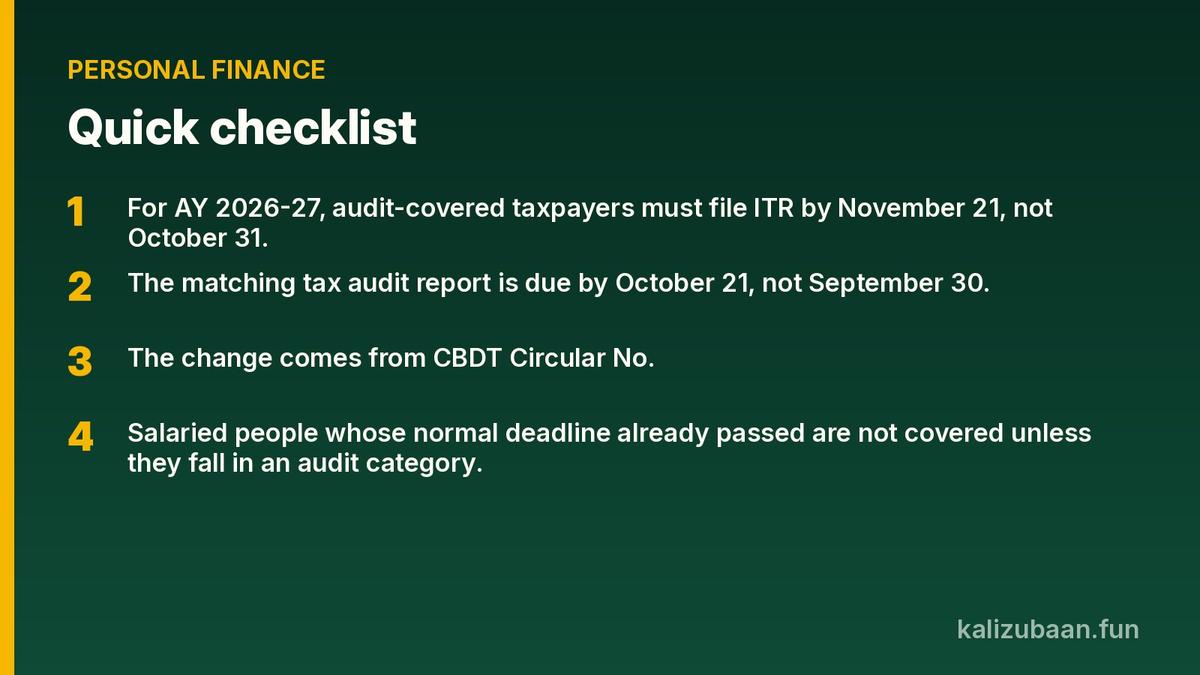
- For AY 2026-27, audit-covered taxpayers must file ITR by November 21, not October 31.
- The matching tax audit report is due by October 21, not September 30.
- The change comes from CBDT Circular No. 07/2026 dated September 28, 2026.
- Salaried people whose normal deadline already passed are not covered unless they fall in an audit category.
This is general education about published tax deadlines, not tax advice; check with a qualified tax professional before you file.
What is the new ITR deadline for audit cases?
Audit-covered taxpayers for AY 2026-27 now have until November 21, 2026 to file their ITR.
Mint reports that the Central Board of Direct Taxes extended the income tax return filing deadline for assessment year 2026-27 from October 31 to November 21, 2026 for companies and other eligible taxpayers whose accounts must be audited under the Income-tax Act (Mint).
The Economic Times pins the legal reference: Circular No. 07/2026 dated September 28, 2026 made that shift, and the tax audit report moved from September 30, 2026 to October 21, 2026 (The Economic Times).
ETGovernment summarises the same 21-day stretch for both the ITR and the audit report for corporates (ETGovernment.com).
Who does the November 21 ITR deadline cover?
The November 21 date covers companies and other taxpayers whose accounts require audit, plus eligible partners of audited firms, not every individual filer.
Mint states the extension also covers partners of firms whose accounts are subject to audit, subject to applicable conditions, and warns that individuals whose regular ITR filing deadline has already expired should not assume they qualify (Mint).
On who needs a tax audit in the first place, The Economic Times says a company carrying on business generally needs one when total sales, turnover or gross receipts exceed Rs 1 crore. That threshold rises to Rs 10 crore when cash receipts and cash payments do not exceed 5% of the respective aggregates (The Economic Times).
For companies under Section 44AB, the audit report is furnished in Form 3CA with the statement of particulars in Form 3CD, because those accounts are already under statutory audit under the Companies Act, 2013 (The Economic Times).
Source: Mint / CBDT Circular No. 07/2026
What most guides miss: the ITR date and the audit-report date moved together. Filing on November 21 only works if the Form 3CA / Form 3CD package was ready by October 21. Treating November 21 as your first hard date skips the earlier report that Circular No. 07/2026 also reset.
What should audit-case filers check before November 21?
Reconcile books, AIS/Form 26AS credits and any special forms before you hit submit, and pay self-assessment tax so Sections 234A and 234B interest do not pile up.
Mint says taxpayers must ensure self-assessment tax liabilities are paid before filing to avoid interest under Sections 234A and 234B, and that businesses should finish pending audits and reconciliations well before November 21 (Mint).
The Economic Times, citing Grant Thornton Bharat's Richa Sawhney, stresses reconciling the return with books, audited financial statements, Form 26AS, the Annual Information Statement and other filings, including TDS/TCS, advance tax and self-assessment tax credits (The Economic Times).
Companies that do not claim exemption under Section 11 generally use Form ITR-6. Those opting for the concessional regime under Section 115BAA need Form 10-IC within the stipulated timeline, and a resident company claiming foreign tax credit needs Form 67 with supporting evidence under Rule 128 (The Economic Times).
Other triggers called out in the same piece include Form 3CEB under Section 92E for international or specified domestic transactions, Form 29B where Minimum Alternate Tax under Section 115JB applies, Form 10DA for a Section 80JJAA claim, and Form 3CEA for a slump sale under Section 50B.
What happens if you are not in an audit category?
If you are not an audit-covered taxpayer or an eligible partner of an audited firm, the November 21 window does not reopen your personal deadline.
Mint is explicit that the extension does not apply to all taxpayers, and that people whose regular deadline has expired should not assume they are covered (Mint).
Use the November 21 date only after you confirm you sit in the audited bucket Circular No. 07/2026 actually moved. For a salary-plus-side-income filing walkthrough from an earlier post, see 47.3% Earn Beyond Salary: Salary and Freelance Income ITR Guide.
FAQs
What is the ITR deadline for audit cases for AY 2026-27?
November 21, 2026, after CBDT Circular No. 07/2026 moved it from October 31, 2026 for companies and other eligible audit-covered taxpayers.
When is the tax audit report due after the extension?
October 21, 2026. The circular moved that date from September 30, 2026, one month before the revised ITR due date.
Does every taxpayer get until November 21?
No. Mint states the extension does not apply to all taxpayers. Individuals outside the audit categories should not treat November 21 as a fresh personal deadline.
What is the turnover level that usually triggers a company tax audit?
The Economic Times cites Rs 1 crore of sales, turnover or gross receipts as the broad trigger, rising to Rs 10 crore when cash receipts and cash payments stay within 5% of the respective aggregates.
Expert review: pending.
This article is for education only and is not tax advice.
Related reading
- ₹1.5 Lakh Penalty Risk: Tax Audit Deadline Has Passed. Now What?
- ₹1,200 Late Fee: Money Rule Changes From 1 November 2026
- Lost a Parent With FDs in Their Name? Who Pays Tax on the Interest, Explained
Sources
Tagged Topics
Keep reading


Thanks for reading Kali Zubaan
Explore more articles in Personal Finance or return to the main publication feed.


