₹3.41 Crore Tax Notice Over Yen: How a Dubai NRI Won at ITAT
A tax officer read Japanese yen as rupees and added ₹3.41 crore to an NRI's income as unexplained money. Here is how bank records won the case, and what every NRI with FCNR or NRE deposits should keep ready.

A woman living in Dubai put money into two fixed deposits in India with her husband. Years later, a tax officer added ₹3.41 crore to her income as "unexplained money". The catch: the deposits were in Japanese yen, and the officer had read the yen figures as rupees.
The Income Tax Appellate Tribunal (ITAT) in Jaipur threw the addition out. The money actually invested was about ₹2 crore, and every rupee of it could be traced through bank records.
Quick answer
- The tax officer treated yen amounts on two FCNR deposits as rupees and added ₹3.41 crore under Section 69A (unexplained money).
- ITAT Jaipur upheld the deletion of the full addition in its order dated 22 September 2026.
- She won because bank statements traced the money to transfers from abroad, and her husband's explanation for the same deposits had already been accepted.
- If you are an NRI, keep your remittance trail, deposit certificates and proof of residence, and never ignore a tax notice.
What happened in this case
The taxpayer, Kavita Khanwani, is originally from Beawar in Rajasthan and now lives in Dubai. She held two Foreign Currency Non-Resident (FCNR) term deposits jointly with her husband, Kishan Chand.
He was the first holder of both deposits, and she was the second holder. The money was wired from Dubai into a joint Non-Resident External (NRE) savings account at IndusInd Bank.
Her husband chose to keep the deposits in Japanese yen. The first, opened on 14 October 2017, had a principal of 1.726 crore yen. The second, opened on 21 February 2018, had a principal of 1.658 crore yen.
Both husband and wife later got separate notices alleging unexplained money under Section 69A. The tribunal order covers only her case, for assessment year 2018-19. His proceedings are separate.
The yen-for-rupees mistake
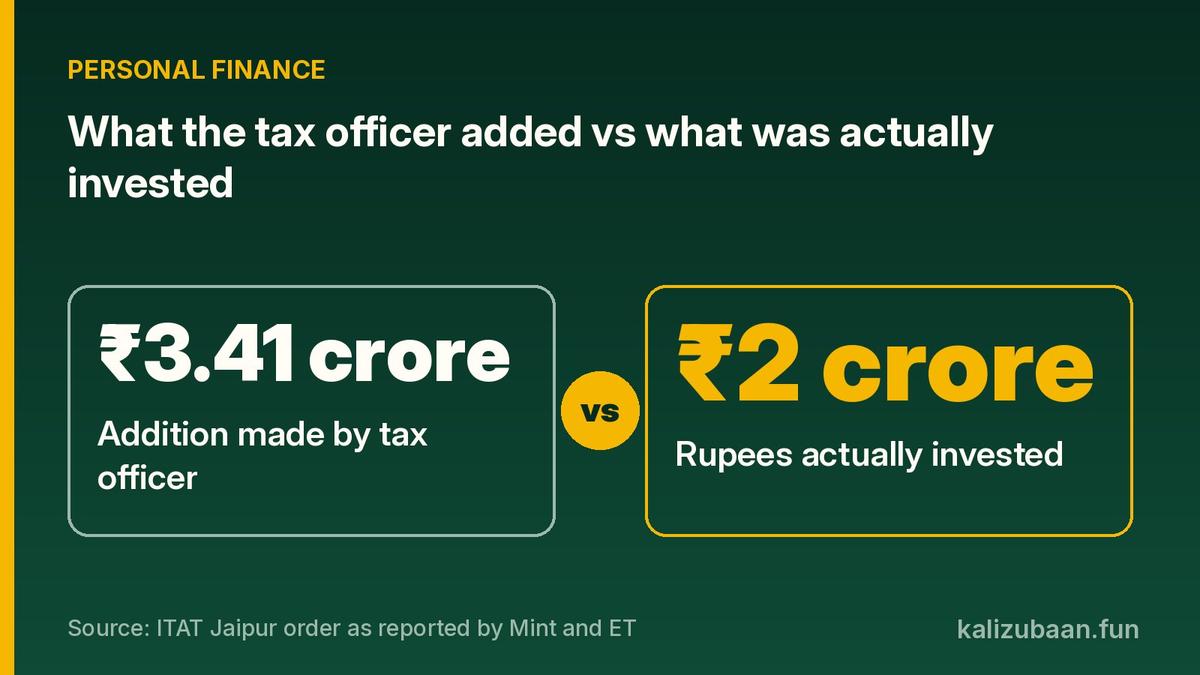
The tribunal found that the two deposits together had a principal of about 3.384 crore yen. The rupee amount actually invested was about ₹2 crore.
The addition of ₹3.41 crore, it said, did not match any sum of money in rupees found with her. The officer had simply read the yen figures as rupees.
Source: ITAT Jaipur order as reported by Mint and ET
This was not a small rounding error. The officer's number was well above the real investment, and it was built on the wrong currency.
Why the bank trail won the case
During the original assessment, she did not reply, because the notices apparently never reached her. That is how the addition was made without her side of the story.
At the first appeal, before the Commissioner of Income Tax (Appeals), she submitted bank statements. They showed that each deposit was funded by a debit of roughly ₹1 crore from the joint NRE savings account.
Each of those debits came right after a ₹1 crore credit received through the banking channel, with her husband's name in the transaction narration.
There was more. The tax department itself had asked IndusInd Bank for details under Section 133(6) on 9 November 2022. The bank confirmed the transactions and the source of the funds.
The tribunal put it plainly: "The immediate source is thus identified from the bank's own record and points to the first holder." The department never alleged that the money came from any source in India.
Joint holder, already-explained money
Section 69A applies when you are found to own money and either give no explanation for where it came from, or the officer is not satisfied with your explanation.
Here, the same jurisdictional officer had questioned her husband about the very same deposits and accepted his explanation. The tribunal held that money already explained by the first holder cannot become unexplained in the hands of the second holder just because she is a joint holder.
Her NRI status mattered too
The officer's assessment order showed her as a resident, without any finding to support it. The appeal authority had recorded her as a non-resident, which matched her Dubai address and the NRE and FCNR accounts.
The tribunal treated her as a non-resident. Under Section 5(2) of the Income-tax Act, a non-resident is taxed in India only on income received or deemed received in India, or income that accrues or arises here. No such income was identified.
Rahul Jain, a partner at Khaitan & Co, told ET that interest a non-resident earns on an NRE account in an Indian bank is specifically exempt from tax in India, and the principal is generally not taxable either.
What NRIs should do now
- Keep a clean remittance trail. Save bank statements, inward remittance records and deposit certificates for every FCNR or NRE deposit. In this case, the bank's own records decided the outcome.
- Check currency on every document. FCNR deposits are held in foreign currency. Make sure any notice, reply or computation clearly separates the foreign amount from its rupee value.
- Keep your Indian contact details current. Update your email and address on the income tax portal, so notices actually reach you.
- Reply to notices on time. Missing the assessment stage meant a long appeal. A timely reply with statements could have avoided it.
- Keep proof of residence. Your visa, overseas address proof and the NRE or FCNR nature of your accounts help establish non-resident status.
- If you hold deposits jointly, coordinate. When one holder's explanation is accepted, share that order with the other holder's case.
Mistakes and red flags
- Assuming that because NRE interest is tax-free, you will never get a notice about the deposit itself.
- Letting notices go unanswered because you live abroad.
- Losing old bank statements. These deposits were opened in 2017 and 2018, and the bank query came in 2022.
- Treating a tribunal win as automatic for everyone. This ruling depends on its own facts.
FAQs
What is an FCNR deposit? It is a term deposit that a non-resident holds in an Indian bank in a foreign currency, such as the Japanese yen in this case, instead of rupees.
What is Section 69A? It lets the tax department tax money, bullion, jewellery or other valuables when the owner gives no explanation of where they came from, or the explanation is not satisfactory.
Is interest on an NRE account taxable in India? According to Rahul Jain of Khaitan & Co, quoted by ET, interest a non-resident earns on an NRE account is specifically exempt from tax in India, and the principal is generally not taxable.
Does this ruling settle the husband's case too? No. The order covers only her case. His separate proceedings are not decided by it.
This article is for education only and is not investment, tax or legal advice.
Sources
- Mint: NRI's ₹3.41 crore FCNR deposits flagged as unexplained money after tax officer mistook yen for rupees, ITAT gives relief
- The Economic Times: Rs 3.41 crore in FCNR deposits tagged as unexplained money despite being held by Dubai-based individual; ITAT Jaipur grants full relief
- The Times of India: Dubai-based woman invests 3.41 crore in FCNR deposits along with husband, gets tax notice for unexplained money
- AnpTaxCorp: ITAT Jaipur grants full relief on ₹3.41 crore FCNR deposits
Tagged Topics
Keep reading



Thanks for reading Kali Zubaan
Explore more articles in Personal Finance or return to the main publication feed.


