₹11.23 Lakh Tax Win: How Much Gold You Can Really Keep at Home
A Navi Mumbai woman got back gold and 11.2 kg of silver after a tax search. What CBDT Instruction 1916 really says about jewellery at home, and the papers that protect your family.

Income Tax officials searched a Navi Mumbai woman's home and two bank lockers. They found gold, diamond jewellery and 11.2 kg of silver, valued at about ₹29.49 lakh, and treated part of it as unexplained income.
She had no old bills for much of it. She still won. In July, the Mumbai tribunal deleted the remaining ₹11.23 lakh tax addition in full. Her case is the best answer yet to a question almost every Indian family asks quietly: how much gold can we keep at home?
Quick answer
- There is no legal ceiling on how much gold or silver you can keep at home or in a bank locker, as long as you got it lawfully and can explain where it came from.
- CBDT Instruction No. 1916 gives search officers a benchmark: 500 grams of gold jewellery for a married woman, 250 grams for an unmarried woman and 100 grams for a male family member.
- Those numbers are not a tax-free allowance. They are a practical guide for when jewellery is usually not seized during a search.
- Silver has no fixed benchmark. The tribunal accepted 11.2 kg here based on the family's history and finances.
What happened in this case
The case is ITA No. 3073/Mum/2026, decided by the Mumbai bench of the Income Tax Appellate Tribunal (ITAT) on 14 July 2026. Mint reports that the taxpayer, Smita Kelkar, lives in Vashi, Navi Mumbai.
At her home, officials found 392.71 grams of gold jewellery, 92 grams of pure gold, diamond jewellery with 161.33 grams of gold and 27.4 carats of diamonds, and 800 grams of silver articles and coins.
Her two lockers held another 35 grams of gold jewellery, 166 grams of pure gold and 10.4 kg of silver-mix articles.
Her explanation was simple and very Indian. She had been married since 1983. Around 250 grams of jewellery came from her mother and relatives at the wedding. More came as inheritance after her mother and mother-in-law died, and the rest was bought on family occasions over the years.
The family's finances backed this up. The ITAT order records that she and her husband reported aggregate gross total income of about ₹4.55 crore over five assessment years.
The 700-gram family benchmark
The Assessing Officer (AO) did not reject everything. He accepted purchase bills for 195.996 grams of gold jewellery. For another 231.714 grams he applied CBDT Instruction No. 1916.
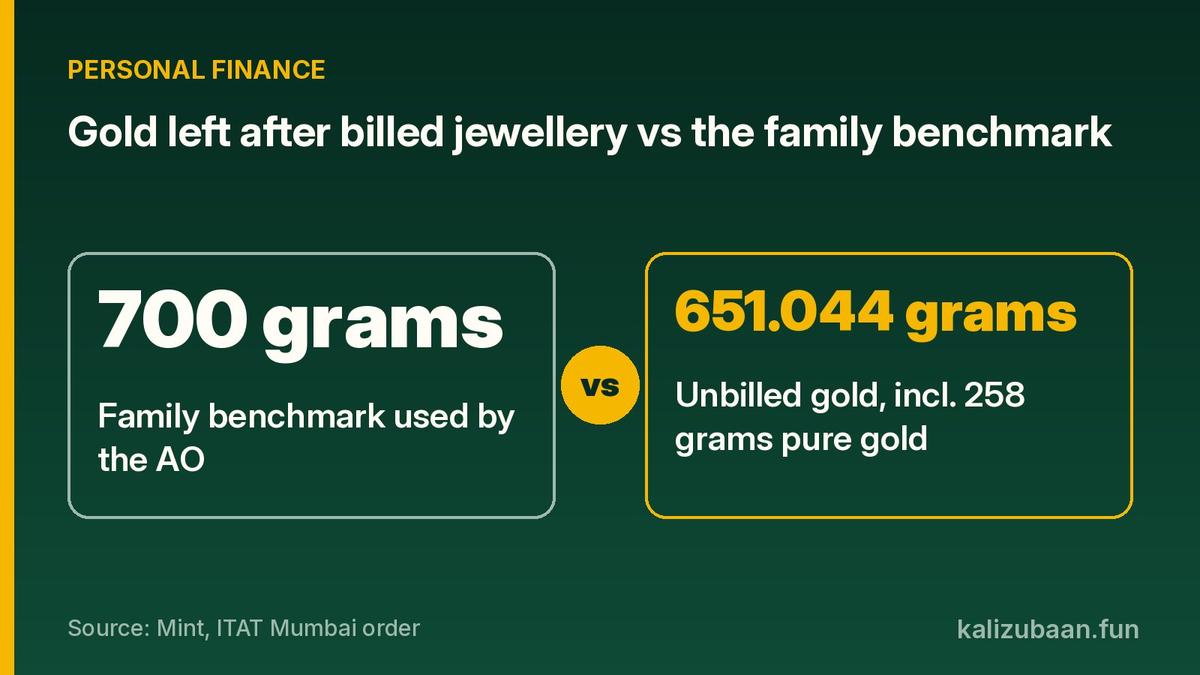
He used a family benchmark of 700 grams: 500 grams for her as a married woman, plus 100 grams each for her husband and son. Anything outside that, and the pure gold and silver, was treated as unexplained under Section 69A. The addition came to ₹18.05 lakh.
The tribunal did the maths differently. After removing the 195.996 grams backed by bills, the remaining jewellery, the gold inside the diamond pieces and the pure gold came to 651.044 grams.
Source: Mint, ITAT Mumbai order
That figure sits below the AO's own 700-gram benchmark. So the tribunal asked an obvious question: how can ordinary jewellery and diamond jewellery from the same family holding be accepted, while the pure gold is rejected only because of its physical form?
Why she won
By the appeal stage, the Commissioner of Income Tax (Appeals) had already deleted the diamond jewellery addition. But it kept ₹8.10 lakh for 258 grams of pure gold and ₹3.12 lakh for the silver.
The ITAT deleted both. Chartered Accountant Suresh Surana, speaking to ET, summed up the key reasons:
- Her story fit the family's circumstances. A marriage of more than 35 years, wedding gifts, streedhan, inheritance and a family income that could support the purchases.
- The department brought no contrary evidence. Neither the AO nor the appeals officer showed that the pure gold was freshly bought from undisclosed income in the year under review.
- Missing old bills were not enough. The tribunal said the absence of decades-old purchase bills does not by itself prove income is unexplained, when the explanation is marriage gifts, inheritance and long accumulation.
On silver, the tribunal relied on an earlier Indore ITAT ruling, Dinkar Laxman Mujumdar v. DCIT, which had extended the benefit of the same instruction to silver articles.
What CBDT Instruction 1916 does and does not do
This is where most WhatsApp forwards get it wrong.
It does not set a legal limit. Surana told ET there is no statutory ceiling on gold or silver at home. "Any quantity may be possessed, provided its acquisition is lawful, and the person can satisfactorily explain its source."
It is not a tax exemption either. Surana warns that the 500, 250 and 100 gram figures "should not be regarded as absolute tax-free ownership thresholds". The tribunal said the quantities are a practical benchmark for judging whether a family's jewellery can reasonably be accepted as explained.
It does not automatically cover pure gold or bullion. The tribunal limited its pure gold finding to the facts of this case. Coins and bars will not always get the same treatment as jewellery.
It does not cover silver with a fixed number. No quantity for silver is written into the instruction. The 11.2 kg accepted here rested on this family's history, not on a general rule.
Who should pay attention
- Married women holding wedding and family jewellery. Your 500-gram benchmark is the largest, but larger holdings can still be explained.
- Families with inherited gold. Inheritance and streedhan were central to this win, so keep whatever shows where the gold came from.
- Anyone buying coins or bars as an investment. Pure gold drew the most scrutiny here, so purchase bills matter even more.
- Households with a lot of silver. With no benchmark for silver, your explanation and family records do the heavy lifting.
What to do now
- Keep every purchase bill you still have. In this case, bills for 195.996 grams were accepted straight away.
- Write down where the rest came from. Note wedding gifts, who gave them, and what came through inheritance. Surana advises keeping documents or other reasonable evidence of purchase, inheritance, gifting or long family ownership.
- Keep wills, inheritance papers and family records together. They support an explanation based on inheritance, as here.
- Make sure your income tells the same story. Her family's ₹4.55 crore of reported income over five years made the holdings believable.
- Treat coins and bars separately. Store their invoices safely, because the tribunal did not set a general rule for pure gold.
FAQs
Is there a legal limit on gold at home in India? No. There is no statutory ceiling, according to Suresh Surana, as long as the gold was acquired lawfully and you can explain its source.
What are the CBDT Instruction 1916 limits? 500 grams of gold jewellery for a married woman, 250 grams for an unmarried woman and 100 grams for a male family member. These guide seizure during a tax search; they are not tax-free limits.
Can the tax department seize gold if I don't have bills? It can question it, as happened here. But the tribunal said missing old bills alone are not enough when gifts, inheritance and decades of accumulation explain the gold, and the department has no contrary evidence.
Is there a limit for silver? No specific quantity is prescribed. The tribunal accepted 11.2 kg of silver-mix articles in this case based on its particular facts.
This article is for education only and is not investment, tax or legal advice.
Sources
- The Economic Times: How much gold and silver jewellery can you have in your home without getting into trouble with the Income Tax authorities?
- Mint: Income Tax Dept seized gold and silver from Mumbai woman; here's why ITAT deleted ₹11.23 lakh tax addition
- The Times of India: Woman had gold, diamond jewellery and silver in her home and locker; ITAT deletes Rs 11.23 lakh additions
Tagged Topics
Keep reading



Thanks for reading Kali Zubaan
Explore more articles in Personal Finance or return to the main publication feed.


