₹1,200 Late Fee: Money Rule Changes From 1 November 2026
Money rule changes from 1 November 2026 hit PNB credit card users, IndusInd savers, pensioners and some taxpayers. Here is what changed, who pays more and the dates to remember this month.

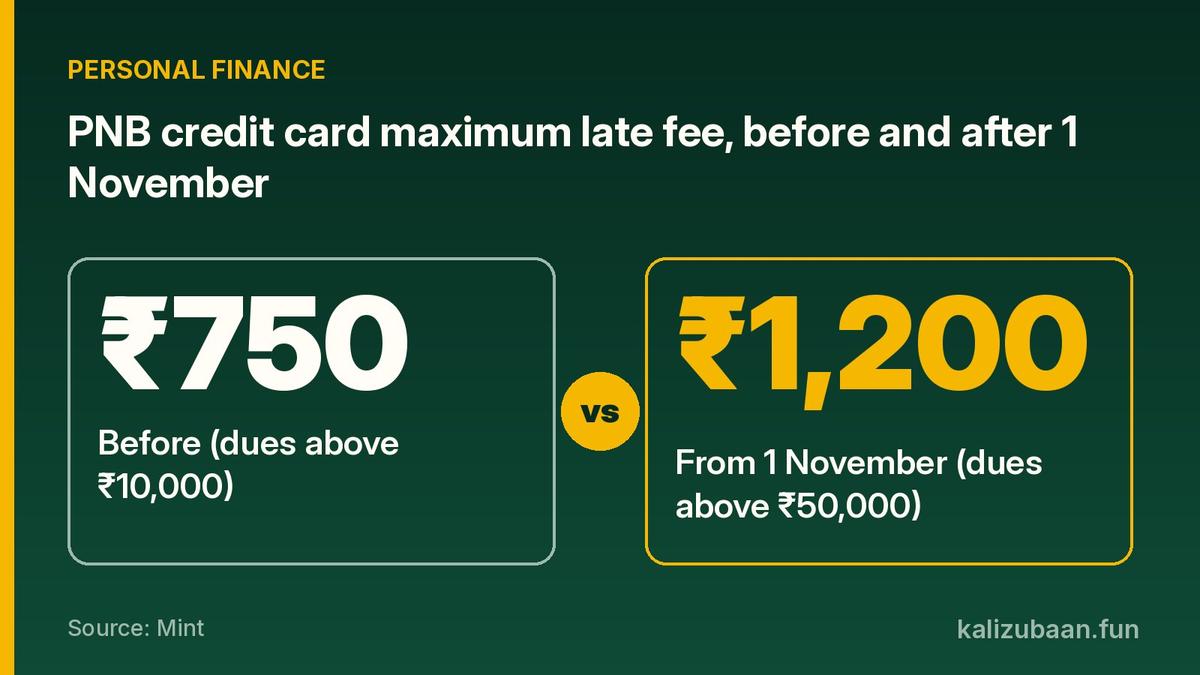
Miss a PNB credit card payment this month and the late fee can now climb to ₹1,200. Until yesterday, the highest it went was ₹750.
That is just one of the money rule changes from 1 November 2026. Pensioners, IndusInd Bank savers and some taxpayers also have new rules or new deadlines starting today, and a few of them cost money if you ignore them.
Quick answer
- PNB has raised its credit card late fee cap to ₹1,200 and added a 1% fee on utility bill payments above ₹50,000 in a billing cycle.
- IndusInd Bank now charges ₹25 for a POS or ATM transaction that fails because of low balance, and ₹50 for a cheque returned for non-financial reasons.
- Pensioners below 80 years must submit their life certificate between 1 November and 30 November.
- Taxpayers covered by audit, who filed their audit report by 21 October, now have until 21 November to file their ITR.
This is general education, not financial advice. Check your own bank's charge schedule, or check with a qualified adviser before you act.
What are the money rule changes from 1 November 2026?
The big money rule changes from 1 November 2026 are new PNB credit card fees, new IndusInd Bank failed-transaction charges, the life certificate window for pensioners, an extended ITR deadline and GST amendments for businesses.
Mint lists these changes as covering GST provisions, revised bank charges and the annual life certificate window for pensioners, along with a revised ITR deadline for eligible taxpayers (Mint).
Most of these do not touch every household. But if you hold a PNB credit card, an IndusInd savings account or draw a government pension, at least one of them applies to you.
How much more will PNB credit card users pay?
PNB credit card users now pay more for cash withdrawals, late payments and large utility bill payments, on both Visa and RuPay cards.
The cash withdrawal fee at a PNB ATM is now 2.5% of the amount or ₹400, whichever is higher. At other domestic ATMs it is 2.5% or ₹500, whichever is higher (Mint).
The late fee slabs have also moved. Earlier, there was no charge for dues of ₹1,000 or less, and the maximum fee was ₹750 for dues above ₹10,000. Now, no fee applies only for dues up to ₹500, and the maximum goes up to ₹1,200 for dues above ₹50,000.
Source: Mint
There is a new fee too. If your utility bill payments on the card cross ₹50,000 in a billing cycle, PNB charges 1% of the total, up to ₹2,000 per transaction. Earlier, no such fee existed.
The Economic Times adds that the revision also covers reward redemption, auto-debit failure and cheque return charges (The Economic Times).
What most guides miss: the ₹400 floor matters more than the 2.5% rate for small withdrawals. Take ₹10,000 in cash on a PNB card at a PNB ATM and 2.5% works out below the floor, so you still pay the full ₹400, plus the interest that cash advances usually start charging from day one.
What are IndusInd Bank's new charges on failed transactions?
IndusInd Bank now charges for three kinds of failed transactions on some savings accounts, all of which were free before today.
A POS payment declined for insufficient funds costs ₹25, a failed IndusInd ATM transaction due to low balance costs ₹25, and a cheque returned for non-financial reasons costs ₹50 per cheque (The Economic Times).
These apply to Indus Delite, Indus Digi-start, Indus Online-Min Bal Required and Indie Star, Superstar and Megastar accounts. Mint notes the charges are exclusive of GST, so the amount debited will be a little higher.
The simplest fix is boring but it works. Check your balance before you tap a card at a shop or try an ATM withdrawal, especially near month-end when salary has not landed yet.
When must pensioners submit their life certificate?
Government pensioners below 80 years must submit their annual life certificate between 1 November and 30 November 2026, or their pension may be held up.
Pensioners aged 80 and above could start from 1 October and can keep submitting until the same 30 November deadline (The Economic Times).
You can submit it in person at the bank branch that pays your pension. Or you can do it digitally through Jeevan Pramaan, using Aadhaar-based and face authentication.
Unified Pension Scheme (UPS) subscribers have a separate route. PFRDA has enabled the UPS Jeewan Setu Digital Life Certificate facility, and eligible pensioners must submit through the Protean eGov App by 30 November (Mint).
If an elderly parent depends on a pension, do this in the first week. Waiting until the last few days of November is how people end up in long branch queues.
Who gets the extended ITR deadline of 21 November?
Only taxpayers covered by tax audit for AY 2026-27, who filed their audit report by 21 October 2026, get the extended ITR deadline of 21 November 2026.
CBDT extended the due date through Circular No. 07/2026 dated September 28, 2026, moving it from October 31 to November 21. The audit report deadline in these cases moved from September 30 to October 21 (The Economic Times).
This mostly covers businesses, professionals and firms. A regular salaried person whose accounts are not audited is not part of this extension, so check the notification before you assume you have extra time.
What changes in GST from 1 November?
GST amendments effective 1 November 2026 change the rules on post-supply discounts, credit notes and refunds, which mainly matter to businesses.
The government notified changes to the Central Goods and Services Tax Act, 2017, including revised conditions for excluding post-sale discounts from taxable value, such as reversing the linked input tax credit (Mint).
The refund changes are also relevant for businesses with an inverted duty structure. If you run a small business, ask your CA whether your discount and credit note process needs a tweak this month.
FAQs
What are the money rule changes from 1 November 2026?
They include new PNB credit card charges, IndusInd Bank fees on failed transactions, the life certificate window for pensioners, an extended ITR deadline for audit cases, and GST amendments on discounts and refunds.
What is the new PNB credit card late fee?
No late fee applies for dues up to ₹500. The maximum late fee is now ₹1,200 for outstanding amounts above ₹50,000, up from ₹750 earlier.
What is the last date to submit a life certificate in 2026?
All eligible government pensioners must submit their life certificate by 30 November 2026. Pensioners below 80 years can start from 1 November.
Is the ITR deadline extended for everyone?
No. The 21 November deadline applies only to certain taxpayers covered by audit for AY 2026-27 who filed their tax audit report by 21 October 2026.
Expert review: pending.
This article is for education only and is not investment, tax or legal advice.
Related reading
- 1% Fee Above ₹50,000: SBI Credit Card Fuel Charges From Dec 1
- 31 October Bank Holiday: Are Banks Open Today, Saturday?
- ₹100 a Day: What Your Bank Owes You When a UPI Payment Fails
Sources
Tagged Topics
Keep reading



Thanks for reading Kali Zubaan
Explore more articles in Personal Finance or return to the main publication feed.