₹100 a Day: What Your Bank Owes You When a UPI Payment Fails
UPI payment failed but money debited? Under RBI rules, banks must reverse it within T+1 or T+5 days, or pay you ₹100 for every day of delay. Here is the exact fix.

You tap send on UPI. The app spins, your bank sends a debit SMS, and the person on the other side says nothing arrived. Your UPI payment failed but money debited from your account, and now you are wondering whether to pay again.
Don't. Under Reserve Bank of India (RBI) rules, your bank has a fixed deadline to put that money back. If it misses the deadline, it owes you ₹100 for every day of delay, credited automatically.
Quick answer
- A failed person-to-person UPI transfer must be reversed within T+1 day, where T is the date of the transaction.
- A failed merchant payment must be reversed within T+5 days.
- If the bank misses the deadline, you get ₹100 per day of delay, with no separate claim needed.
- Never pay twice before checking the status, and never share your UPI PIN or OTP with anyone "helping" you.
Why this matters now
UPI is now the default way most of us pay. NPCI recorded about 24.07 billion UPI transactions in September 2026, according to a fintech CEO quoted by The Economic Times.
At that scale, even a tiny failure rate means a lot of stuck money. A UPI payment passes through your bank, the receiver's bank, NPCI's switching network and the app itself. A glitch anywhere in that chain can leave the payment hanging after your account is debited.
Experts quoted by ET list the usual culprits: network failures, bank server breakdowns, timeouts, a slow response from the receiver's bank, or reconciliation errors. None of these are your fault, and the rules reflect that.
What the RBI rule actually says
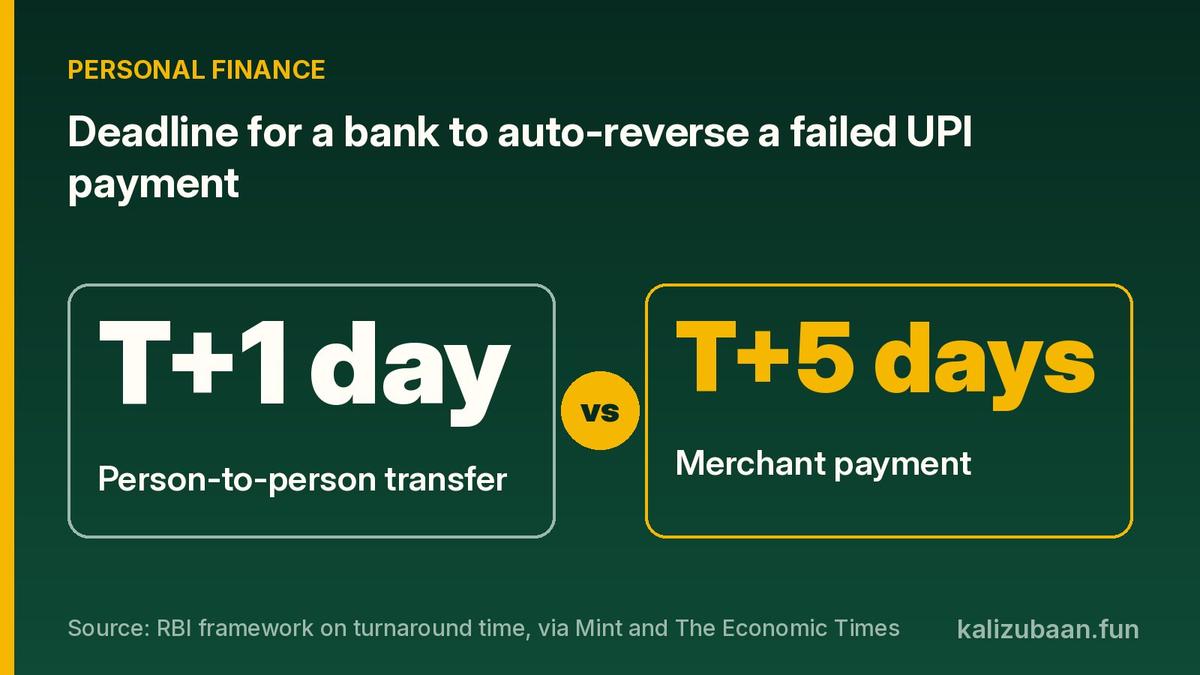
The RBI's framework on turnaround time (TAT) and customer compensation for failed transactions sets two clocks, depending on who you were paying.
Source: RBI framework on turnaround time, via Mint and The Economic Times
Person-to-person transfers. If your account is debited but the receiver's account is not credited, the money must be automatically reversed within T+1 day if the credit cannot be completed.
Merchant payments. If your account is debited but the shop or website never gets confirmation, the auto-reversal deadline is T+5 days.
Compensation. If the bank misses the applicable deadline, compensation of ₹100 per day is prescribed for the delay. Both Mint and ET note that this money is meant to be credited automatically. You do not have to file a separate claim to get it.
That last point is the part most people miss. The penalty is the bank's problem, not a favour you have to chase.
Who this affects
Pretty much everyone with a UPI app. It matters most for:
- Students and young earners who pay rent, fees or splits through UPI and cannot afford money stuck for days.
- Small shop owners who see a customer's payment fail at the counter and need to know whether to accept a second payment.
- Families sending money home, where a stuck transfer can delay groceries or bills.
- Older parents who are most likely to panic and pay again, or to trust a fake "refund agent".
What to do now: the exact fix
Here is the escalation path laid out in the ET and Mint reports. Follow it in order, and keep notes as you go.
- Check the status first. Open the UPI app's transaction history and see whether the payment shows as successful, failed or pending. Save the transaction reference number and ask the receiver whether the money arrived.
- Raise a dispute inside the app. Use the transaction's help or dispute option and pick the issue, such as money debited but receiver not credited. Write down the complaint or ticket number. NPCI's UPI FAQs say users can raise grievances or check status through participating UPI apps.
- Complain to your own bank. If the app does not fix it, lodge a formal complaint with the bank that holds your sending account. Share the transaction details and the app's complaint reference, and ask them to trace the payment. For merchant payments, it can also help to contact the merchant.
- Escalate on NPCI's portal. NPCI runs a Register a Complaint portal that routes your case to the right bank or app. The bank still has to resolve it.
- Go to the RBI Ombudsman if needed. If the bank rejects your complaint, gives a poor answer or does not reply in time, you can escalate through the RBI's Complaint Management System under the Integrated Ombudsman framework. The RBI's 2026 scheme came into effect on 1 July 2026.
What to keep as proof
Bhavin Patel, co-founder and CEO of LenDenClub, told ET that customers should retain:
- the transaction reference number
- the date and amount
- the debit confirmation
- the recipient's details
- every complaint acknowledgement number
These records show exactly when the deadline was crossed. That is what supports your claim to the ₹100-a-day compensation if the bank drags its feet.
Mistakes and red flags
Paying again in a hurry. If the first payment later goes through, you have now paid twice and have to chase a refund from the receiver. Check the status before you resend.
Relying only on chat support. ET's experts advise a documented path, not repeated informal conversations. Ticket numbers matter more than polite promises.
Falling for refund scams. A failed payment makes people anxious, and scammers know it. They pose as bank staff or app support and promise an instant refund. A real complaint never needs your UPI PIN, OTP or passwords. If someone asks, hang up.
Searching for a "customer care number" online. Many fake helplines show up in search results. Raise the dispute from inside your UPI app or your bank's official app instead.
FAQs
My UPI payment failed but money was debited. Will I get it back? Yes, in most cases it is reversed automatically: within T+1 day for a transfer to a person and T+5 days for a merchant payment, under the RBI framework.
Do I need to apply for the ₹100 per day compensation? No. According to Mint and ET, it is meant to be credited automatically when the bank misses the deadline. If it does not show up, mention it in your complaint and keep your proof.
What does T mean in T+1? T is the date of the transaction. So T+1 means the day after you made the payment.
Can I complain directly to the RBI? Only after you have complained to your bank and it has rejected the complaint, replied unsatisfactorily, or not replied within the allowed period. Then use the RBI's Complaint Management System.
This article is for education only and is not investment, tax or legal advice.
Sources
Tagged Topics
Keep reading



Thanks for reading Kali Zubaan
Explore more articles in Personal Finance or return to the main publication feed.


