₹50,000 Cash via NEFT: RBI Domestic Money Transfer Rules 2026
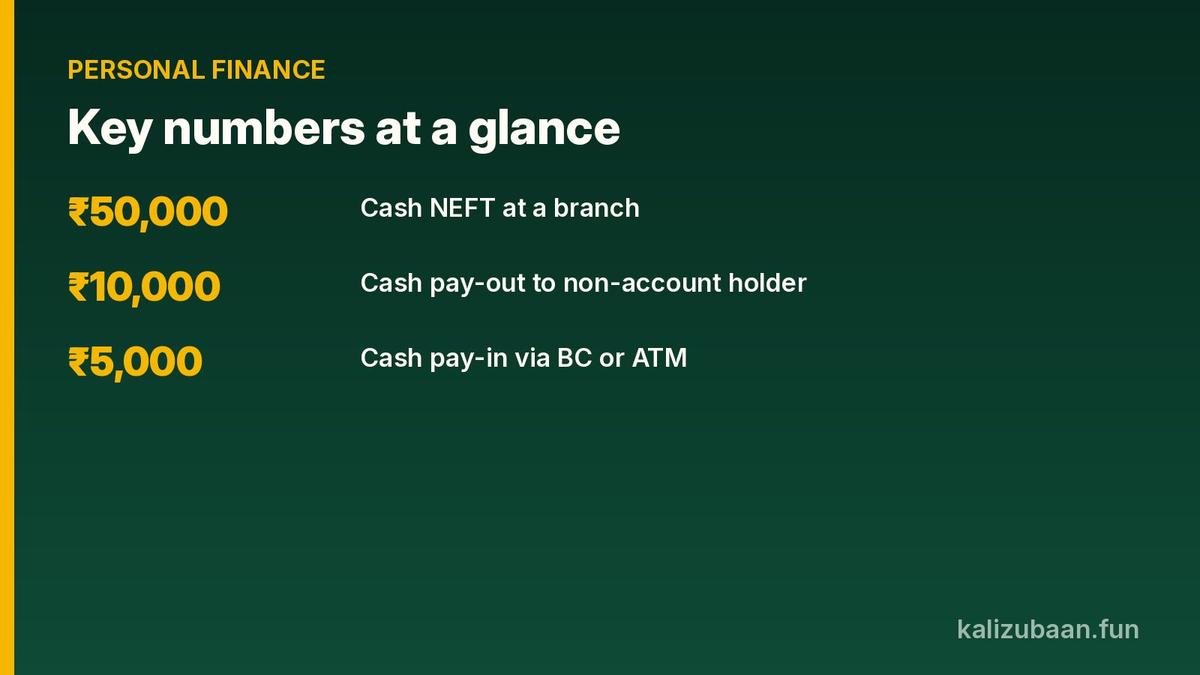
Under the new RBI domestic money transfer rules, a walk-in customer can send up to ₹50,000 in cash via NEFT at a branch, but only ₹5,000 at a time through an ATM or agent. Here are all the limits.

Picture a migrant worker in Indore with cash in hand and no bank account, trying to send money home. Under the RBI domestic money transfer rules issued on November 11, he can walk into a bank branch and send up to ₹50,000 to his family's account through NEFT.
Try the same thing at an ATM or a banking agent, and the ceiling drops to ₹5,000 per transaction.
The RBI did not invent these limits this week. It pulled scattered old circulars into one rulebook, the Domestic Money Transfer Directions, 2026, and kept the numbers. But it also spelled out the KYC, authentication and fraud checks that come with every cash transfer.
Quick answer
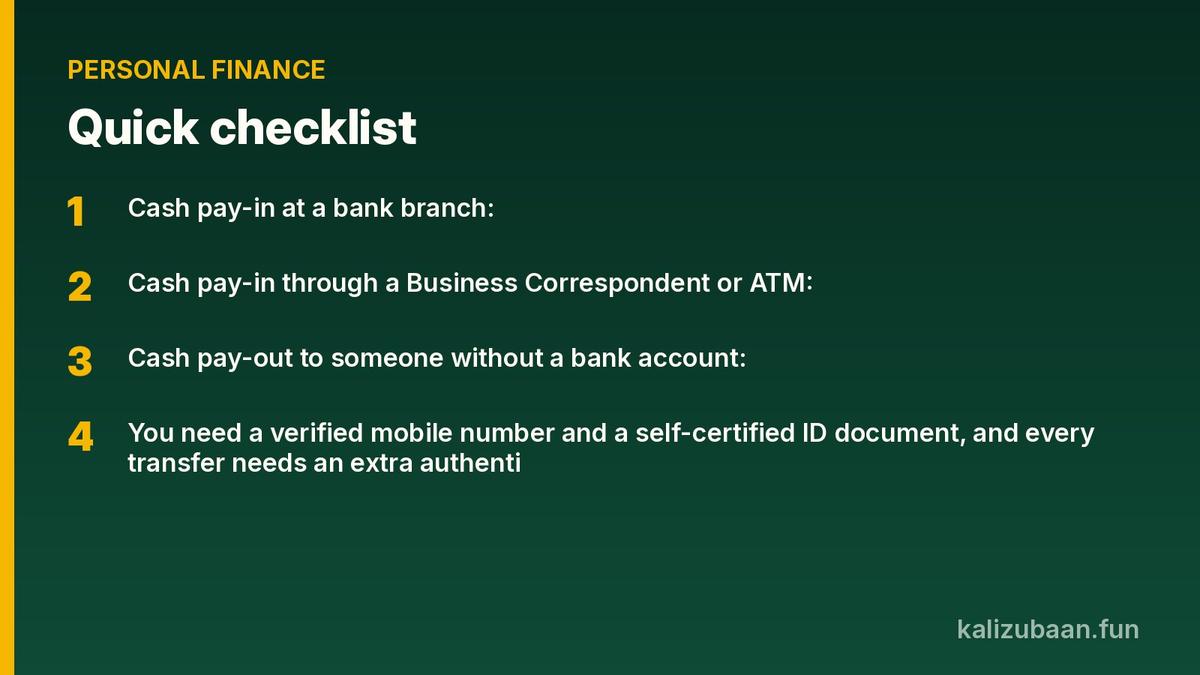
- Cash pay-in at a bank branch: a walk-in customer can send up to ₹50,000 to someone's bank account through NEFT.
- Cash pay-in through a Business Correspondent (BC) or ATM: up to ₹5,000 per transaction, capped at ₹25,000 a month per sender.
- Cash pay-out to someone without a bank account: up to ₹10,000 per transaction, capped at ₹25,000 a month per beneficiary.
- You need a verified mobile number and a self-certified ID document, and every transfer needs an extra authentication step.
This is general education, not financial advice; confirm the current limits and charges with your bank before you send money.
What are the RBI domestic money transfer rules?
The RBI domestic money transfer rules are a single set of directions, effective immediately from November 11, that govern small cash-based transfers through banks, ATMs and banking agents for people who lack regular banking access.
The RBI says the framework exists to help small-value transfers through formal channels, "particularly for persons, including migrant workers, who lack access to such channels for want of proof of identity/address" (RBI).
The new directions replace two older circulars: Domestic Money Transfer – Relaxations from 5 October 2011 and Domestic Money Transfer – Review of Framework from 24 July 2024 (Mint).
They apply to scheduled commercial banks, regional rural banks, urban and state co-operative banks, district central co-operative banks, and authorised payment operators. Card-to-card transfers are left out.
How much cash can you send without a bank account?
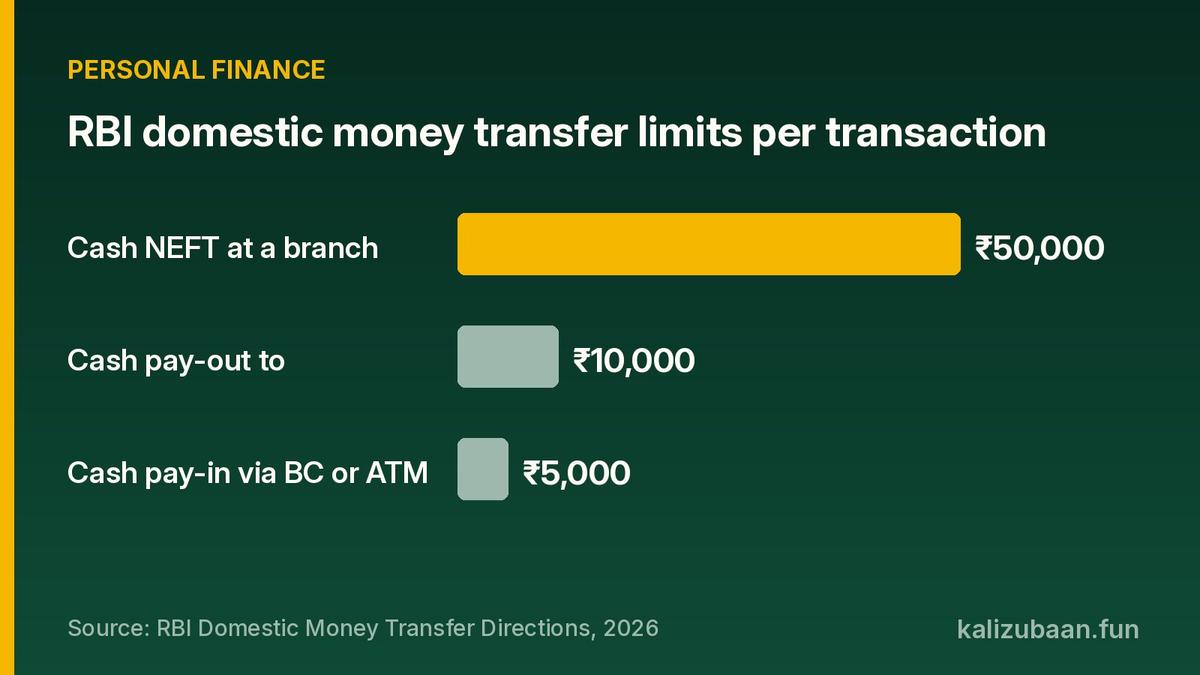
If you do not have a bank account, you can deposit cash to send up to ₹50,000 to someone's account through NEFT at a bank branch, or up to ₹5,000 per transaction through a BC or ATM.
Business Standard notes that a walk-in customer at a branch does not need an account with that same bank to use NEFT for this (Business Standard).
The agent and ATM route is far tighter. Each transfer is capped at ₹5,000, and one sender can move at most ₹25,000 a month this way.
This is called the Cash Pay-in Service. The RBI calls the sender a "remitter", and the monthly cap is per remitter, not per bank.
Source: RBI Domestic Money Transfer Directions, 2026
What most guides miss: the ₹5,000 agent limit and the ₹25,000 monthly cap mean a sender using only BCs or ATMs gets just 5 full-size transfers a month. One branch visit can move twice that monthly total in a single NEFT.
How much can someone without a bank account receive in cash?
Someone without a bank account can receive up to ₹10,000 per transaction in cash, with a ceiling of ₹25,000 a month per beneficiary, collected at an ATM, a BC or another authorised channel.
The RBI text is direct: "The maximum amount that may be transferred under the Cash Pay-out Service shall be ₹10,000 per transaction, subject to an overall monthly ceiling of ₹25,000 per beneficiary" (RBI).
This is the Cash Pay-out Service. The money leaves the sender's bank account, and the person on the other end picks it up as cash.
The sender's bank must record the beneficiary's name and address, according to Hindustan Times.
So if you send money to a parent who has no account, plan around ₹25,000 a month. Two ₹10,000 pay-outs plus one ₹5,000 pay-out hits the ceiling.
What KYC and checks apply to cash transfers?
Every cash pay-in sender must register with a verified mobile number and a self-certified Officially Valid Document under the RBI's KYC Directions, 2025, and every transaction needs an Additional Factor of Authentication.
Banks must also put the sender's details into the IMPS or NEFT message and tag it as a cash-based remittance, says Moneycontrol.
That tag matters. It lets banks and investigators spot cash moving into accounts.
The rules require velocity checks and customer alerts on credits through these services. Any unusual jump in credits to an account, or a group of accounts, must be investigated at once, and suspicious transactions must be reported.
Banks and BCs must also follow income-tax rules on cash deposits under the Income-tax Act, 2025.
If you lend your account details to a stranger to "receive some money", this is the trail that leads back to you.
Are there charges, and where do you complain?
Yes, banks and non-banks may set reasonable charges for these transfers, and complaints fall under the Reserve Bank - Integrated Ombudsman Scheme, 2026.
The RBI has not fixed a single fee, so ask your bank or agent before you pay (Moneycontrol).
Transfers are meant to go through in real time or near real time. Settlement between banks can only run through RBI-approved payment systems.
If an agent overcharges you or a transfer goes missing, complain to the bank first. If it does not resolve the issue, take it to the RBI Ombudsman.
Did the RBI change the old limits?
No, the RBI kept the existing limits; the 2026 directions consolidate the older rules and update references to the new KYC Directions, Income-tax Act and Ombudsman Scheme.
Business Standard reports that the transaction limits "were part of the existing framework and have been retained in the latest directions" (Business Standard).
So if a WhatsApp forward claims the RBI "raised" or "cut" cash limits this week, it is wrong. What changed is that every rule now sits in one document you can check.
FAQs
Can I send money through NEFT without a bank account?
Yes. A walk-in customer at a bank branch can deposit cash and send up to ₹50,000 to a beneficiary's bank account through NEFT, after registering with a verified mobile number and an ID document.
What is the monthly limit for cash transfers through a banking agent?
Through a Business Correspondent or ATM, the cap is ₹5,000 per transaction and ₹25,000 a month per sender.
How much cash can a person without a bank account receive?
Up to ₹10,000 per transaction, with a monthly ceiling of ₹25,000 per beneficiary, collected at an ATM, a BC or another authorised channel.
Do the RBI domestic money transfer rules apply to card-to-card transfers?
No. Card-to-card transfers are excluded and follow the rules for those payment instruments.
Expert review: pending.
This article is for education only and is not financial, tax or legal advice. Limits and charges can change; check with your bank or the RBI before you transfer money.
Related reading
- Jan 1, 2027: New Cheque Book Rules Are Fake, Says RBI
- ₹100 a Day: What Your Bank Owes You When a UPI Payment Fails
- 31 October Bank Holiday: Are Banks Open Today, Saturday?
Sources
- RBI: Reserve Bank of India (Domestic Money Transfer) Directions, 2026
- Mint: No bank account? Check how much cash you can send or receive through ATM, NEFT under RBI domestic money transfer rules
- Business Standard: RBI consolidates money transfer rules, allows ₹50,000 cash NEFT transfers
- Hindustan Times: Customers without bank accounts can send up to ₹50,000 with cash pay-in service
- Moneycontrol: RBI caps cash transfers under domestic money transfer services at Rs 10,000 per transaction
Tagged Topics
Keep reading



Thanks for reading Kali Zubaan
Explore more articles in Personal Finance or return to the main publication feed.


