₹50 Lakh LRS Sub-Limit: What RBI's Proposal Means for You
RBI has reportedly proposed a ₹50 lakh cap on some LRS spending like business travel and pilgrimages, inside the $250,000 yearly limit. Here is who it hits, what stays exempt and what to do now.

You can send up to $250,000 abroad every year under India's Liberalised Remittance Scheme. That is roughly ₹2 crore. Now the RBI LRS sub limit of ₹50 lakh, reported this week, could shrink how much of that room you can use for some trips.
The idea is still a proposal. But if you plan business travel, a pilgrimage abroad or a big overseas investment, it is worth knowing what may change.
Quick answer
- RBI has reportedly proposed a ₹50 lakh yearly sub-limit on certain LRS spending, such as business travel and pilgrimages.
- The overall LRS limit of $250,000 (about ₹2 crore) per financial year would stay the same.
- Education and medical expenses are likely to be kept out of the new cap.
- There is no start date and no formal notification yet, so nothing changes today.
This is general education, not a recommendation to move money or invest; check with a SEBI-registered adviser or your bank before a large remittance.
What is the proposed ₹50 lakh LRS sub-limit?
It is a reported ₹50 lakh yearly cap on specific kinds of overseas remittances, sitting inside the existing $250,000 LRS ceiling.
According to a Zee Business report cited by Mint, the Reserve Bank of India has proposed a ₹50 lakh sub-limit on certain transactions under the LRS (Mint).
The stated aim is to curb dollar outflows and support India's foreign exchange reserves. Business travel and pilgrimages may be brought under the cap.
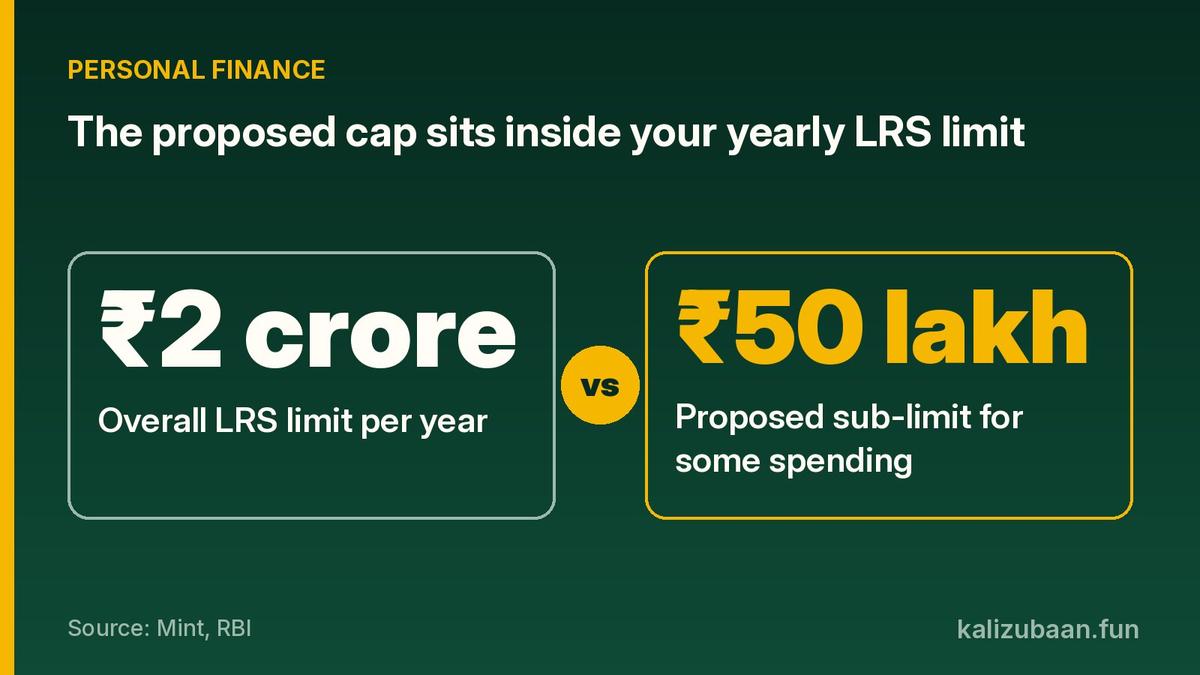
Think of it as a smaller box inside a big box. The big box is your yearly LRS limit. The small box is a separate ceiling for chosen categories of spending.
How does the LRS limit work today?
Today, a resident individual can remit up to USD 2,50,000 per financial year, April to March, for any permitted current or capital account transaction or a mix of both.
That is the wording in the RBI's own master direction on the scheme (RBI). The limit covers private visits, gifts and donations, going abroad for a job, emigration, supporting relatives abroad, business trips, medical treatment and studies.
A few points people often miss:
- The scheme is open to all resident individuals, including minors. For a minor, the Form A2 must be countersigned by a natural guardian.
- You must give your Permanent Account Number (PAN) to make a remittance.
- The scheme is not available to companies, partnership firms, HUFs or trusts.
- Sending more than USD 2,50,000 in a year needs prior permission from the RBI.
Some transfers are banned outright. LRS cannot be used for lottery tickets, margin payments to overseas exchanges or foreign exchange trading abroad (Mint).
How would the sub-limit change your travel budget?
If the cap comes in, you could send only up to ₹50 lakh a year for the covered purposes, even if most of your $250,000 limit is still unused.
Mint gives a simple example. If the ₹50 lakh sub-limit applies to business travel, a person could remit up to ₹50 lakh for that purpose, while all remittances together would still be capped at $250,000 (Mint).
Source: Mint, RBI
So unused room under the main limit would not let you go past ₹50 lakh in a capped category. The two limits work together, not as a choice.
What most guides miss: the proposed cap is about a quarter of the overall limit. ₹50 lakh out of roughly ₹2 crore means a family that books big business trips or pilgrimages every year could hit the sub-limit long before the main LRS ceiling.
Who is affected and what stays exempt?
The people most likely to feel it are those who spend large sums on business travel or overseas pilgrimages through their personal LRS limit.
Education and medical expenses are likely to be excluded from the proposed cap, the report says, citing sources (Mint). That matters for parents paying foreign tuition and for families funding treatment abroad.
There is a detail on business trips. Under current RBI rules, if an employer sends an employee abroad and pays the costs, those expenses are treated as residual current account transactions outside LRS (RBI). If that rule stays, company-paid trips may not eat into your personal cap at all.
Overseas investors should also watch closely. Chartered accountant Manish P. Hingar of Fintoo said some reports suggest overseas investments may need RBI approval (Mint). That part is less clear than the travel cap.
Do international mutual funds count towards LRS?
No. Investments in international mutual funds in India do not count towards your LRS limit, according to Hingar.
He told Mint that NRI account remittances follow separate rules, and that the LRS limit applies when you send money abroad to invest directly in foreign stocks, bonds or other permitted assets (Mint).
So if you hold a US index fund through an Indian fund house, the proposed cap does not touch that route. Direct investing through a foreign broker app is the route that uses your LRS room.
What should you do now?
Do nothing hasty. The proposal has no start date, so there is no reason to rush remittances before the rules are final.
That is Hingar's own advice: "It's only a proposal with no start date, so investors shouldn't rush remittances; review global allocation once rules are final" (Mint).
A simple plan:
- List your overseas spending for this financial year by purpose: travel, study, medical, gifts, investing.
- Check which of those could fall under a business travel or pilgrimage cap.
- Keep receipts and the purpose code your bank uses for each transfer.
- If you invest abroad, compare direct investing with Indian international funds, which sit outside LRS.
- Watch for an RBI notification before changing anything.
Common mistakes to avoid
The biggest mistake is treating news reports as final rules. Until the RBI issues a circular, the current master direction is what your bank follows (RBI).
Other red flags:
- Splitting one person's travel spend across family members to dodge a cap. Clubbing is not allowed for capital account transactions unless family members co-own the account or investment.
- Using LRS for banned purposes like forex trading abroad or margin calls.
- Forgetting that unspent foreign exchange, unless reinvested, has to be brought back and surrendered within the set period.
FAQs
Is the ₹50 lakh LRS sub-limit already in force?
No. It is a reported proposal. There is no start date and no formal RBI notification yet.
Will the overall LRS limit of $250,000 change?
Not under this proposal. The $250,000 yearly limit, about ₹2 crore, would stay. The ₹50 lakh cap would apply only to some categories inside it.
Are education and medical payments covered by the new cap?
They are likely to be excluded, according to the report cited by Mint. Wait for the final rules to be sure.
Do Indian international mutual funds use my LRS limit?
No. Investing in international mutual funds in India does not count towards an individual's LRS limit.
Expert review: pending.
This article is for education only and is not investment, tax or legal advice.
Related reading
- Rupee Up 93 Paise on RBI's 20% Rule: What It Means for US Stocks
- ₹10 Lakh per Bill: RBI's New Rule for Freelancers Paid Abroad
- ₹50 Lakh First, Then SIP: How PMS SIP and STP Really Work
Sources
Tagged Topics
Keep reading



Thanks for reading Kali Zubaan
Explore more articles in Personal Finance or return to the main publication feed.


