₹50 Lakh First, Then SIP: How PMS SIP and STP Really Work
Some PMS investors now add money monthly instead of one big cheque. Here is how a PMS SIP differs from an STP, what it costs, how it is taxed, and why the ₹50 lakh minimum still applies first.

More than 15% of Dezerv's PMS clients now also invest through SIPs, and their average monthly SIP ticket is ₹85,000. Individual SIPs there range from ₹50,000 to ₹1 crore a month.
That sounds like the mutual fund SIP habit moving up the wealth ladder. But a PMS SIP works very differently, and it does not get you in the door for less.
Quick answer
- A PMS SIP lets you add money every month, but only after you have already committed the ₹50 lakh minimum.
- A PMS STP means you commit the full amount upfront, park it in a liquid holding inside the PMS, and move it into equity every month.
- Both spread out your entry points. Neither reduces the portfolio's risk or guarantees better returns.
- Taxes and fees work differently from a mutual fund, so check them before you start.
How common are PMS SIPs?
Mutual fund SIP inflows in India run at over ₹32,000 crore a month. In the PMS world, systematic investing is still a small trend.
PMS Bazaar, a large PMS research and distribution platform, surveyed 576 PMS strategies. Of these, 220 strategies run by 86 portfolio managers accept SIPs, while 261 strategies of 102 PMSes do not. Another 33 portfolio managers running 95 strategies did not respond.
Adoption depends on the provider
At Dezerv, more than 15% of PMS clients use SIPs. At Aditya Birla Sun Life AMC, less than 5% of PMS investors opt for the SIP route, says Sameer Narayan, its head of alternates and offshore.
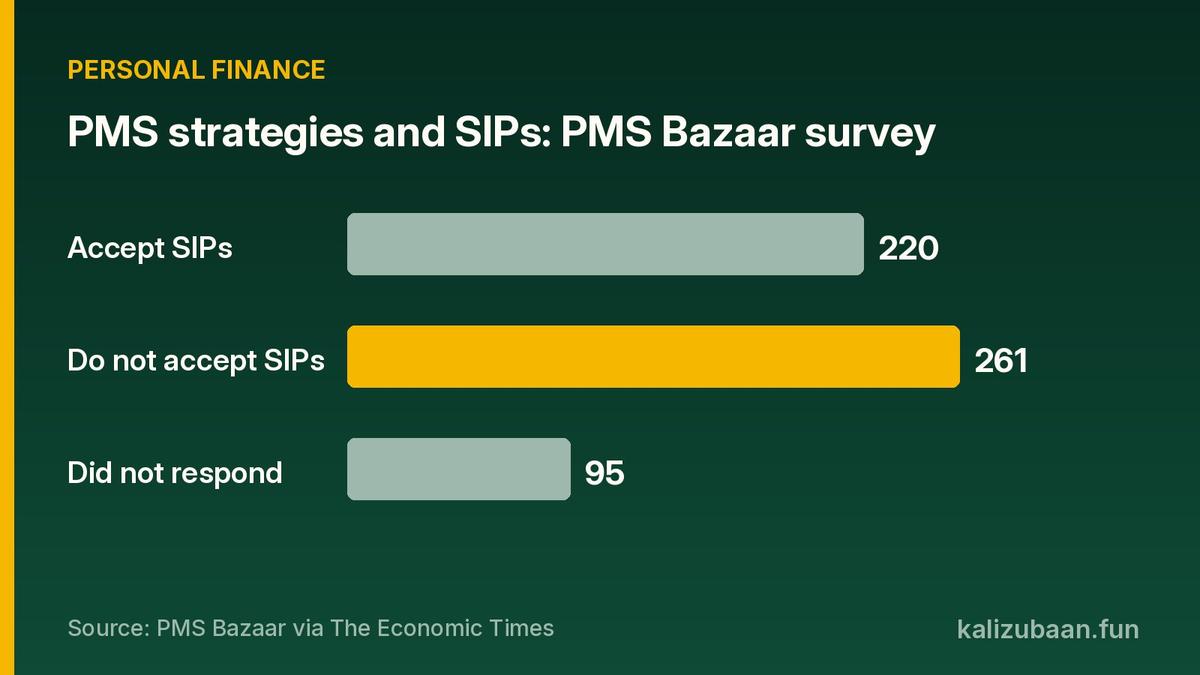
Source: PMS Bazaar via The Economic Times
Narayan points to a related shift. More than 50% of investors enquiring about PMS at his firm are considering an STP to deploy their money.
SIP vs STP: the real difference
PMS SIP. You put in fresh money at regular intervals. It suits people whose investible surplus keeps coming in, like salaried professionals saving for retirement or business owners with cash through the year.
PMS STP. You commit the whole corpus upfront. It sits in a liquid or low-risk holding within the PMS, and tranches move into the equity portfolio every month.
Prashasta Seth, CEO of Prudent Investment Managers, says it is common practice to collect the minimum ₹50 lakh upfront, split it between an equity approach and a liquid approach, and shift money from liquid to equity every month.
So the STP is for someone who already has the money but does not want to invest it all at once. The SIP is for someone building up over time.
Why investors stagger their money
Markets are jumpy. Seth notes the Nifty is around 14% below its January high, foreign investors are selling and crude oil is above $100 a barrel.
Staggering helps spread your entry points and reduces the regret of investing everything at a peak. R. Pallavarajan, founder of PMS Bazaar, says the main motivation is to capture volatility.
Safety or illusion?
Here is the part people miss. Mayur Shah, PMS fund manager at Anand Rathi Advisors, says the biggest misconception is that an SIP makes a PMS safer or guarantees better returns. It only changes when your money goes in.
What an SIP can do: spread investments across entry points, build a habit of investing surplus cash, and reduce the pressure to time the market.
What it cannot do: remove market or stock-specific risk, beat a lump sum for sure, rescue a poorly performing strategy, or make a mid-cap or small-cap portfolio safer.
Rushabh Desai of Rupee with Rushabh Investment Services adds that SIPs do not suit very aggressive thematic or sectoral PMS products, which need precise entry and exit timing.
Not your mutual fund SIP
The minimum does not drop. Under SEBI rules, a PMS SIP is an extra funding option only for investors who have already committed ₹50 lakh.
Taxes hit you directly. In a PMS, the shares sit in your own demat account. Every time the manager sells a stock, the gain is taxable in your hands. Since each SIP instalment buys shares on a different date, part of a sale can be short-term gain and part long-term.
Fees run on the whole portfolio. Narayan says the management fee is calculated on average monthly AUM, whether you invested by lump sum, SIP or STP. Also check performance fees, brokerage, transaction, custodian and demat charges.
How to judge whether it is working
With money going in on different dates, simple return figures can mislead. Look at XIRR, which accounts for how much you put in and when.
Jethwani suggests a simple test: run the same SIP cash flows through the benchmark index and compare the two XIRRs. Judge it over a full market cycle, ideally five years or more.
PRIM could change the picture
SEBI has created a new route called PRIM, the Portfolio Managers Route for Investing in Mutual Fund units. Portfolio managers can build client portfolios using direct plans of mutual funds, ETFs, index funds and SIFs, with a minimum of ₹25 lakh.
The new rules take effect on 1 April 2027. Under PRIM, the fixed management fee is capped at 1% of AUM, and investment in schemes of affiliated AMCs is capped at 25%.
One catch: a renewal at the end of the agreement counts as a fresh investment, so your portfolio must meet the ₹25 lakh minimum again at that point. Pallavarajan expects SIPs in PMS to become more popular as PRIM brings in younger investors with regular cash flows.
FAQs
Can I start a PMS with an SIP instead of ₹50 lakh? No. For a regular PMS, the SIP is an add-on for investors who have already committed ₹50 lakh.
Is a PMS SIP safer than a lump sum? Not by itself. It spreads your entry dates but does not change the risk of the portfolio.
How are PMS SIPs taxed? Gains are taxed in your hands whenever the manager sells. Instalments bought on different dates can create a mix of short-term and long-term gains on the same stock.
When does PRIM start? The new SEBI portfolio manager rules, including PRIM, take effect from 1 April 2027.
This article is for education only and is not investment, tax or legal advice.
Sources
- The Economic Times: SIP or STP for PMS investments? Key differences, costs and risks investors should know before choosing
- Mint: PRIM mutual fund route explained, ₹25 lakh minimum investment and contract renewal rules
- Moneycontrol: SEBI notifies revamped PMS regulations, new rules to take effect from April 2027
- Mint: SEBI launches portfolio managers route for mutual funds, what the new ₹25 lakh PRIM route means
Tagged Topics
Keep reading

Thanks for reading Kali Zubaan
Explore more articles in Personal Finance or return to the main publication feed.


