1% Fee Above ₹50,000: SBI Credit Card Fuel Charges From Dec 1
From December 1, SBI Card adds a 1% fee on fuel spends above ₹50,000 a billing cycle and on single transport payments above ₹30,000. Here is who pays, how much, and how to avoid surprises.
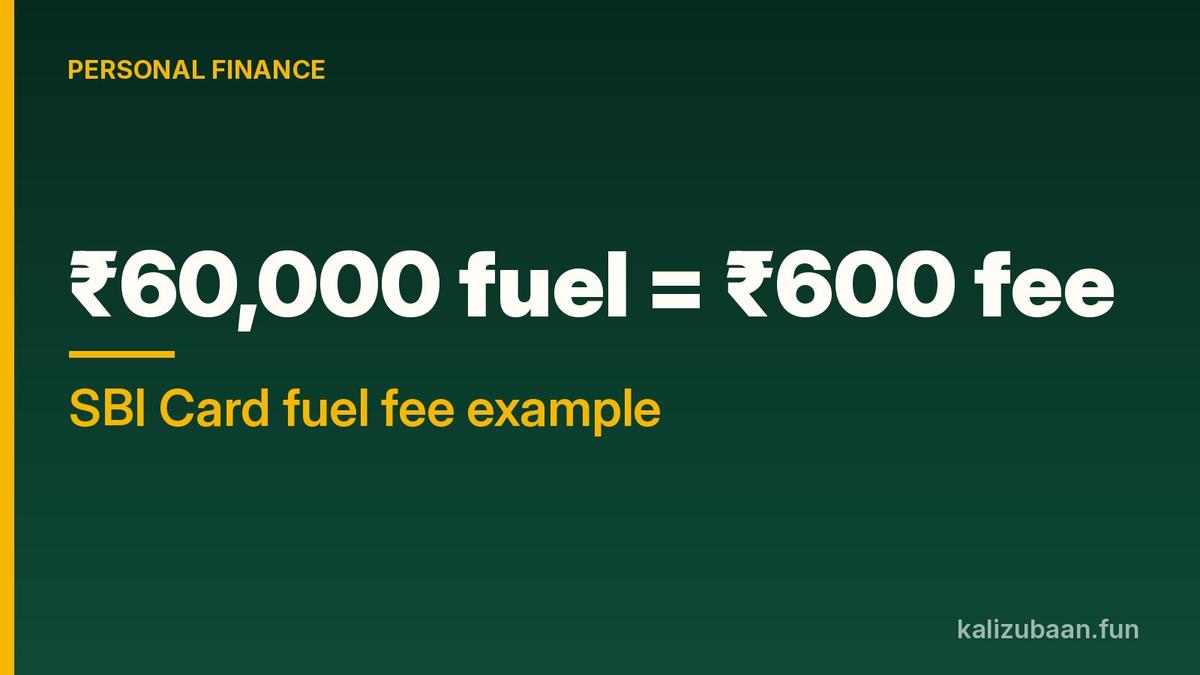
Fill up ₹50,000 of fuel on your SBI credit card in one billing cycle and you pay no extra fee. Spend ₹55,000 and the bill carries ₹550 more.
That jump is the heart of the new SBI credit card fuel charges that start on December 1. A second fee hits large transport payments too.
Quick answer
- From December 1, SBI Card charges 1% on total fuel spends if they cross ₹50,000 in a billing cycle.
- The fuel fee applies to the entire fuel spend, not just the part above ₹50,000.
- Any single transportation transaction above ₹30,000 also attracts a 1% fee.
- The changes apply across all SBI credit card variants, and taxes are extra.
This is general information, not financial advice; check SBI Card's official website for the exact terms that apply to your card.
What are the new SBI credit card fuel charges?
If your total fuel transactions in one billing cycle exceed ₹50,000, SBI Card will charge 1% on the whole fuel spend from December 1.
SBI Card announced the change in a communication dated October 27, and it covers all its credit card variants (Mint).
Fuel transactions are identified by Merchant Category Codes, or MCCs. The relevant codes are 5172, 5541, 5542 and 5983, which cover fuel dealers, petrol pumps and fuel dispensers.
A billing cycle is the 28- to 31-day period between two statement dates. Every fuel swipe in that window is added together before the ₹50,000 test is applied.
How much will the fuel fee cost you?
You pay nothing at or below ₹50,000 of fuel in a cycle, and 1% of the full amount once you go even slightly above it.
The Economic Times quotes the SBI Card notice: "if the total amount of all fuel transactions made in a billing cycle exceeds Rs.50,000, a fee of 1% will be charged on the total fuel spends."
Its illustration looks like this:
| Total fuel spend in a billing cycle | Extra charge |
|---|---|
| ₹40,000 | ₹0 |
| ₹50,000 | ₹0 |
| ₹55,000 | ₹550 |
| ₹60,000 | ₹600 |
| ₹75,000 | ₹750 |
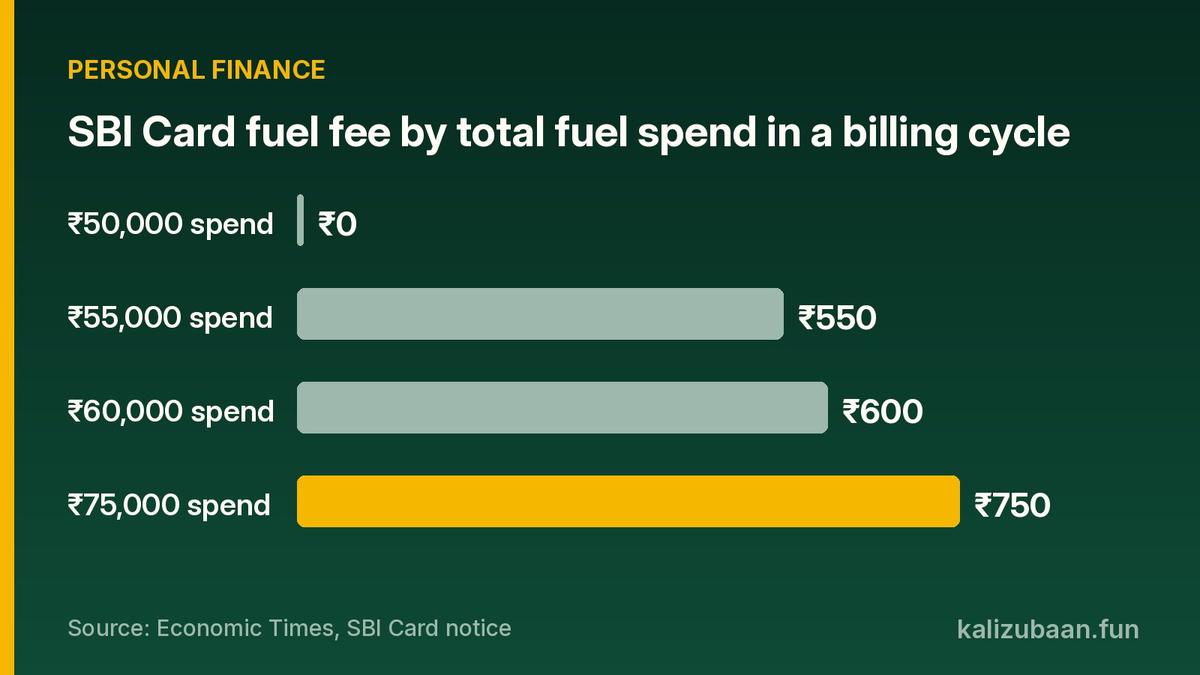
Source: Economic Times, SBI Card notice
GST or other applicable taxes are charged on top of these fees, so the final hit on your statement is a little higher.
What most guides miss: this is a cliff, not a slope. Going from ₹50,000 to ₹55,000 of fuel adds ₹550 in fees, so the extra fuel effectively costs more than its pump price, which is why tracking your statement date matters more than tracking your monthly fuel bill.
What changes for transport payments like tolls and bus tickets?
Any single transportation transaction above ₹30,000 will attract a 1% fee, while payments of ₹30,000 or less stay free.
The fee applies to MCCs 4111, 4784 and 4131, which cover commuter transport, tolls and bridge fees, and bus services (Mint).
Unlike fuel, the transport limit is checked per transaction. Several smaller transport payments in a cycle are not added up.
So a ₹35,000 transport payment costs ₹350 in fees, and a ₹50,000 one costs ₹500, plus taxes. A ₹25,000 or ₹30,000 payment costs nothing extra.
Who will feel these SBI Card charges the most?
Fleet operators, taxi businesses and people who spend heavily on fuel will feel the new charges most; most salaried users will not.
Mint reports that cardholders who spend ₹50,000 or less on fuel per billing cycle will not be affected.
Small business owners who run delivery vans or a few cabs on one personal SBI card are the group most likely to cross the line without noticing.
There is one more catch. SBI Card has said MCCs are assigned by network partners and may change, so a merchant's code is not fully in your control.
How can you avoid the new fee?
Watch your billing-cycle dates, keep fuel spend on one SBI card at or under ₹50,000 per cycle, and check how merchants are classified on your statement.
Mint suggests tracking fuel expenses against statement dates and reviewing the revised charges before December 1 (Mint).
A few practical habits help:
- Note your statement date and keep a running fuel total from that day, not from the 1st of the month.
- If your business fuel bill is large, consider a dedicated fuel or business card and compare its fees.
- Read the MCC shown against petrol pump and toll payments on your statement.
- Recheck SBI Card's official terms before December 1, as charges can be revised.
FAQs
Is the SBI Card fuel fee charged only above ₹50,000?
The fee is triggered only when total fuel spend in a billing cycle exceeds ₹50,000. Once triggered, 1% is charged on the entire fuel spend, not just the excess.
Does the fee apply to all SBI credit cards?
Yes. Mint reports the revised charges apply across all SBI credit card variants from December 1.
Is the transport fee based on monthly spend?
No. The transport fee is checked per transaction. Only a single transportation payment above ₹30,000 is charged 1%.
Are taxes extra on these fees?
Yes. The fee amounts in SBI Card's examples exclude applicable taxes, which are added on top.
Expert review: pending.
This post is for education only and is not financial advice. Credit card fees and terms can change; always confirm the latest charges on SBI Card's official website before you decide how to pay.
Related reading
- 10% Off Zomato, Capped at ₹2,000: Inside the Eternal SBI Card
- ₹39.92 Lakh Home Loan, Flat Sold Twice: Why the HC Backed Him
- ₹781 More EMI or ₹4.96 Lakh Extra: Your SBI Home Loan Choice
Sources
Tagged Topics
Keep reading



Thanks for reading Kali Zubaan
Explore more articles in Personal Finance or return to the main publication feed.


