₹781 More EMI or ₹4.96 Lakh Extra: Your SBI Home Loan Choice
SBI has raised its home loan benchmark by 25 basis points. On a ₹50 lakh loan, you either pay ₹781 more a month or keep your EMI and pay about ₹4.96 lakh extra interest. Here is the maths.

Take a ₹50 lakh SBI home loan with 20 years left. After this week's rate hike, your bank gives you two quiet options.
Pay ₹781 more every month. Or keep your EMI exactly where it is, and end up paying about ₹4.96 lakh more in interest over the life of the loan.
Most borrowers never actively choose. The bank often picks for them.
Quick answer
- SBI raised its External Benchmark Linked Rate (EBLR) by 25 basis points, from 7.90% to 8.15% plus premiums, effective 15 October 2026.
- In BankBazaar's illustration, a ₹50 lakh, 20-year loan at 8% sees its EMI rise from ₹41,822 to ₹42,603 at 8.25%.
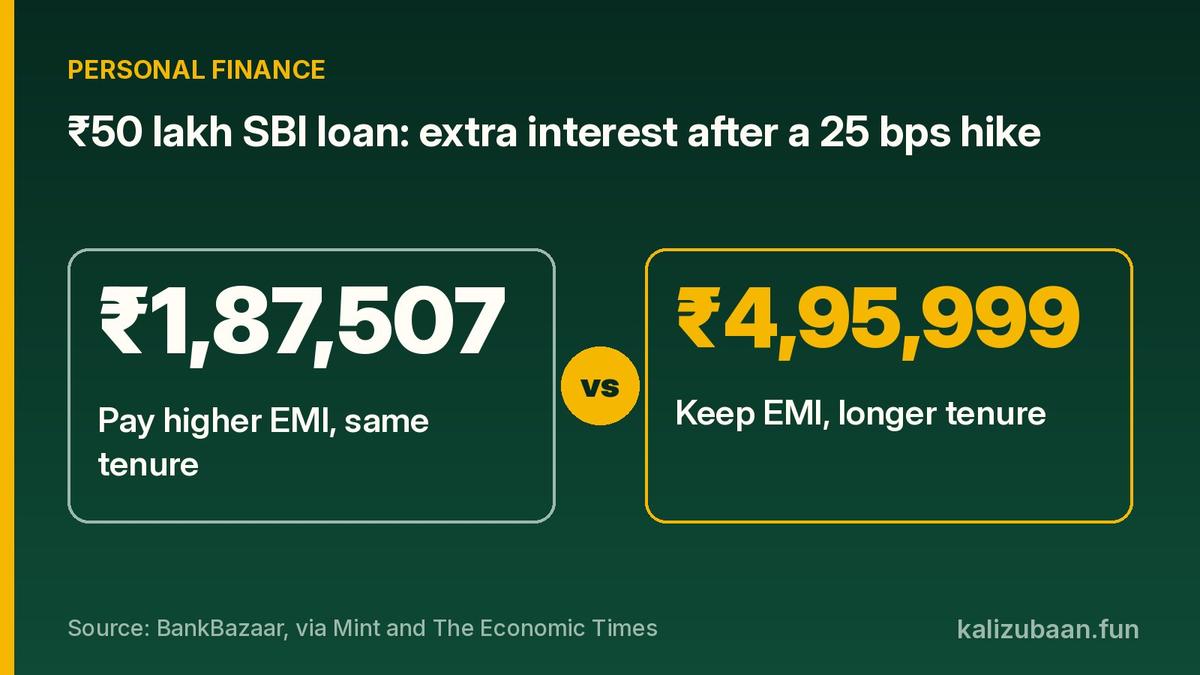
- Keeping the old EMI stretches the loan by 12 months, to 21 years, and raises the extra interest from ₹1,87,507 to ₹4,95,999.
- PNB, Bank of Baroda, Canara Bank, Bank of India and Indian Bank have also raised their repo-linked lending rates.
Why your home loan just got costlier
The Reserve Bank of India raised the repo rate, and banks have started passing it on. Most new home loans in India are linked to an external benchmark, usually the repo rate, so a hike reaches borrowers quickly.
SBI moved its EBLR from 7.90% + CRP + BSP to 8.15% + CRP + BSP. CRP is the credit risk premium and BSP is the business strategy premium. Its Repo Linked Lending Rate (RLLR) went from 7.50% + CRP to 7.75% + CRP.
Both changes are effective October 15, 2026. If your loan is linked to these benchmarks, your rate goes up at the next reset in your loan agreement.
SBI's new home loan rates
Your exact rate depends on your loan product, credit score and the spread in your agreement. According to SBI's published rates from 15 October 2026:
- Home Loan (term loan): 7.50% to 8.80%
- Home Loan Maxgain (overdraft): 8.00% to 9.30%
- Top Up Loan: 8.00% to 10.75%
- Top Up (OD) Loan: 8.50% to 11.25%
- Loan Against Property: 9.20% to 10.75%
- Reverse Mortgage Loan: 10.55%
- YONO Insta Home Top-up Loan: 8.35%
Higher EMI or longer tenure: the real cost
BankBazaar ran the numbers for loans from ₹30 lakh to ₹1 crore, assuming an 8% rate rising to 8.25% with 20 years left.
Source: BankBazaar, via Mint and The Economic Times
Route 1: pay the higher EMI. Your tenure stays at 240 months. On ₹50 lakh, the EMI goes up by ₹781, and the extra interest over the loan is ₹1,87,507.
Route 2: keep the same EMI. Your EMI stays at ₹41,822, but the loan runs for 252 months instead. That extra year costs ₹4,95,999 in additional interest.
In other words, the longer tenure costs more than twice as much extra interest as the higher EMI. Accepting the bigger monthly payment is the cheaper choice over the full loan.
What it means for your loan size
Here is the same illustration across loan amounts.
- ₹30 lakh: EMI rises by ₹469. Higher EMI route costs ₹1,12,504 extra. Longer tenure costs ₹2,97,599 extra.
- ₹50 lakh: EMI rises by ₹781. Extra interest is ₹1,87,507 versus ₹4,95,999.
- ₹80 lakh: EMI rises by ₹1,250. Extra interest is ₹3,00,011 versus ₹7,93,599.
- ₹1 crore: EMI rises by ₹1,563, from ₹83,644 to ₹85,207. Extra interest is ₹3,75,014 versus ₹9,91,998.
The pattern holds at every loan size. The bigger the loan, the bigger the gap between the two routes.
These are illustrations, not your exact numbers. Your outstanding principal, remaining tenure and spread will change the result.
Other banks have raised rates too
SBI is not alone. Several public sector banks have raised their repo-linked rates this month, according to The Economic Times.
- Punjab National Bank: RLLR up from 8.10% to 8.35%, effective October 8, 2026.
- Bank of India: RLLR up from 8.10% to 8.35%, effective October 7, 2026.
- Indian Bank: RBLR up from 7.95% to 8.20%.
- Bank of Baroda: retail BRLLR now 8.15%, effective October 8, 2026.
- Canara Bank: RLLR of 8.25%, effective October 9, 2026.
If you are about to take a new home loan, compare these benchmarks and the spread each bank offers you, not just the headline rate.
What to do now
- Check your loan statement or SBI's app. Find your benchmark, spread and the next reset date.
- Ask whether your bank changed your EMI or your tenure. Many banks extend the tenure by default.
- If your budget allows, choose the higher EMI. In every case in the illustration, it costs far less interest than a longer tenure.
- If the higher EMI strains your budget, keep the tenure route for now, and plan small part-prepayments when you can.
- Review your credit score. SBI's final rate depends partly on borrower eligibility, including credit score.
Mistakes to avoid
Ignoring the tenure. A steady EMI feels safe, but a quietly longer loan is the most expensive outcome here.
Looking only at the EMI hike. ₹781 a month sounds small. The real cost shows up in total interest over the years.
Comparing headline rates only. The final rate includes premiums and your spread, which differ between borrowers.
FAQs
When did SBI's new home loan rates take effect? From 15 October 2026. Your loan's rate changes at the reset date in your agreement.
Is the higher EMI always cheaper? In BankBazaar's illustration, yes. Paying the higher EMI cost much less extra interest than extending the tenure for every loan size shown.
Will my tenure increase automatically? It depends on your bank and agreement. Ask your branch or check your statement.
Are other banks raising rates? Yes. PNB, Bank of India, Bank of Baroda, Canara Bank and Indian Bank have also raised their repo-linked lending rates.
This article is for education only and is not investment, tax or legal advice.
Sources
- Mint: SBI hikes home loan interest rates: Higher EMI or longer tenure? Costs compared
- The Economic Times: SBI increases home loan rates: How your Rs 30 lakh to Rs 1 crore home loan EMIs can be impacted
- The Economic Times: Home loan borrower alert: SBI, PNB, Bank of India and other banks revise repo-linked lending rates
Tagged Topics
Keep reading



Thanks for reading Kali Zubaan
Explore more articles in Personal Finance or return to the main publication feed.


