₹795 More a Month: Higher EMI or Longer Home Loan Tenure?
After the RBI's 25 bps repo hike, your lender will either raise your EMI or stretch your loan. Here is what each choice costs on a ₹50 lakh loan, and how to pick the one that fits your budget.

Take a ₹50 lakh home loan with 20 years to go. If its rate moves from 8.5% to 8.75%, the EMI goes from ₹43,391 to ₹44,186. That is ₹795 more, every single month.
You can also refuse the higher EMI and let the bank stretch the loan instead. That feels painless today, but it is the more expensive choice over the life of the loan.
Quick answer
- The RBI raised the repo rate by 25 basis points to 5.50%, its first hike since February 2023, so floating-rate home loans will reset higher.
- Paying a higher EMI keeps your original end date and limits the extra interest.
- Extending the tenure keeps your EMI steady but you pay interest for more months.
- RBI rules let you choose: a higher EMI, a longer tenure, a mix of both, or a prepayment.
Why this question is back now
On 7 October, the RBI's Monetary Policy Committee voted unanimously to raise the repo rate by 25 bps to 5.50%. It also changed its stance to "calibrated tightening".
Loans linked to an external benchmark such as the repo rate feel this first. Santosh Agarwal, CEO of Paisabazaar, told Mint that borrowers should check their loan's benchmark and reset frequency to know when the hike will hit.
There is some comfort in the numbers. BankBazaar CEO Adhil Shetty pointed out that this hike is one-fifth of the 125 basis points of cuts delivered earlier, so much of that relief is still in place.
What a 25 bps hike does to your EMI
The extra EMI depends on your loan size, rate and remaining tenure. Raoul Kapoor of Andromeda Sales and Distribution worked it out for a 20-year loan whose rate rises from 7.15% to 7.40%.
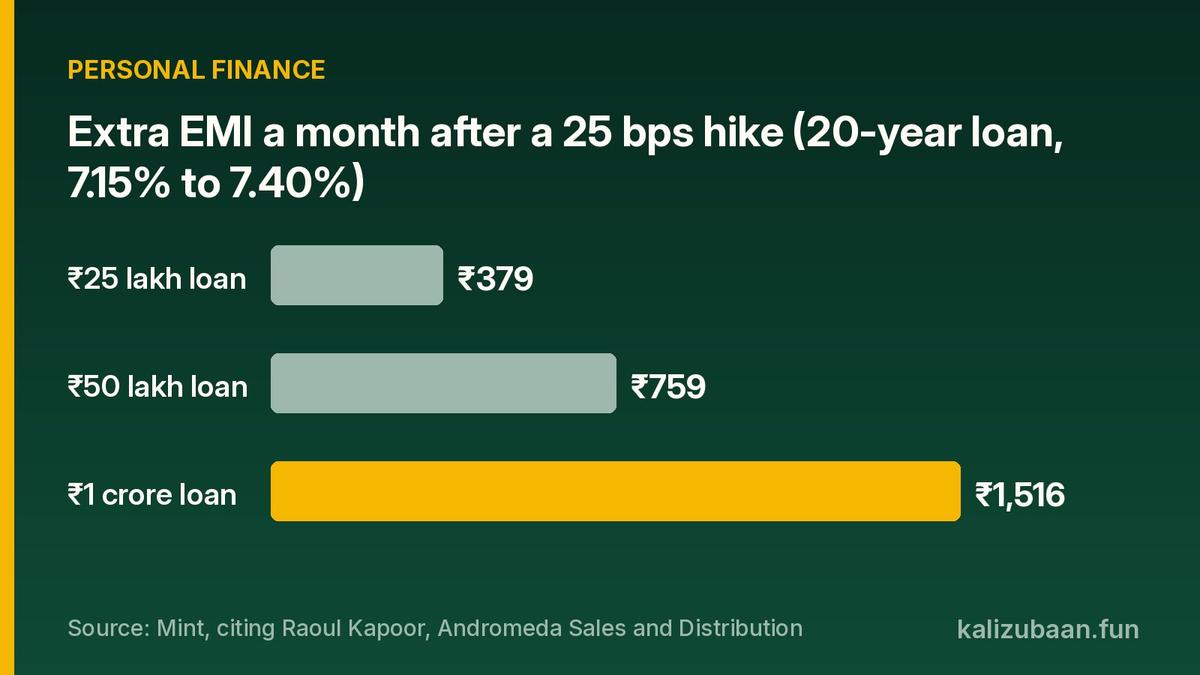
Source: Mint, citing Raoul Kapoor, Andromeda Sales and Distribution
On a ₹50 lakh loan, that takes the EMI from ₹39,216 to ₹39,975. Double the loan and the monthly jump doubles too.
Longer loans hurt more in total. Atul Monga, CEO of BASIC Home Loan, estimated that on a 30-year ₹50 lakh loan the EMI rises by ₹852 at a public sector bank and ₹867 at a private bank. Over the full 30 years, that adds roughly ₹3.07 lakh and ₹3.12 lakh of interest.
Option 1: Pay the higher EMI
Interest on a home loan is charged on the principal still outstanding. If you pay more each month, the principal falls faster and you pay interest on a smaller amount.
In the example from Godrej Housing Finance's Mehernosh Tata, the hike from 8.5% to 8.75% lifts total interest on the ₹50 lakh, 20-year loan from about ₹54.14 lakh to ₹56.05 lakh. That assumes you pay the revised EMI and keep the original 20-year end date.
This route suits you if:
- your salary is stable and has room for a few hundred rupees more a month
- you have few other loans
- your emergency fund stays untouched after the increase
"Those with stable income and sufficient room in their monthly budget may consider increasing the EMI to limit the additional interest cost," Tata told Mint.
Option 2: Extend the tenure
Here your EMI stays the same and the loan runs longer. For the same ₹50 lakh example, Tata said keeping the EMI unchanged meant extending the loan by 12-13 months, which could take the total amount repayable to ₹59.41 lakh.
That extra year of payments is the real price of a steady EMI. Shetty put it plainly: "Many lenders extend the tenure to keep the EMI unchanged, which feels easier but costs more over time."
This route can make sense if:
- you already juggle rent, school fees or other loans
- your income is irregular, as for many freelancers and business owners
- a higher EMI would push you to skip savings or insurance
Be careful if retirement is close. A longer tenure can push repayments into years when your regular income may stop.
The middle path: prepay when you can
You don't have to lock yourself into one extreme. A partial prepayment cuts the outstanding principal, which brings down future interest.
Monga suggests using an annual bonus or yearly savings to prepay one extra EMI each year. Shetty also said a small prepayment every year can reduce the extra interest from a hike.
Just don't empty your emergency fund to do it. Mint's report is clear that keeping enough cash for essentials and surprises still matters more than a slightly smaller loan.
What the RBI rules allow you to ask for
Under the RBI's August 2023 framework for floating-rate loans repaid in EMIs, regulated lenders must tell you about any change in EMI or tenure. They must also give you options to manage a rate rise:
- Increase the EMI.
- Extend the tenure.
- Combine both.
- Make a partial or full prepayment.
Switching to a fixed rate may also be possible, but that depends on the lender's policy. Compare the new rate, conversion charges and conditions before you switch.
What to do this week
- Check your loan statement for the benchmark (repo-linked or other) and the reset date.
- Ask your lender in writing whether the hike is being applied as a higher EMI, a longer tenure, or both.
- Request a revised repayment schedule for each option, showing the EMI, remaining tenure and total interest.
- Compare the total cost, not just the monthly change.
- Plan a yearly prepayment from your bonus if your budget allows it.
A common mistake is ignoring your lender's reset notice because the EMI didn't change. If your lender quietly extended the tenure, you could be paying for months longer than you planned.
FAQs
Will my EMI go up automatically after the RBI hike? Not always. Many lenders extend the tenure and keep the EMI unchanged. Ask your lender which method it is using for your loan.
Is it always better to pay a higher EMI? It usually costs less in total interest, but only if you can afford it without cutting essentials, insurance or emergency savings.
Can I switch from a longer tenure back to a higher EMI later? The RBI framework requires lenders to offer options, including increasing the EMI or prepaying. The exact terms depend on your loan agreement, so check with your lender.
Should I wait to buy a house until rates fall? Agarwal told Mint that buyers who are financially ready should not delay only because of a rate hike, since rates move through many cycles over a long loan.
This article is for education only and is not investment, tax or legal advice.
Sources
- Mint: Home loan borrowers: Pay higher EMI every month or extend your loan tenure?
- Mint: Have a ₹50 lakh home loan? Check how much your EMI could rise after the RBI rate hike
- Mint: RBI repo rate hike: How will the 25 bps increase affect your home-loan EMI?
- RBI: Monetary Policy Statement, Resolution of the Monetary Policy Committee, October 2026
Tagged Topics
Keep reading



Thanks for reading Kali Zubaan
Explore more articles in Personal Finance or return to the main publication feed.


