₹2.5 Lakh Limit: GST Registration for Ecommerce Sellers Eased
From November 1, small online sellers can use a platform's warehouse as their GST address in other states. Here is who qualifies, the ₹2.5 lakh limit and how to apply.

A small seller in one state wants her products stocked in a marketplace warehouse three states away. Until now, that usually meant renting an office in each of those states just to get a GST number.
That changed on November 1. Around 9.5 lakh small sellers could now reach the national market without opening offices in every state, according to Mint.
Quick answer
- Small sellers who sell only through an e-commerce platform can now declare that platform's warehouse as their principal place of business in a state where they have no office.
- It works only if the tax they pass on to registered business buyers stays within ₹2.5 lakh a month.
- They still need a real, verified GST registration in one home state, and the platform has to consent.
- Refunds and post-sale discounts also got simpler from the same date.
This is general education about a tax rule, not tax advice; check your own case with a chartered accountant or GST practitioner before you apply.
What changed in GST registration for ecommerce sellers?
Small sellers can now get GST registration in another state by naming an e-commerce platform's warehouse there as their principal place of business, instead of opening their own office.
The GST Council approved this at its 57th meeting on October 8, and it rolls out in phases from November 1 (Mint).
The legal home for it is a new Rule 14B in the CGST Rules. The tax board, CBIC, inserted it through a notification dated 26.10.2026, as A2Z Taxcorp explains.
Why did sellers need this? GST registration is state-specific. Sellers who stored stock in a marketplace's fulfilment centre in another state had to register there, and applications that showed the platform's warehouse as the place of business were often rejected or stuck in long checks.
Who qualifies for the warehouse option?
You qualify if you sell goods through an e-commerce platform that collects tax at source, you have a verified registration in your home state, and the platform agrees to let you use its warehouse address.
The money test is specific. The total output tax on your supplies to registered buyers (CGST, SGST or UTGST, and IGST added together) must not cross ₹2.5 lakh per month, per A2Z Taxcorp. Stock transfers between your own registrations on the same PAN are left out of that count.
A few more conditions apply:
- The new registration is for supplying goods only through that platform.
- You can hold a single such registration against a PAN in a state or union territory.
- Your home state is where you actually do business. Aadhaar checks and physical verification happen there.
If you already opted for the older simplified route under Rule 14A in your home state, you must first withdraw from it in Form GST REG-32 before applying under the new rule.
How do you apply, and how long does it take?
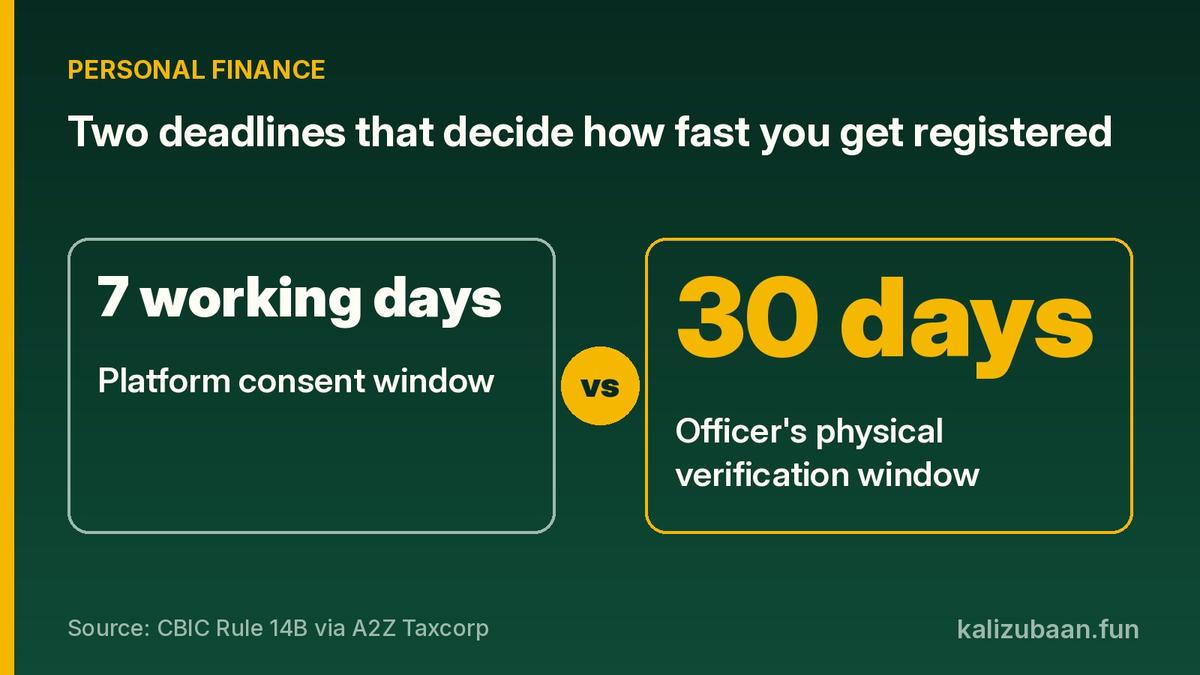
You apply online in Form GST REG-01, the platform gets seven working days to consent, and the system then grants registration once your home-state checks are complete.
Here is the flow, based on the CBIC rule as summarised by Free Press Journal and A2Z Taxcorp:
- Fill Form GST REG-01 and choose the new option in field 4.2. Give your home-state GSTIN and the address of the platform's warehouse in the new state.
- The portal sends your application to the platform. It has 7 working days to say yes. If it does not, your application stops there.
- After consent, your home-state officer runs biometric Aadhaar authentication and document checks, if they were not already done.
- Physical verification of your home-state place of business follows, again only if it was not done before.
- Registration is granted electronically. Your certificate shows the warehouse and your home-state address.
Source: CBIC Rule 14B via A2Z Taxcorp
There is a safety net for delays. If the officer does not finish physical verification within 30 days of your application reference number, after Aadhaar and documents are cleared, the application is treated as approved.
If physical verification finds no business at your home-state address, the application is deemed rejected. So the home state has to be real.
What most guides miss: the ₹2.5 lakh monthly cap counts only the tax on sales to GST-registered buyers, not on sales to ordinary shoppers. A seller who mostly sells to retail customers on a marketplace can have far bigger sales and still fit, while a seller who mainly sells to other businesses can hit the cap quickly.
What else changed in GST from November 1?
Three other process changes started on the same day: clearer registration documents, faster refunds and easier post-sale discounts.
The GST department has listed exactly which documents and details registration needs, and the portal is getting drop-down lists and tooltips to cut rejections, as Mint reports.
Refunds move faster too:
- Full refunds of excess balance in the electronic cash ledger will be sanctioned automatically, with no officer involved.
- For zero-rated supplies, such as exports, and inverted duty structure cases, the system will sanction 90% of the claim provisionally after a risk check.
Post-sale discounts get looser. Earlier rules needed a pre-existing agreement and a link to a specific invoice. Those requirements go, though the credit note safeguards and the matching input tax credit reversal stay.
Deloitte India's Mahesh Jaisingh told PTI the discount change matters for FMCG, manufacturing and small businesses, and that MSME sellers will get working capital relief from it.
What should a small online seller do now?
Check your monthly B2B output tax against the limit, ask your marketplace whether it will consent for its warehouses, and keep your home-state registration and records clean.
Your marketplace consent is the gate. Under the rule, if a platform later withdraws consent, it must report that on the GST portal, and you get 30 days to file Form GST REG-14 to change your principal place of business (A2Z Taxcorp).
A short checklist:
- Pull last few months of GST returns and see your tax on sales to registered buyers.
- Confirm your home-state Aadhaar authentication and physical verification are complete.
- Keep books and records ready, because you must produce them on demand.
- Note that the change of a warehouse address also needs fresh platform consent.
Red flag: do not use a home-state address where you do no business. That is the one check that can sink the whole application.
FAQs
Can I register for GST in another state without an office?
Yes, if you sell goods only through an e-commerce platform, stay within the ₹2.5 lakh monthly output tax limit on sales to registered buyers, and the platform consents to you using its warehouse address there.
Which form do ecommerce sellers use for this GST registration?
Form GST REG-01, with the new option in field 4.2. You quote your home-state GSTIN and the platform warehouse details.
What if the marketplace does not reply in time?
If the platform does not consent within 7 working days, your application is not processed further. You would need to apply again or use the regular registration route.
Do I still need Aadhaar verification?
Yes. Biometric Aadhaar authentication and physical verification are done in your home state, if they were not completed earlier.
Expert review: pending.
This article is for education only and is not investment, tax or legal advice.
Related reading
- ₹1,200 Late Fee: Money Rule Changes From 1 November 2026
- ₹1.5 Lakh Penalty Risk: Tax Audit Deadline Has Passed. Now What?
- ₹1 Lakh of Diwali Stock: 4 Side Businesses and Their Margins
Sources
- Mint: New GST reforms start today: Relief for online businesses, no need to open offices in every state
- A2Z Taxcorp: CBIC inserts Rule 14B for small sellers supplying goods through e-commerce operators
- Free Press Journal: GST rules eased for small online sellers, 9.5 lakh businesses likely to benefit
Tagged Topics
Keep reading


Thanks for reading Kali Zubaan
Explore more articles in Personal Finance or return to the main publication feed.


