₹1 Lakh of Diwali Stock: 4 Side Businesses and Their Margins
Dry-fruit hampers, puja items, sweets supply and ethnic wear can turn about ₹1 lakh of festive stock into side income. Here are the margins reported, a real candle example, and the mistakes to avoid.

Last Diwali, a group of women in Dehradun made candles at a cost of ₹10 to ₹20 each and sold them for ₹15 to ₹35. Their two self-help groups earned over ₹1.5 lakh from candle sales in one festive season.
That is the whole festive side-business idea in one line: buy or make small, price well above cost, and sell before the lights go up. This year, a Jagran business report says about ₹1 lakh of stock is enough to start one of four festive businesses. Here is what each one involves, and what the margins really mean.
Quick answer
- Jagran lists four festive businesses you can start with about ₹1 lakh: dry-fruit gift packs, puja and décor items, sweets and snacks supply, and ready-made ethnic wear.
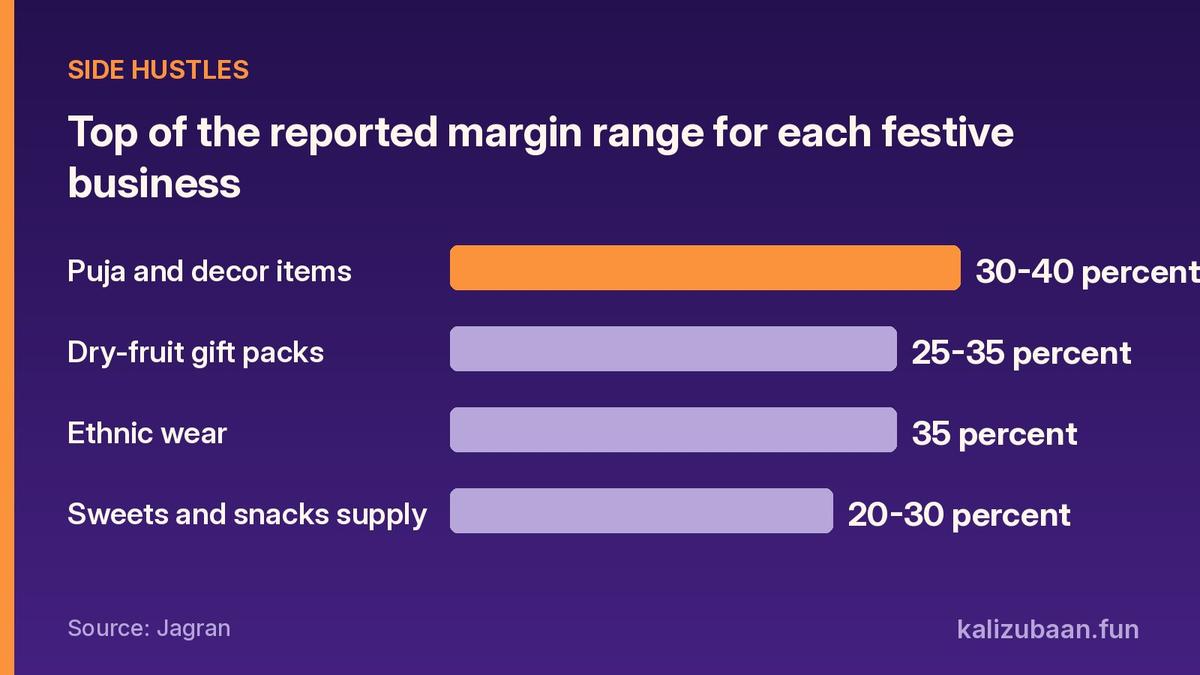
- Reported margins range from 20-30% for sweets supply to 30-40% for puja and décor items.
- With good planning and marketing, the report says savings of up to ₹50k in a month are possible. Treat that as a best case, not a promise.
- Anything edible needs FSSAI registration or a licence before you sell.
The 4 festive businesses, and the money involved
1. Dry-fruit and gift packing. Diwali and corporate gifting push demand for dry fruits highest from October to November. You buy almonds, cashews, pistachios, raisins and walnuts from a wholesale market and pack small and large gift boxes.
About ₹1 lakh covers stock, packaging boxes and printing, the report says. If you sell ₹1.5 lakh to ₹2 lakh of boxes at a 25 to 35 percent margin, it estimates ₹40k to ₹60k left over in a month.
2. Puja items and festive décor. Diyas, incense, decorative lights, rangoli, torans, kalash and ready puja kits all sell more around Navratri and Diwali. This one can run from home.
You buy from a wholesale market and sell through local shops, housing societies, online platforms and social media. Margins of 30-40% on ₹1 lakh are common, according to Jagran, and good sales could leave up to ₹50k of net profit.
Margins compared
Source: Jagran
3. Sweets and snacks supply. Companies, shops and households buy mithai and namkeen in bulk for the festivals. If you cannot make them yourself, you can tie up with reputed local halwais and manufacturers and take orders.
This order-first model keeps investment and stock risk low. On corporate or housing-society orders, Jagran puts the margin at 20-30%.
4. Ready-made and ethnic wear. Dussehra, Diwali and the start of the wedding season lift demand for kurtas, sarees, lehengas, jackets and children's traditional wear. You buy wholesale from markets like Delhi, Surat, Jaipur, Ahmedabad and Lucknow.
About ₹1 lakh gets you starting stock. If sales reach ₹2 lakh at a 35 percent margin, the report says up to ₹50k of savings is possible.
Margin is not profit
Here is the part most "festive business idea" lists skip. A margin is what you make on what you sell. It is not what you keep.
Look at the ethnic wear example. A 35 percent margin on ₹2 lakh of sales is more than the ₹50k the report says you might save. The gap is your real costs: packaging, delivery, payment fees, discounts, and anything you could not sell.
So work out your own numbers before you buy anything. List the cost of each item, the packing, the delivery and the payment fee. Then set a price that still leaves a profit after all of that.
What the Dehradun candle groups did right
The Dehradun example is small, but it shows the method.
Ten women from the Durga and Lakshmi self-help groups were trained in candle-making under the National Rural Livelihoods Mission, Garhwal Post reported. They prepared one thousand packets, each with six to eight candles, and sold them through city shops and home delivery.
They also had cheap working capital. The group got a ₹1.5 lakh cash credit limit at 7% interest, a ₹75,000 Community Investment Fund at 1% interest, and a ₹10,000 revolving fund.
You may not have access to the same scheme, but the lesson carries over. Start with a product you can make cheaply, sell in packs rather than single pieces, and use more than one sales channel.
How to start this week
1. Pick one idea, not four. The ones that need the most money are ethnic wear, because of the many sizes, and dry-fruit boxes, because the stock is costly, SitesPlaced notes.
2. Make or buy a small first batch. SitesPlaced suggests a low-budget first batch can cost under about ₹5,000 for crafts like painted diyas, rangoli kits and torans.
3. Sell in sets. Sell diyas in sets of 6 or 12, not one by one, and photograph them lit as well as in daylight.
4. Take orders before you buy more. Share samples on WhatsApp, social media and your local network, as Jagran suggests. Buy extra stock only after orders come in.
5. Keep both payment options. Jagran advises keeping cash and digital payments, and SitesPlaced suggests one simple store link with UPI and cash on delivery.
Mistakes to avoid
Selling food without registration. Homemade sweets, cookies, namkeen and dry-fruit boxes are food businesses. Depending on the size and nature of the business, FSSAI registration or a licence may be needed, so apply first, because it takes time to come through.
Buying a big stock on a guess. Unsold festive stock is the fastest way to lose money. Pre-orders protect you.
Starting too late. Buyers need to see your product for two or three weeks before your last order date. If your idea needs a month of setup, it is next year's idea.
Forgetting tax. Side-business income counts as income. This is information only, so check with a CA if you are unsure how to report it.
FAQs
Can I really start a festive business with ₹1 lakh? Jagran's report says about ₹1 lakh is enough for any of its four ideas. Craft items like painted diyas and rangoli kits can start with much less, under about ₹5,000 for a first batch, according to SitesPlaced.
Which festive business has the best margin? Of the four in the report, puja and décor items have the highest reported margin, at 30-40%. Sweets supply is the lowest at 20-30%, but it carries less stock risk because you take orders first.
Do I need a licence to sell Diwali sweets from home? Yes, edible products need FSSAI registration or a licence, depending on the business. Most craft and décor items do not.
How much did the Dehradun candle groups earn? Over ₹1.5 lakh from decorative candle sales, Garhwal Post reported.
Which festive product would you try first, and what would you charge for it?
Results vary; nothing here is a promise of income.
Sources
- Jagran: Start these 4 businesses with ₹1 lakh of stock in October-November
- Garhwal Post: Women SHGs to brighten Diwali with handmade candles in Doon
- Dun City News: Women's Self-Help Groups from Disaster-Hit Sahastradhara to Light Up Dehradun This Diwali
- SitesPlaced: 15 Diwali Business Ideas You Can Start From Home in October 2026
- Wikipedia: Food Safety and Standards Authority of India
Tagged Topics
Keep reading


Thanks for reading Kali Zubaan
Explore more articles in Side Hustles or return to the main publication feed.


