₹2.49 Lakh vs ₹2.25 Lakh: Gold vs Silver Investment Returns
₹1 lakh in silver three years ago is worth about ₹2.49 lakh, gold about ₹2.25 lakh. Over five years gold wins. Here is what gold vs silver investment returns really show.
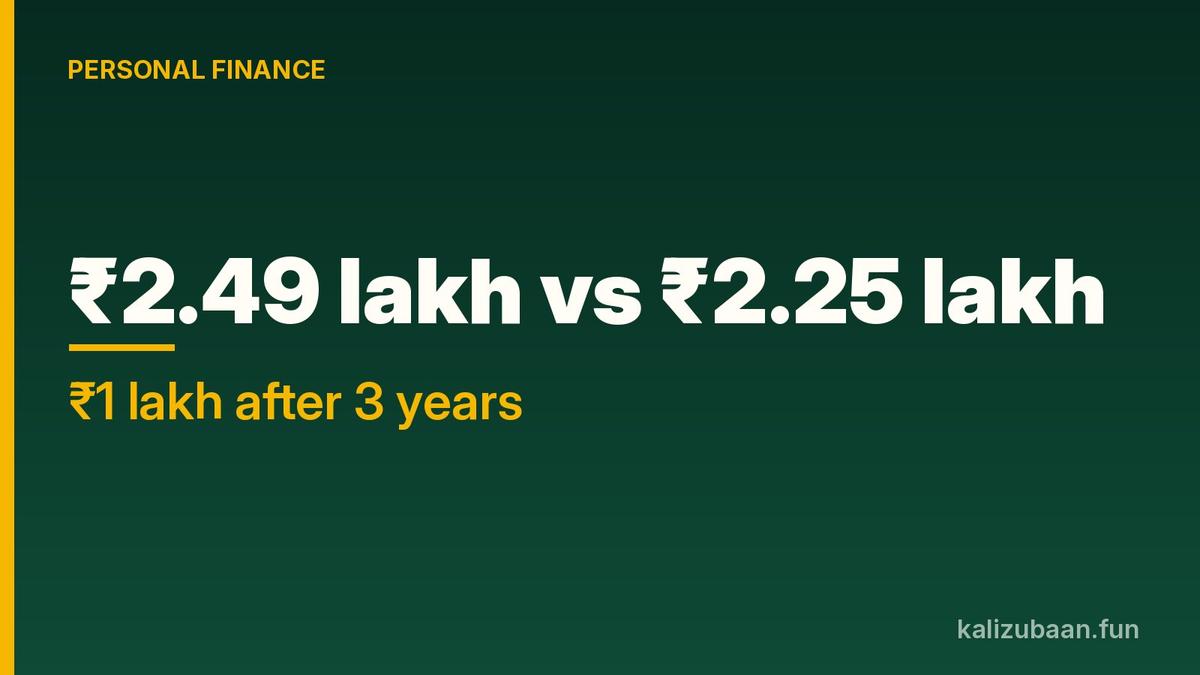
Put ₹1 lakh into silver three years ago and it would be worth nearly ₹2.49 lakh today. The same money in gold would be worth about ₹2.25 lakh.
So silver is the better buy? Not so fast. Stretch the window to five years and gold comes out ahead, with ₹1 lakh growing to around ₹2.88 lakh against ₹2.79 lakh in silver (Mint).
The winner depends on which years you look at. Here is what gold vs silver investment returns actually show, and what they leave out.
Quick answer
- Over 1 year, silver returned 18.17% and gold 13.91%, based on IBJA 999-purity rates up to 3 November 2026.
- Over 3 years, silver returned 149.29% and gold 125.26%.
- Over 5 years, gold leads with 188.09% against 179.26% for silver.
- These are benchmark price returns. Physical buyers pay 3% GST, and jewellery adds making charges, so real gains are lower.
This post is general education about past metal prices and is not a recommendation to buy or sell gold, silver or any fund. Past returns do not predict future returns; speak to a SEBI-registered adviser before you invest.
Which gave better returns on ₹1 lakh, gold or silver?
Silver gave better returns over one and three years, while gold gave better returns over five years, based on IBJA benchmark rates up to 3 November 2026.
Mint's comparison uses India Bullion and Jewellers Association (IBJA) rates for 999-purity gold and silver. It shows a hypothetical ₹1 lakh in each metal, measured on 3 November 2026 (Mint).
Over one year, ₹1 lakh in silver grew to around ₹1.18 lakh. Gold reached approximately ₹1.14 lakh.
Over three years, the gap widened. Silver's 149.29% rise took ₹1 lakh to nearly ₹2.49 lakh, while gold's 125.26% return took it to around ₹2.25 lakh.
Over five years, the order flips. Gold turned ₹1 lakh into about ₹2.88 lakh, and silver into ₹2.79 lakh. Mint calls that gap relatively small.
How do the 1, 3 and 5 year returns compare?
Silver leads the short and medium windows, and gold edges the long one, a pattern that both Mint's IBJA data and The Economic Times' MCX data agree on.
The Economic Times ran the same test on MCX prices with ₹5 lakh. It found gold gave an absolute return of 189.98% over five years, against 178.28% for silver (The Economic Times).
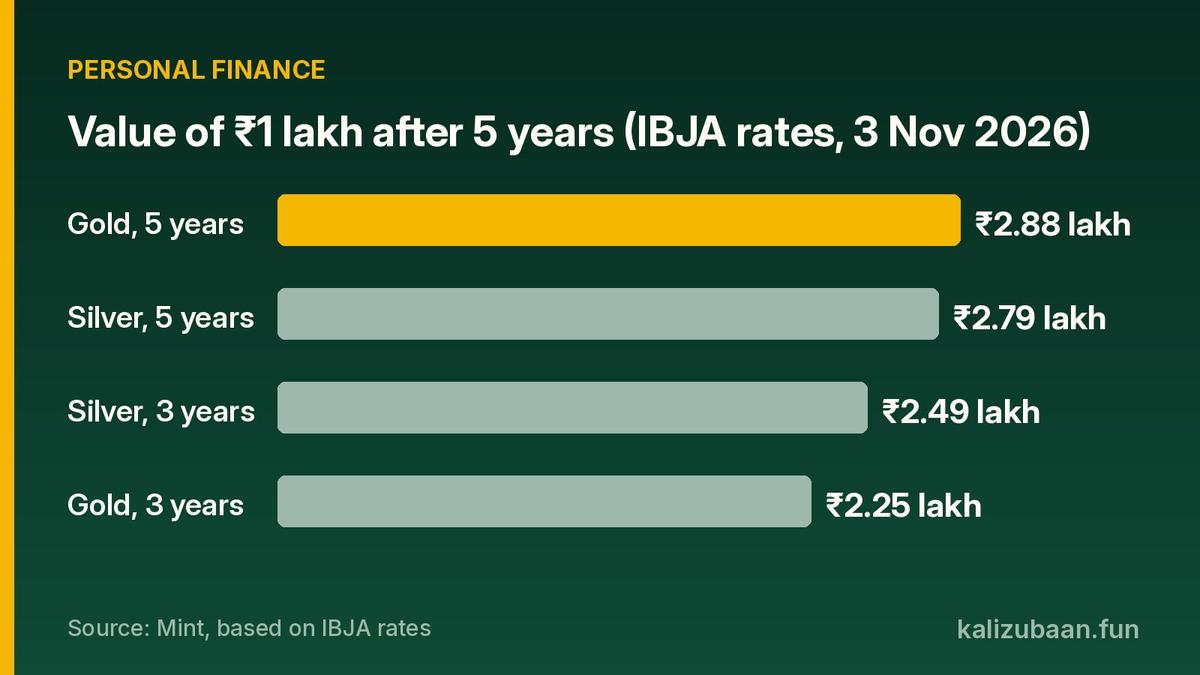
Source: Mint, based on IBJA rates
In rupee terms, the ET data shows ₹5 lakh in gold five years ago would now be worth about 14,49,880 rupees. The same amount in silver would be worth about 13,91,850 rupees.
The price moves behind this are large. Gold went from Rs 47,257 per 10 grams on 3 November 2021 to Rs 1,37,034 on 3 November 2026. Silver went from Rs 62,908 per kg to Rs 1,75,117 per kg in the same period.
What most guides miss: silver's lead depends on where you start. In ET's data, ₹5 lakh in silver fell to 4,52,963 rupees by November 2022, a -9.41% return, while gold was up 5.64% at the same point. Silver made up the ground later, which is exactly the kind of swing a short-term buyer may not sit through.
Why does silver swing more than gold?
Silver swings more because it is both an investment and an industrial metal, so factory demand and investor mood can both move its price.
Gold is widely viewed as a safe-haven asset, and central-bank buying and investment demand drive much of its price. Silver has investment and industrial uses, with demand from solar energy, electronics and electric vehicles, so it can be more volatile (Mint).
Both metals still react to some of the same things. These include the US dollar, interest-rate expectations, geopolitical uncertainty and investor demand.
That shared link is why both rose over the past year. It is also why owning both is not as much of a hedge as it may look.
Did Dhanteras 2025 buyers make money?
Yes, both metals rose for buyers around last Dhanteras, with silver up about 9.99% and 24-carat gold up about 9.29%, according to IBJA rates.
IBJA's 999-purity gold was ₹1,29,584 per 10 grams on 17 October 2025 and ₹1,41,622 on 4 November 2026. Silver moved from ₹1,69,230 per kg to ₹1,86,133 per kg (Mint).
In plain terms, ₹1 lakh of gold bought then is now worth about ₹1.09 lakh, an indicative gain of around ₹9,290. ₹1 lakh of silver is worth about ₹1.10 lakh, a gain of around ₹9,988.
You can check your own purchase with Mint's simple formula. For gold, divide what you paid by ₹1,29,584 and multiply by ₹1,41,622. For silver, divide by ₹1,69,230 and multiply by ₹1,86,133.
If you bought 22-carat jewellery, use the 916-purity rate instead of the 24-carat benchmark.
Will you actually get these returns when you sell?
Probably not in full, because benchmark rates leave out GST, making charges, dealer margins and purity deductions that cut what you receive.
IBJA benchmark rates exclude 3% GST and making charges. Making charges are generally not recovered at resale, and jewellers may apply deductions based on purity and their buyback policies (Mint).
Gold and silver ETFs avoid storage worries. But their returns will not exactly match metal prices because of expenses and tracking differences.
So before choosing, ask yourself three things:
- How long can you hold without needing the money?
- Can you handle a year where the value falls?
- Are you buying jewellery to wear, or metal to invest?
FAQs
Is silver a better investment than gold right now?
Silver beat gold over one and three years up to 3 November 2026, but gold beat silver over five years. Past performance is not indicative of future results, and silver tends to be more volatile.
How much is ₹1 lakh in gold worth after 5 years?
Based on IBJA rates, ₹1 lakh in gold five years ago would be worth around ₹2.88 lakh on 3 November 2026, a return of 188.09%.
Do gold and silver ETFs give the same return as the metal price?
No. ETF returns will not exactly match benchmark metal prices because of fund expenses and tracking differences.
Is GST charged on buying gold and silver?
Yes. Buyers of physical gold and silver may pay 3% GST, and jewellery also attracts making charges.
Expert review: pending.
This article is for education only and is not investment, tax or legal advice.
Related reading
- ₹11 Trillion of Gold Is Pledged: Rethink Your Dhanteras Buy
- ₹2 Lakh Gain, ₹9,375 Tax: LTCG on Stocks, Gold and Property
- 17 Fund Houses Shut Gold FoFs: What Happens to Your SIP Now
Sources
Tagged Topics
Keep reading
Thanks for reading Kali Zubaan
Explore more articles in Personal Finance or return to the main publication feed.