96% vs Under 1%: The New AI Detector Photo Tools, Explained
An AI detector photo check now reads pixels, hidden watermarks and signed credentials. Here is what Pangram, Sightova and the free Phrasly tool found, and how to check if a photo is AI.
A researcher took a real photo of a working camera and asked an AI editor to crack its screen. Then they sent it through a chat app, the way a fake refund claim would arrive. The watermark was gone and the file details were stripped, yet a new AI detector photo model still scored it at 96% AI.
The real photo of the same camera scored under 1%. That gap is the whole story of this month's AI image detector launches: the tools have stopped relying only on labels that are easy to remove.
Quick answer
- An AI detector photo tool now checks three things: hidden watermarks such as Google's SynthID, signed content credentials (C2PA), and the pixels themselves.
- Pangram says its new Image 1.0 model scored 99.96% accuracy on its own test of 1,200 AI images.
- Sightova's model, live since November 9, wrongly flags 0.37% of real web images, roughly 1 in 270.
- Phrasly offers a free, no sign-up detector for files up to 20 MB.
What is an AI detector photo tool, and how does it work?
An AI detector photo tool is software that estimates whether an image was made or edited by AI, using watermarks, file signatures and a trained pixel model.
The first check is the watermark. SynthID is Google DeepMind's invisible watermark, and Phrasly says that when it finds one, the verdict is 100% certain (Phrasly).
The second check is content credentials. ChatGPT, Gemini, Adobe Firefly, Copilot and FLUX sign the images they make, and a detector can verify that signature against the official C2PA trust list.
The third check is the pixel model. This is the part that matters when someone takes a screenshot, because screenshots and re-saves wipe the file details that used to give an image away.
Which new AI image detectors launched in November 2026?
Three companies shipped new photo detectors this month: Pangram, Sightova and Phrasly, each aimed at a slightly different user.
Pangram launched Image 1.0 for photos and Image Flash 1.0 for video, plus a Chrome extension that flags AI content while you scroll (Pangram). It also lowered its minimum image size from 512x512 to 256x256 pixels.
Sightova put a new model into production on November 9, built for evidence photos such as damage claims and warranty cases (Sightova).
Phrasly's tool is the one most readers can try today. It is free, needs no account, accepts JPG, PNG, WebP, HEIC, AVIF and GIF files, and says images are never stored.
Source: Pangram, Sightova
How accurate are these AI photo detectors really?
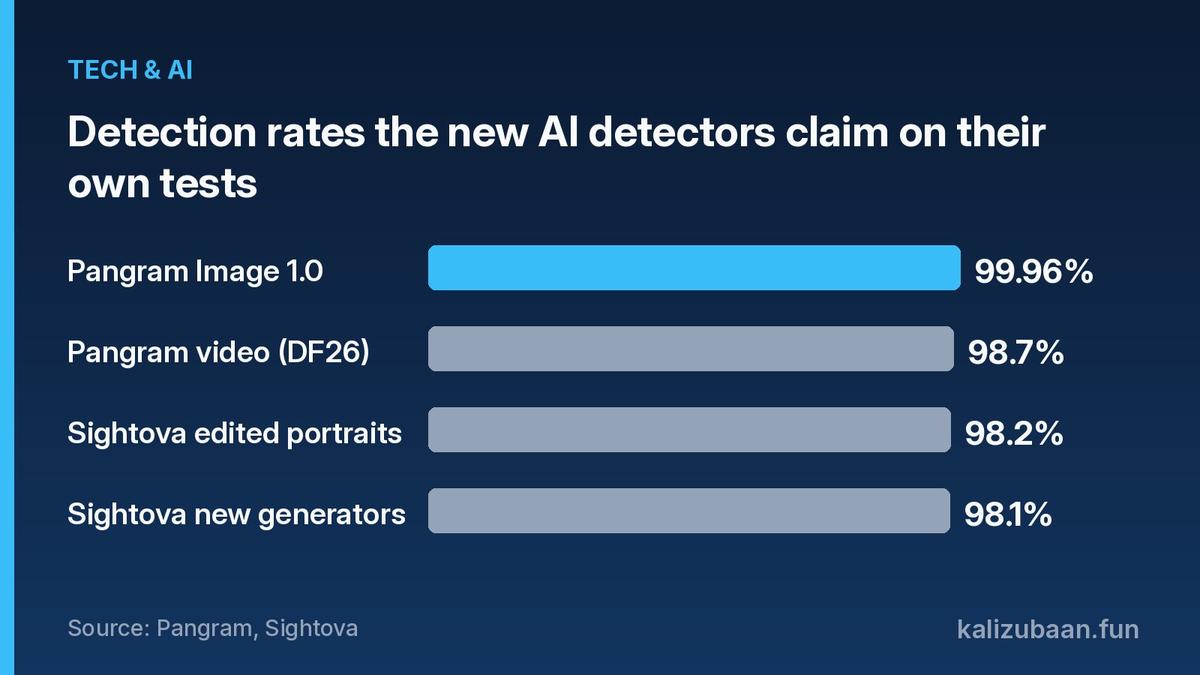
On their own tests, the new detectors claim catch rates near the top of the scale, but every figure comes from the company that built the tool.
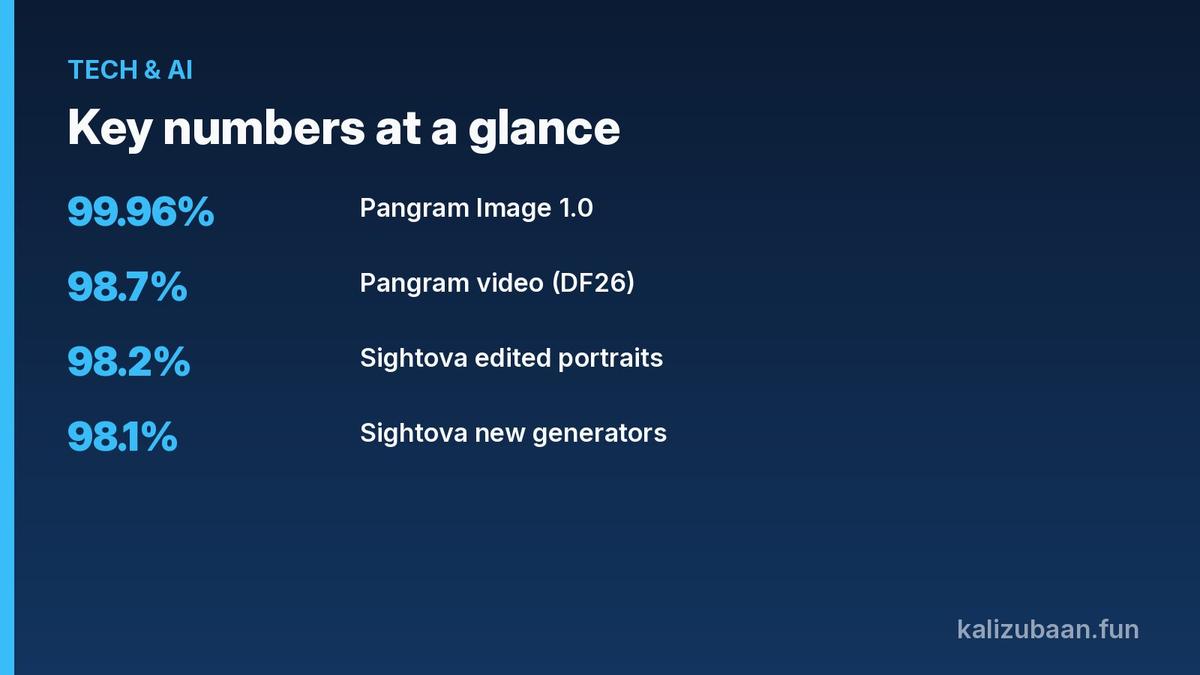
Pangram built its test by making AI mirrors of 100 real photos with 12 image generators, for 1,200 synthetic images, and reports 99.96% accuracy on that set (Pangram). For video, it says Image Flash 1.0 scores 98.7% on the DF26 benchmark, a 29-point lead over the next best detector.
Sightova says its new model catches 98.1% of images from nine of the newest generators and 98.2% of AI-edited portraits (Sightova). It also admits edits from open-source models are harder for it.
German tech site heise reported the Pangram figures and noted the company also tested against academic benchmarks (heise online). No independent lab has published its own numbers yet.
What most guides miss: the false-alarm rate matters more than the catch rate for normal users. Sightova's 0.37% sounds tiny, but at 1 in 270 a person checking a large photo album of real pictures should still expect a false alarm now and then.
Can a detector still catch a photo after the watermark is removed?
Yes, sometimes. Pixel models can flag edited photos even after a chat app strips the watermark and the signed credentials.
In Sightova's test, a Gemini edit of a cracked lampshade went through a chat-app copy that removed both, and the model still flagged it at 96% (Sightova). The chat-app copy was scaled to at most 1,280 pixels and saved as a JPEG.
Straight from Gemini, a smashed clock edit scored 94%, with SynthID found. Two genuine photos of broken devices, taken on an iPhone and a Google Pixel, both scored under 1%.
That is a demonstration of eleven photos, not a benchmark, and Sightova says so itself. Treat it as a sign of direction, not proof.
Why are watermarks becoming the law?
Watermarks are spreading because the EU now requires AI providers to mark their output and make it detectable.
Article 50(2) of the EU AI Act took effect with limited scope on 2 August 2026 and applies fully on 2 December 2026, with reach outside Europe (Wikipedia). Google announced a SynthID-based detector in May 2025 and expanded it in May 2026.
The C2PA standard behind content credentials is the other half of the system, a signed record of how a file was made (Wikipedia). The weakness is the same for both: a screenshot can drop them. That is why the pixel model exists.
How to check if a photo is AI generated
Upload the original file, not a screenshot, to a detector that shows its evidence, and treat the score as a clue rather than a verdict.
Phrasly advises uploading the original file rather than a screenshot or a heavily compressed copy for the strongest result (Phrasly). Here is a simple routine:
- Save the photo directly, or ask the sender for the original file.
- Run it through a free detector that reports watermarks and credentials, not just a percentage.
- Look at the heatmap. A small highlighted patch usually means an edit, not a fully fake image.
- If the image matters, such as a loan document, a property listing or viral news, check it in a second tool.
- Never accuse someone based on one score alone.
For Indian WhatsApp forwards, this matters most. Forwarded images lose their metadata, which is exactly the case where only the pixel model has anything left to read.
FAQs
Is there a free AI detector photo tool?
Yes. Phrasly's AI image detector is free, needs no sign-up and accepts files up to 20 MB (Phrasly).
Can an AI detector be wrong about a real photo?
Yes. Sightova says its model wrongly flags 0.37% of real web images, and more on some sets of compressed web photos.
What is SynthID?
SynthID is an invisible watermark from Google DeepMind. Phrasly says it is used by both Google and OpenAI on images from their tools.
Does a screenshot fool AI image detectors?
A screenshot removes watermarks and content credentials, but pixel models can still catch many edits, as Sightova's chat-app test showed.
Can these tools detect AI video?
Pangram's Image Flash 1.0 checks videos frame by frame. Phrasly checks still images only, not video.
Expert review: pending.
This is a news explainer based on company announcements and publisher reports. Accuracy figures are the vendors' own and have not been independently verified, so do not rely on a single detector score for legal, financial or personal decisions.
Related reading
- 3 Billion Images a Week: ChatGPT Image Editor Online Free Guide
- 50% Faster: ChatGPT Photo Editing Prompt That Makes GIFs
- 100 Million to No. 1: ChatGPT Users in India Overtake the US
Sources
Tagged Topics
Keep reading

Thanks for reading Kali Zubaan
Explore more articles in Tech & AI or return to the main publication feed.