2.5x Faster: Google Gemini 4 Hydrogen Features and Price
Google Gemini 4 Hydrogen features and price, explained: 2.5x faster than Gemini 3.8 Flash, four thinking levels, a 1 million-token window and $1.50 per million input tokens.

A coding test that Google's last fast model passed only 18.2 per cent of the time? Its new one clears 57 per cent. That is the headline number behind Google Gemini 4 Hydrogen features and price news this week, and it changes what a cheap AI model can do for Indian developers and students.
Google says Hydrogen finishes tasks 2.5 times faster than Gemini 3.8 Flash. It costs $1.50 per million input tokens. And you can already pick it inside the Gemini app.
Quick answer
- What it is: Gemini 4 Hydrogen is the speed-first model in Google's Gemini 4 family, built for coding, research and multi-step agent tasks.
- Speed and skill: 2.5x faster than Gemini 3.8 Flash, and 57 per cent on Terminal-Bench 4.1 against Flash's 18.2 per cent.
- Price: $1.50 per million input tokens and $7.50 per million output tokens on the Gemini API, flat across its 1 million-token context window.
- Where: Gemini app model menu, Google Search, Google AI Studio, the Gemini API and Android Studio; Antigravity for paid AI Pro and Ultra users.
What is Google Gemini 4 Hydrogen?
Gemini 4 Hydrogen is Google's fast, everyday model in the Gemini 4 lineup, meant for coding, research, data analysis and writing rather than the deepest reasoning.
Google positions Carbon and Argon for complex reasoning and long tasks, while Hydrogen "focuses on speed and execution" (Business Standard).
Think of it as the worker, not the architect. It can read instructions, break a task into steps, call outside tools and keep going with limited hand-holding.
It also reads more than text. Google says it can process PDFs, spreadsheets, charts, audio files and recorded videos to produce reports.
If you read our explainer on what Gemini 4 Carbon is, Hydrogen is the third piece of the same family.
How fast and smart is it compared with Gemini 3.8 Flash?
On Google's own numbers, Hydrogen is 2.5 times faster than Gemini 3.8 Flash and more than triples its coding benchmark score.
Hydrogen scored 57 per cent on Terminal-Bench 4.1, a test of how well models work with command-line tools, against 18.2 per cent for Gemini 3.8 Flash (The Economic Times).
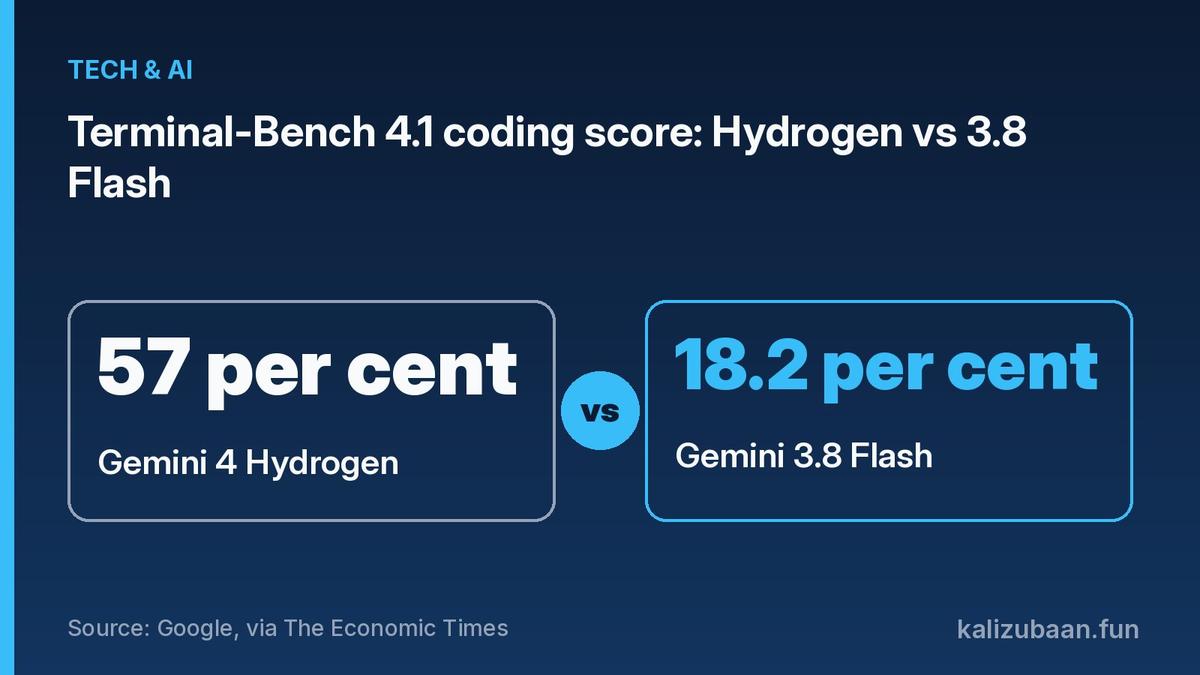
Source: Google, via The Economic Times
Google also says Hydrogen cut fabricated claims by more than five times. These are company benchmarks, not independent tests, so treat them as a starting point.
Sundar Pichai summed up the pitch on X: it finishes tasks faster and has thinking levels, "so you only wait and pay for the reasoning depth a task requires."
What most guides miss: output tokens cost five times as much as input tokens ($7.50 vs $1.50 per million). So long answers, not long prompts, drive your bill, and the low thinking level is the easy saving on simple jobs.
What are the four thinking levels?
Hydrogen lets you choose how hard it thinks: low, medium, high or extra-high, so simple jobs stay quick and cheap.
Google's default setting is high, and the 2.5x speed claim is measured at that default (Business Standard).
Use low for quick rewrites, summaries or small code fixes. Move to high or extra-high for debugging across many files or multi-step research.
The point is control. You no longer pay top-tier reasoning cost to fix a typo.
What can Hydrogen do for coding?
Hydrogen is built to debug, edit and test code inside large repositories, changing only the parts that need work instead of rewriting whole files.
It can read and search several files at once, run tests and move around big codebases, according to Business Standard.
Google is also adding Orchestrator in Google Antigravity. It hands planning to Carbon and execution, testing and verification to Hydrogen, and several Hydrogen agents can work on different parts of a project at the same time.
On Terminal-Bench 4.0, Orchestrator came close to Carbon's success rate while using 24 per cent less quota and finishing 19 per cent faster (The Economic Times).
For a fresher or student on a budget, that split matters. The expensive model plans once; the cheap one does most of the typing.
What is the Gemini 4 Hydrogen price?
On the Gemini API, Hydrogen costs $1.50 per million input tokens and $7.50 per million output tokens, and that rate holds across the full 1 million-token window.
Google keeps the same price whether you send a short prompt or a huge document, says The Economic Times.
Input tokens are what you send, including uploaded files. Output tokens are what the model writes back.
Google has not announced a separate rupee price for the API. Indian developers pay the dollar rate through their Google Cloud billing.
For regular users, there is no separate charge listed for the Gemini app or Search. Access and subscription needs vary by product, and Antigravity access is for paid Google AI Pro and Ultra subscribers.
Is Gemini 4 Hydrogen safe to use with agents?
Google says Hydrogen is harder to trick and less likely to overstep its permissions, though these are again its own test results.
It is more than 2.3 times more resilient on the Gray Swan Indirect Prompt Injection benchmark and scored 96.7 per cent on Google's internal agent honesty evaluation (Business Standard).
Prompt injection means hidden instructions inside a web page or document that an AI agent reads while working. It is a real risk if you let an agent browse or open files for you.
Google also reports up to 81 per cent fewer excessive actions in agent tasks. Even so, keep agents away from passwords, payments and production servers until you trust them.

FAQs
What is Gemini 4 Hydrogen used for?
It is Google's fast model for coding, research, data analysis and writing. It handles multi-step tasks with tools and can read PDFs, spreadsheets, charts, audio and video.
How much does Gemini 4 Hydrogen cost?
On the Gemini API it costs $1.50 per million input tokens and $7.50 per million output tokens, the same across its 1 million-token context window.
Can I use Gemini 4 Hydrogen in India?
Yes. Google says it is in the Gemini app model menu and is coming to Google Search for users globally, with developer access through the Gemini API, Google AI Studio and Android Studio.
Is Hydrogen better than Gemini 4 Carbon?
Not for everything. Carbon and Argon handle the hardest reasoning and planning; Hydrogen trades some depth for speed and lower cost.
Expert review: pending.
Benchmarks quoted here are Google's own figures; prices are as listed by Google and can change.
Related reading
- 88.2% Bug-Finding Score: What Is Gemini 4 Carbon, Explained
- $2 Per Million Tokens: What Gemini 4 Argon Costs Indian Devs
- 100,000 Indian Engineers Now Build With Gemini. Are You Ready?
Sources
Tagged Topics
Keep reading
Thanks for reading Kali Zubaan
Explore more articles in Tech & AI or return to the main publication feed.


