100,000 Indian Engineers Now Build With Gemini. Are You Ready?
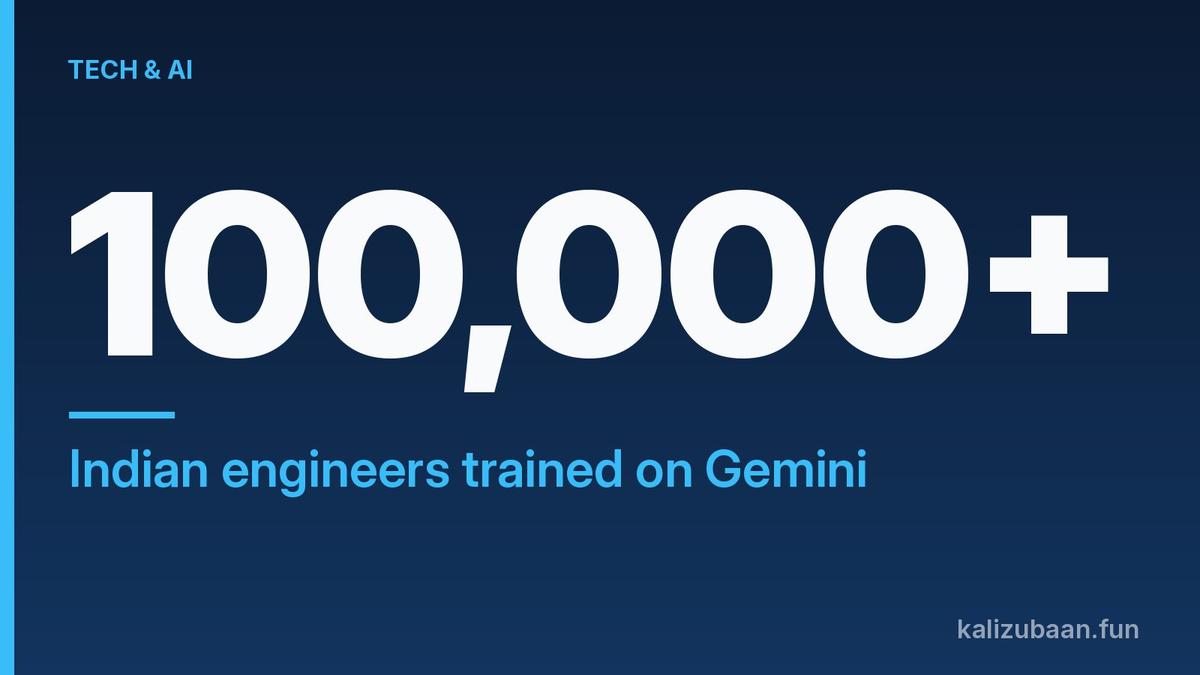
Google Cloud's Build with Gemini programme has trained over 100,000 developers and architects at TCS, Infosys, Wipro and four more IT giants. Here is what that says about the AI skills Indian tech jobs now want.
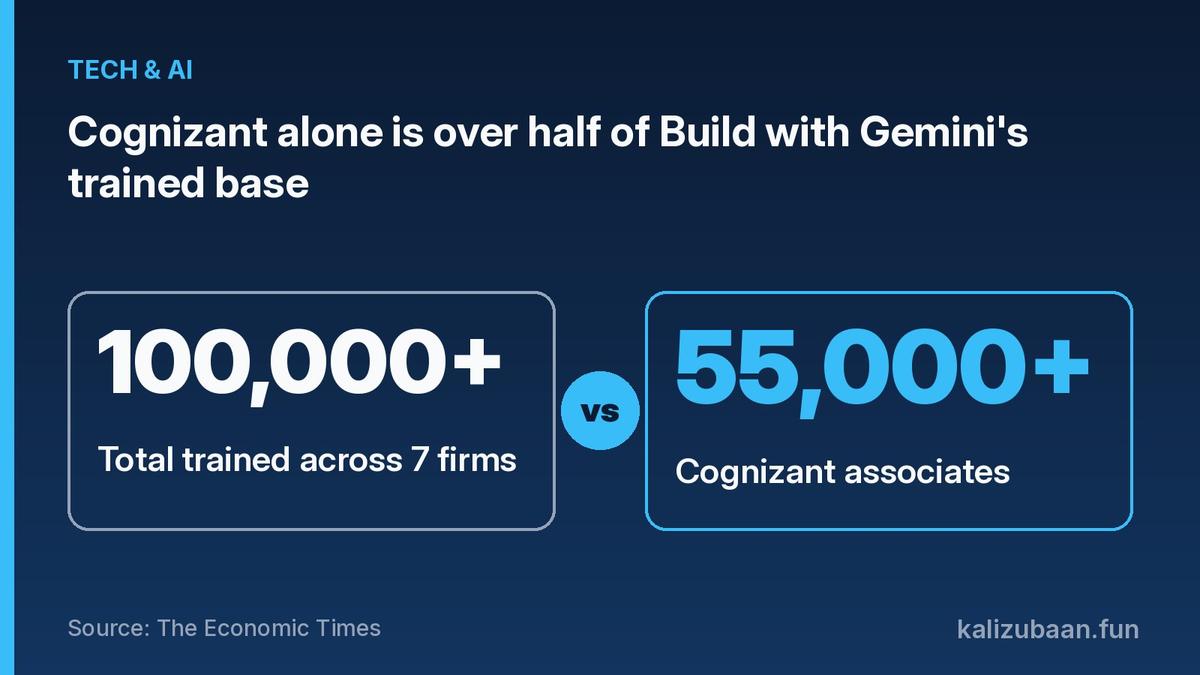
At Cognizant alone, more than 55,000 employees went hands-on with Google's Gemini models. That is nearly one in six of the company's entire workforce.
Add six more IT giants, and Google Cloud's Build with Gemini initiative crossed 100,000 trained developers and architects in September. If you work in Indian IT, or want to, this tells you exactly which skills the big employers are paying to build.
Quick answer
- Google Cloud's Build with Gemini initiative has trained more than 100,000 developers and architects across 7 global system integrators.
- The companies are Cognizant, HCLTech, IBM, Infosys, Tata Consultancy Services, Tech Mahindra and Wipro.
- The training is not about prompting. It focuses on enterprise data grounding, multi-agent systems, integration, security, governance and cloud-native scaling.
- For freshers and job seekers, the message is clear: "using AI" is now basic, and "engineering with AI" is the skill that stands out.
What happened
The Economic Times reported the milestone in a piece on Google Cloud's programme. The trained base spans developers and architects who worked hands-on with the platform, enterprise AI agents and agent orchestration.
The 7 partners are the giants that employ a huge share of India's IT workforce: Cognizant, HCLTech, IBM, Infosys, TCS, Tech Mahindra and Wipro.
The article reads like a Google Cloud showcase, with quotes from Google Cloud and the partner companies. So treat it as what these firms say they are doing, not an independent audit. Still, the direction it describes matters for anyone building a tech career here.
Why companies are retraining at this scale
The ET piece makes one argument again and again. The first phase of generative AI was about familiarity: models, prompting and early use cases.
The next phase is harder. Enterprises "no longer need teams that can simply prompt a model or build a proof of concept," it says. They need engineers who can ground AI in company data, plug it into business apps, run multi-agent systems and put security controls around them.
Think about an AI agent handling a customer request. Understanding the question is the easy part. The system may also need to log the user in, pull data from several databases, read company policy, take an action and know when to hand over to a human.
Those are not model questions. As the article puts it, they are architecture, integration, security and governance questions.
Source: The Economic Times
What the big IT firms are saying
Cognizant's Annadurai Elango called it "what a technology partnership looks like when both sides commit at scale." More than 55,000 Cognizant associates worked with Gemini on enterprise AI agents and agentic workflows.
At TCS, Chief Learning Officer Murali Ramanathan tied the training to the company's 5-pillar strategy to become "the world's largest AI-led tech services company." He said the strength of its AI capabilities depends on its people.
Infosys's Balakrishna D. R. said the conversation has moved from what AI can do to how organisations can deploy it "reliably, responsibly and at scale." Infosys is pairing the Gemini training with Infosys Topaz, its AI-first set of services.
Google Cloud's Kelly Rogan called the partner firms "the critical bridge between advanced models and real-world business outcomes."
The skills list hiding in this story
Strip out the corporate language, and the article is a free job description. These are the skills it names again and again:
- Enterprise data grounding: making AI answer from a company's own data, not just the open internet.
- APIs and application integration: connecting a model to the apps a business already runs.
- Multi-agent orchestration: getting several AI agents to work together on one workflow.
- Evaluation: measuring whether the AI's output is actually good enough.
- Identity, security and governance: deciding what data an agent can see, what it can do, and who checks it.
- Observability and cloud-native scaling: watching AI systems in production and running them at scale.
Notice that most of this is classic backend and cloud engineering. Databases, APIs, auth, permissions and monitoring are exactly what full-stack and Node.js developers already learn. The new part is wiring a model into them safely.
What this means for Indian freshers and job seekers
India already has one of the world's largest pools of software engineers, the article notes. The argument is that the next advantage depends less on headcount and more on how fast that talent is retooled for enterprise AI.
For a fresher, that has two sides. The good news: the biggest employers are investing heavily in AI engineering, which means demand. The harder news: if 100,000 people inside these firms already have hands-on Gemini training, a resume that says only "familiar with ChatGPT" will not stand out.
The ET piece does not say whether individuals outside these 7 companies can join Build with Gemini. So don't count on that route. You can still build the same skills on your own.
Gemini itself is a family of multimodal models from Google DeepMind, announced on December 6, 2023, according to Wikipedia. In June 2025, Google released Gemini CLI, an open-source AI agent for the terminal with generous free usage limits for individual developers. That is a low-cost way to start experimenting.
A practical project idea: build a small app where an AI agent answers questions from your own database, checks a user's permissions first, logs every action, and hands over to a human when unsure. That one project touches grounding, integration, security and oversight, the exact list above.
The bigger picture
The article frames this as India moving up the AI value chain. Instead of only maintaining and supporting systems designed elsewhere, Indian teams could design the AI architectures, reusable frameworks and industry solutions themselves.
For tech leaders, it lists three takeaways: AI architecture will become enterprise architecture, agentic AI will raise the governance bar, and engineering capacity will become a strategic AI asset.
For individual developers, it boils down to one line. As models become easy to access, the value moves to what you can build around them.
FAQs
What is Build with Gemini? It is a Google Cloud initiative that trains developers and architects at large IT services firms to build enterprise AI with Gemini models, including AI agents and agent orchestration.
Which companies are part of it? Cognizant, HCLTech, IBM, Infosys, Tata Consultancy Services, Tech Mahindra and Wipro, according to The Economic Times.
Can I join Build with Gemini as an individual? The ET report does not say it is open to individuals. It describes training inside these 7 partner companies.
What AI skills should a fresher learn now? Based on the skills the programme focuses on: grounding AI in your own data, API integration, multi-agent workflows, evaluation, and security and permissions around AI systems.
Sources
Tagged Topics
Keep reading



Thanks for reading Kali Zubaan
Explore more articles in Tech & AI or return to the main publication feed.


