60,000 Microsoft Staff Offered Buyouts: What It Means for India
Microsoft is offering voluntary exit packages to 60,000 eligible employees, including in India. Here is the deal, the December deadline, and what these Microsoft layoffs-by-choice mean for Indian techies.
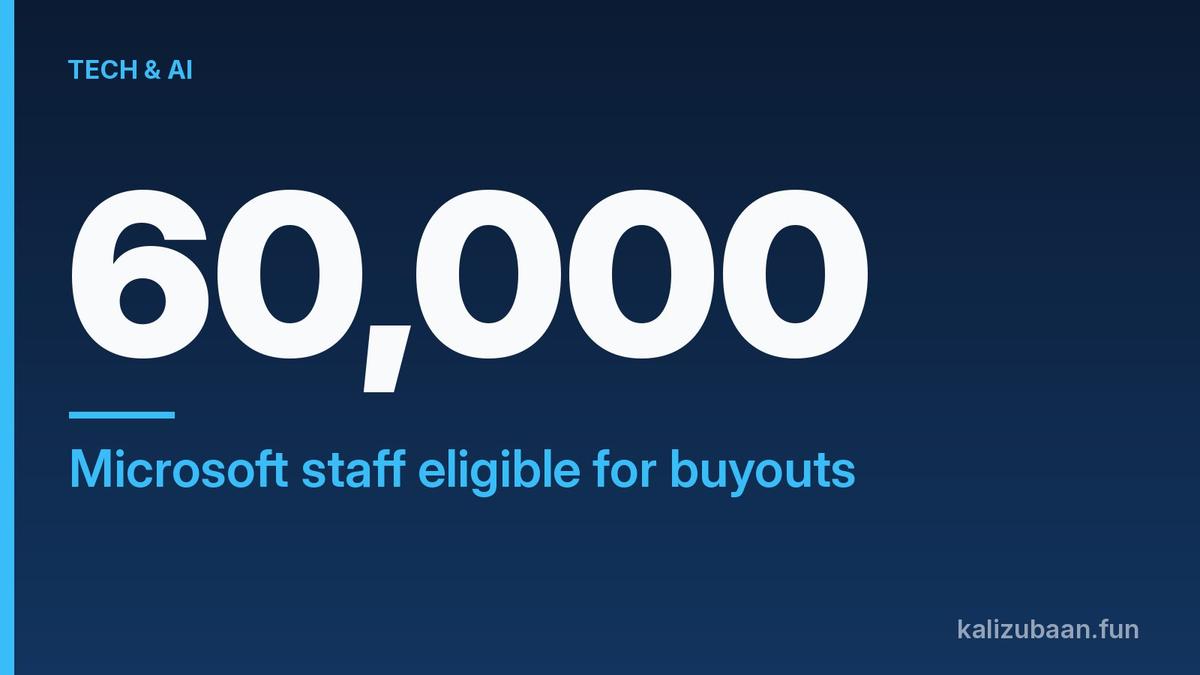
Microsoft employs around 2,23,000 people. On Monday, it told roughly 60,000 of them they can leave with a package if they want to. That is more than a quarter of its global workforce.
India is one of only four countries in the offer. Microsoft calls it a Voluntary Exit Offer, but for many techies watching the news of Microsoft layoffs, it raises one question: is this a layoff by another name?
Quick answer
- Around 60,000 employees in India, the US, the UK and Canada are eligible, not all expected to leave.
- The package is understood to include one month's base salary per completed year of service, plus health insurance and career help.
- Eligible employees in India reportedly have until December 1 to decide, and those who accept leave on December 31.
- Microsoft has about 23,000 employees in India, but it is not yet clear how many are eligible.
What Microsoft actually announced
Microsoft's Chief People Officer Amy Coleman announced the programme in a blog post. It is open to employees at level 70 and below, in participating teams across Canada, India, the UK and the US.
Level 70 is senior. It covers roles like general managers, partners, senior directors and distinguished engineers. So this is not just aimed at junior staff.
Coleman called it a time-limited offer that gives employees "considering a future outside the company" a way to leave with support. "The Voluntary Exit Offer is new for us. We'll learn from it," she wrote.
Microsoft says the offer is not based on age, length of service or performance, according to an internal note seen by The Verge.
The numbers behind the buyouts
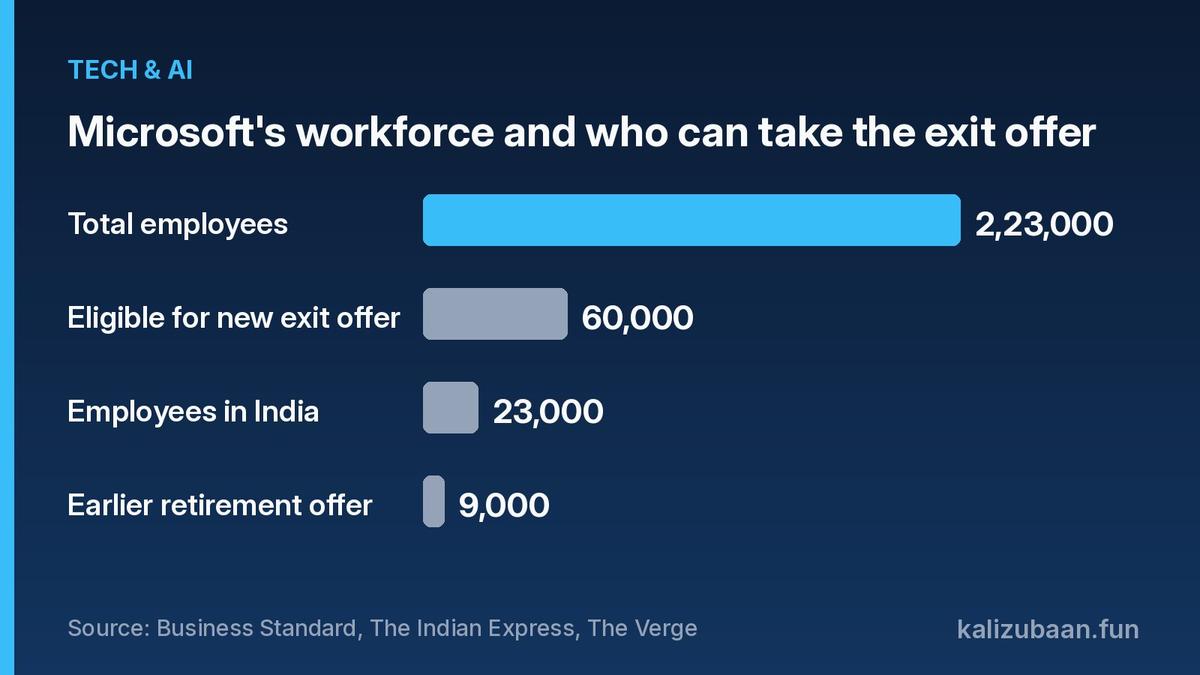
Here is how the offer compares with Microsoft's total workforce and its earlier exit schemes.
Source: Business Standard, The Indian Express, The Verge
The 60,000 figure is the number eligible, not a target. Microsoft has not set any target for how many people should accept.
For context, the earlier voluntary retirement programme this year was open to only around 9,000 US employees. More than 30 per cent of those eligible took it, the company said in July.
This also comes just months after Microsoft laid off 4,800 employees, mainly in Xbox and commercial sales, as The Verge reports.
Which teams are in, and which are out
Not every Microsoft team is part of this. Participation depends on each business unit's priorities, customer commitments and staffing needs.
According to The Verge's sources, staff in AI experiences, Copilot, CoreAI, Windows + Devices, Xbox, finance and HR are eligible. Cloud + AI, Microsoft AI, and the corporate and legal teams are partially in.
Teams in marketing, commercial business, discovery and quantum, and security are not participating.
If you work at Microsoft India, the clear signal is simple: check your email. Eligible employees will get a mail with the terms of their offer.
Why Microsoft is doing this now
The short answer is AI spending. Microsoft is spending billions of dollars on data centres and AI infrastructure, and it needs to balance that with cost control, as The Indian Express explains.
Buyouts let a company shrink with less of the bad press, legal risk and low morale that come with mass layoffs. They also make the cost of exits more predictable.
Money saved on headcount can then fund specialised AI talent, which comes with heavy paychecks. The announcement also lands just before Microsoft's quarterly results on Wednesday.
What it means for Indian techies
For Microsoft's own staff in India, this is a choice, not a pink slip. Someone with long service could walk away with a solid cushion, since the package is tied to completed years.
But shorter tenure means a smaller payout. A person with only a couple of years may not get enough to cover a long job search.
For everyone else in Indian tech, the bigger signal is where the money is going. Microsoft says it is still committed to India, with USD 20.5 billion in planned investment between 2025 and 2029 across cloud, AI infrastructure, skilling and operations. It also says it is on track to give 20 million people in India AI skills by 2030.
So the jobs are not vanishing from India. They are shifting toward AI, cloud and infrastructure work.
Mistakes to avoid if you get the offer
- Deciding on the headline alone. Work out your exact payout from your completed years of service.
- Ignoring health cover. Check how long insurance continues after you leave.
- Leaving without a plan. Start your job search and skill-up before the December 31 exit date, not after.
- Assuming you will be pushed out if you say no. Microsoft has framed this as optional and set no target.
FAQs
Is Microsoft doing layoffs in India? This is not a layoff. It is a voluntary exit offer open to eligible employees in India and three other countries. People choose whether to take it.
What is in Microsoft's voluntary exit package? It is understood to include one month's base salary for every completed year of service, plus health insurance and career transition services.
What is the deadline in India? Eligible employees in India reportedly have until December 1 to decide. Those who accept will leave on December 31.
How many Microsoft employees are in India? About 23,000, according to Business Standard. How many of them are eligible has not been made clear.
This post is for information only and is not career, legal or financial advice. Read your own offer letter carefully before deciding.
Sources
Tagged Topics
Keep reading

Thanks for reading Kali Zubaan
Explore more articles in Tech & AI or return to the main publication feed.