82% of US Gadgets Tested in China, and Now DeepSeek Is Out
The US has ordered civilian agencies to remove DeepSeek and anything built on it from their IT systems. Here is what the ban covers, why it happened, and what it means for Indians who use DeepSeek at work.
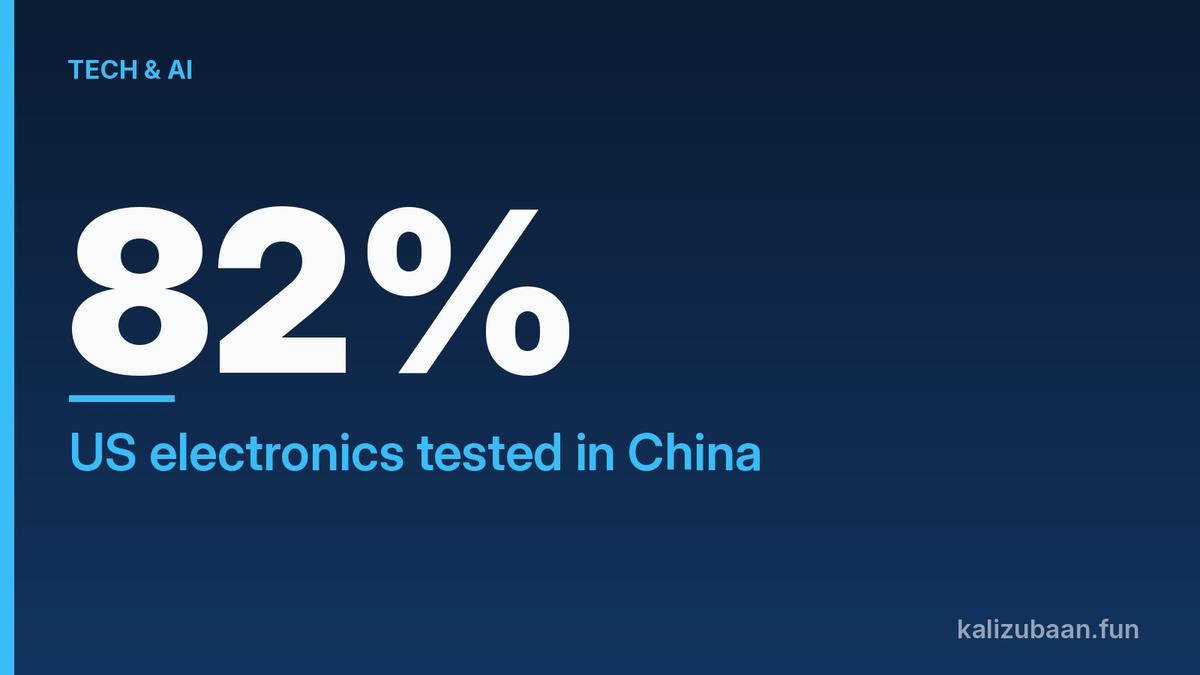
Last year, 82% of US electronics were tested in labs in China. Washington now wants that to end, and on Monday it went after something far more personal than a router: the AI chatbot on a government employee's screen.
The US Homeland Security Department has ordered DeepSeek products, and third-party services built on the Chinese AI model, removed from US civilian agency IT systems. If you use DeepSeek for work in India, this is worth five minutes of your time.
Quick answer
- The US Department of Homeland Security (DHS) has ordered civilian federal agencies to remove DeepSeek products and services built on DeepSeek from their IT systems, and to stop buying them.
- DHS says DeepSeek models pose "multiple threat vectors", including possible transfer of sensitive data to China, and that the models may contain malware or other security vulnerabilities.
- This is a rule for US government systems. It does not ban ordinary people in the US or India from using DeepSeek.
- India has already been cautious: in January 2025 its finance ministry told employees to avoid AI tools like ChatGPT and DeepSeek on office devices.
What the US actually ordered
According to a DHS notice published Monday, reported by The Economic Times and Business Standard, the order has two parts.
First, DeepSeek products and third-party services using the model must be removed from the IT systems of US civilian agencies. Second, those agencies are barred from acquiring DeepSeek products or services developed using DeepSeek.
The second part matters more than it looks. "Third-party services" means a vendor's app that quietly runs on a DeepSeek model is covered too, even if the DeepSeek name never appears on the screen.
DHS also made public a July memo that told federal agencies to monitor traffic flowing in and out of government websites, to address potential risks from DeepSeek.
Why DHS says DeepSeek is a risk
DHS gave three main reasons, all quoted in the reports:
- Using the product "may result in the transfer of sensitive data to the PRC if used by US government employees or vendors."
- Use by government agencies "could produce actionable intelligence on US persons and/or government agencies."
- "The models themselves may contain malware or other security vulnerabilities."
In simple words: the worry is not that DeepSeek gives bad answers. It is about where the data you type goes, and what could be hidden inside the software.
Wikipedia notes that DeepSeek's compliance with Chinese government censorship policies and its data collection practices have raised privacy concerns and drawn regulatory scrutiny in multiple countries. At the same time, it has been praised for its open weights, energy efficiency and contributions to open-source AI.
The Chinese Embassy in Washington did not immediately comment on the order.
Part of a much bigger crackdown
The DeepSeek order did not come out of nowhere. Several US agencies, including the Department of Commerce and the Navy, had already banned DeepSeek on government devices. States including New York, Tennessee and Virginia took similar steps.
The wider push against Chinese tech is even bigger, as the reports lay out:
- The Federal Communications Commission (FCC) will vote on October 29 on barring all Chinese labs from testing electronic devices such as smartphones, cameras and computers for use in the US.
- In December, the FCC banned imports of all new models of Chinese drones and new models of Chinese-made consumer routers.
- In July, the FCC voted to bar sales of devices in the US that contain key hardware from Chinese companies deemed national security risks.
That October 29 vote is where the 82% figure comes from. Here is how dependent US electronics testing has been on China:
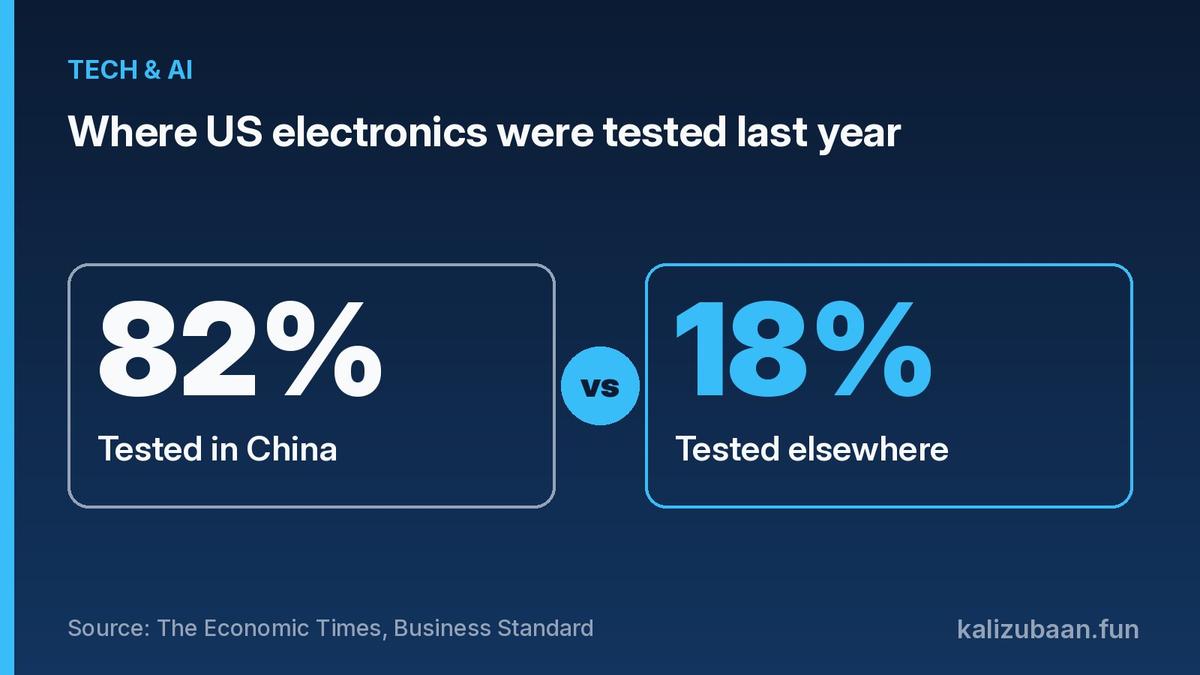
Source: The Economic Times, Business Standard
So the DeepSeek ban is one piece of a long list. The pattern is clear: Washington is pulling Chinese companies out of anything that touches government data or critical hardware.
How DeepSeek got this big, this fast
DeepSeek's rise explains why governments care. Wikipedia says its DeepSeek-R1 model, released on 20 January 2025, became a breakthrough success.
By 27 January, the chatbot had overtaken ChatGPT as the most downloaded free app on the US iOS App Store. That moment came alongside an 18% drop in Nvidia's share price.
It kept shipping after that. DeepSeek released V4 and V4-Pro on 24 April 2026, and DeepSeek-V4.1-Flash on September 9, 2026, according to Wikipedia.
Price is a big part of the appeal. The web version is free, with a cap of 500 messages per hour to stop bots. As of February 2025, its API was priced at roughly $0.28 per million input tokens and $0.42 per million output tokens, cheaper than some rivals.
Cheap, capable and free to try is exactly why staff in offices everywhere started using it, often without asking IT first.
What this means for India
India took a cautious step early. An internal advisory from the finance ministry's Department of Expenditure, dated January 29, 2025, said AI tools and apps "such as ChatGPT, DeepSeek etc." on office computers and devices pose risks for the confidentiality of government data and documents.
BusinessLine reported that the note went to all six departments of the ministry, including Revenue, Economic Affairs and Financial Services, with the approval of the Finance Secretary. It was internal, and there was no clarity on whether other ministries issued similar notes.
Notice the difference. India's note covered all AI tools on office devices, including ChatGPT. The new US order singles out DeepSeek by name and covers products built on it.
BusinessLine also noted that Australia and Italy had placed similar restrictions on DeepSeek, citing data security risks.
India has not shut the door on the technology itself. IT Minister Ashwini Vaishnaw said DeepSeek can be hosted on Indian servers after security checks, so coders and developers can use its open-source code. The IndiaAI Mission had built a common computing facility of about 18,693 GPUs at the time.
If you use DeepSeek at work, do this
You are not breaking any law in India by using DeepSeek. But the US order is a clear signal of how security teams think, and your company's IT team may start thinking the same way.
Check your office policy first. If you work for a government body, a bank, or a client with strict data rules, there may already be a ban on AI tools on office devices.
Never paste confidential data. Client files, source code under NDA, salary sheets, customer phone numbers and passwords should stay out of any public chatbot, Chinese or American.
Watch for hidden DeepSeek. The US order covers third-party services built on DeepSeek. Some apps and plugins use it in the background, so read the "powered by" details of AI tools your team adopts.
Consider self-hosting for sensitive work. Because DeepSeek's weights are open, developers can run the model on their own or Indian servers instead of sending data to DeepSeek's app, which is the route the IT minister pointed to.
Students and freshers: using DeepSeek to learn coding or practise interview questions is fine. Just build the habit of keeping company and personal data out of prompts, because employers will ask about it.
FAQs
Has the US banned DeepSeek for everyone? No. The DHS order covers US civilian government agency IT systems and what those agencies can buy. It is not a ban on ordinary users.
Is DeepSeek banned in India? No. In January 2025 India's finance ministry advised its employees to avoid AI tools like ChatGPT and DeepSeek on office devices, but that was an internal advisory, not a national ban.
Why is the US worried about DeepSeek? DHS says it may send sensitive data to China, could produce intelligence on US persons and agencies, and may contain malware or other security vulnerabilities.
Is it safe to use DeepSeek for personal tasks? That depends on what you share. Avoid typing anything confidential, such as ID numbers, passwords or work documents, into any public AI chatbot.
What else is the US doing against Chinese tech? The FCC will vote on October 29 on barring Chinese labs from testing electronics for the US market, after earlier moves on Chinese drones, routers and devices with risky hardware.
Sources
Tagged Topics
Keep reading

Thanks for reading Kali Zubaan
Explore more articles in Tech & AI or return to the main publication feed.