$75 of $100: India Still Taxes Your Full US Dividend
US brokers withhold 25% on dividends, but India taxes the full gross amount. How foreign tax credit, Form 44 and Form 67 actually work for Indian residents.

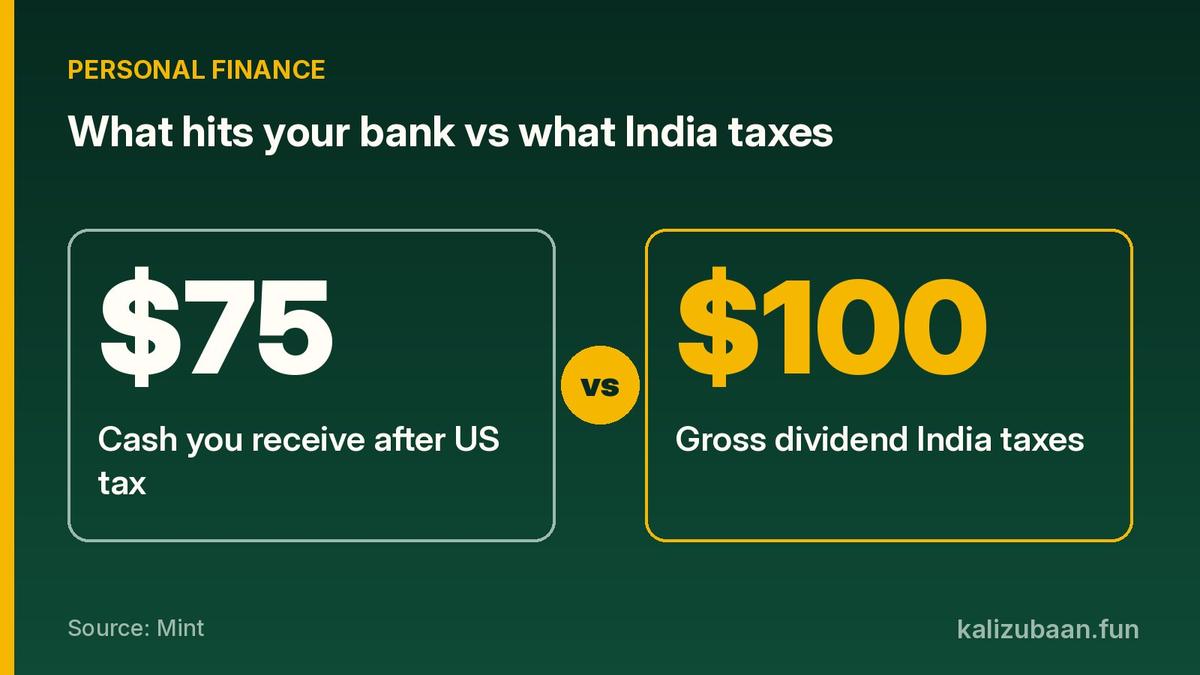
A US company declares a $100 dividend on your shares. Only $75 lands in your account. Then India taxes you as if you got the full $100.
That is not a glitch. Mint's October explainer walks through the same example: the United States withholds a flat 25% on dividends paid to Indian residents, and India still counts the entire gross payout in your income. The escape hatch is a foreign tax credit, not ignoring the US cut.
Quick answer
- Indian residents holding US stocks generally receive dividends after a flat 25% US withholding tax, so a $100 declared payout becomes $75 in the bank.
- India taxes the full $100 at your income-tax slab rate, whether you take cash or reinvest the dividend.
- You can claim a foreign tax credit for eligible US tax already paid, typically via Form 44 (erstwhile Form 67) with supporting documents such as Form 1042-S from your broker.
Why this matters now
Mint published a fresh guide on 14 October for Indian investors who buy US stocks through brokers and platforms. The piece is blunt: tax treaty relief exists, but only if you report the dividend correctly and file the credit paperwork.
A second Mint guide on the India-US double tax avoidance agreement (DTAA) makes the same point with a Microsoft-style example. If you invested $1,000 and received a 0.7% dividend for the year ($70), US authorities take 25% withholding ($17.5). India still wants its cut on the gross dividend unless you claim credit.
If you skip the form, you can end up taxed twice on the same money. That is the failure mode most retail investors discover only at ITR time.
What the rule actually says
Start with the US side. For an Indian resident, Mint says the United States withholds flat 25% tax at source on dividends. That rate is lower than the usual US foreign-investor rate because of the tax treaty with India.
Then comes the India side. Dividends from US stocks are taxable in India at the slab rate that applies to you. Mint is clear that this covers cash payouts and reinvested dividends. The regime you choose (old or new) and your total income for the year set the exact outgo.
The key trap is the tax base. Even if you receive only $75 from a declared $100 dividend after US withholding, India considers the entire $100 for taxation.
Mint's worked example: if Indian tax on that $100 dividend works out to $30, you can claim a foreign tax credit of $25 for the US tax already paid and pay the remaining $5 in India. Chartered accountant Gaurav Makhijani, quoted by Mint, says Indian law lets you claim foreign tax credit for eligible US tax, report the dividend in the Indian return, and file Form 44 (erstwhile Form 67) with the required details and supporting documents.
Source: Mint
Who is affected
- Salaried investors buying US stocks through Indian or global brokers, especially if dividends are small enough that people assume "already taxed abroad."
- Anyone reinvesting dividends instead of taking cash. Mint says India still taxes the payout at slab rates.
- Investors near the ₹7 lakh rebate band under the new regime. A separate Mint Q&A notes that if dividend income falls inside a Section 87A rebate so it is effectively not taxable in India, the 25% US withholding may not offset against Indian tax on other income such as capital gains.
- People remitting under the Liberalised Remittance Scheme. Mint's DTAA guide notes you can invest up to ₹10 lakh a year abroad before a 20% tax collected at source (TCS) kicks in. That TCS is separate from dividend withholding.
What to do now
- Expect $75 on a $100 US dividend. Budget with the 25% US cut already taken.
- Report the full gross dividend in India. Do not file only the $75 that hit your account.
- Collect Form 1042-S from your US broker. Mint's DTAA guide says this is the official US document showing income and withholding.
- File the foreign tax credit form with your ITR. Mint's October piece names Form 44 (erstwhile Form 67). Older Mint coverage of the same credit process focuses on Form 67 filed with the income tax department.
- Match credit to the same income type. The Mint Q&A example shows FTC on dividends cannot blindly wipe Indian tax on US capital gains if the dividend itself is not taxable in India after rebates.
- Watch your slab. Mint's DTAA guide: if you are in the 15% bracket, you may claim credit of only 15% of the US dividend income even though the US withheld 25%. The leftover withholding can become a deadweight loss if you owe little or no Indian tax on that income.
Mistakes and red flags
- Assuming the US tax settles everything. India still taxes the gross dividend.
- Reporting $75 instead of $100. That understates foreign income and breaks the credit maths.
- Skipping Form 44 / Form 67. Mint's DTAA piece quotes a Delhi CA: without Form 67, foreign dividends may be taxed twice.
- Trying to set US dividend tax against unrelated Indian tax. Credit is limited and income-matched.
- Ignoring TCS on remittances. The ₹10 lakh / 20% TCS line in Mint is about sending money abroad, not about dividend withholding, but both hit the same investor.
FAQs
Why do I get only $75 when the company declares $100? Because the United States withholds flat 25% tax at source on dividends paid to Indian residents, Mint explains. The treaty rate is lower than the usual foreign-investor rate, but it is still a real cut.
Does India tax the $75 or the $100? The full $100. Mint's October guide repeats this twice: India considers the entire declared dividend for taxation even after US withholding.
How does the foreign tax credit example work? If Indian tax on a $100 dividend is $30 and the US already took $25, Mint's illustration says you claim $25 as credit and pay $5 more in India.
What papers do I need from the broker? Mint's DTAA guide highlights Form 1042-S for US withholding, plus the Indian foreign tax credit form filed with your return (Form 44 / Form 67, depending on which Mint explainer you follow and the year rules in force).
This article is for education only and is not investment, tax or legal advice.
Sources
Tagged Topics
Keep reading



Thanks for reading Kali Zubaan
Explore more articles in Personal Finance or return to the main publication feed.


