₹17,000 Crore Adviser Wins First MF Lite Nod: What It Means
1 Finance has SEBI's in-principle nod for what ET calls India's first MF Lite fund house. Here is what MF Lite is, what changes for index fund and ETF investors, and what to check before you invest.

A financial planning firm that advises on more than ₹17,000 crore of client money now wants to run its own mutual fund. SEBI has given 1 Finance in-principle approval to set up a fund house under its new MF Lite rules.
The Economic Times calls it India's first MF Lite asset management company licence. If it goes ahead, it will sell only passive products such as index funds and ETFs.
Quick answer
- MF Lite is a lighter SEBI framework for fund houses that run only passive schemes such as index funds and ETFs.
- 1 Finance has in-principle approval, not final registration. It cannot launch any scheme yet.
- It is targeting a launch in the fourth quarter of FY27, subject to SEBI's final registration.
- More fund houses could mean more choice and pressure on costs, but lower fees are not guaranteed.
What 1 Finance announced
1 Finance is a Mumbai-based personal finance advisory and wealth-tech firm. It says it has more than ₹17,000 crore in assets under advice (AUA), and it is backed by the Marwadi Chandarana Group.
Its proposed asset management company (AMC) will focus on passive products. The company has not yet named its schemes or their expense ratios.
"For us, financial planning and investing are deeply interconnected," said co-founder and MD Jeet Marwadi. He said the focus would be on asset allocation, tax efficiency and disciplined investing, "not in chasing market returns".
CEO and co-founder Keval Bhanushali said the aim is investment solutions that are "simple, transparent and cost-efficient".
What is MF Lite, in plain words
SEBI introduced the MF Lite framework on 31 December 2024. Before that, active and passive funds faced the same entry rules on net worth, track record and profitability.
SEBI's view was that many rules written for actively managed funds are not needed for funds that just copy an index. So it created a separate, lighter route for passive-only fund houses.
A passive fund tries to match an index such as the NIFTY50 or SENSEX instead of having a fund manager pick stocks. Index funds and ETFs are the most common examples.
According to law firm Cyril Amarchand Mangaldas, passive funds' assets crossed INR 10 lakh crore as of June 2024. That was about 17 per cent of the total mutual fund market.
How much easier is it to start an MF Lite fund house?
The biggest change is the money a new player needs to put in. Under the alternate route for sponsors without a long track record, SEBI halved the required capitalisation.
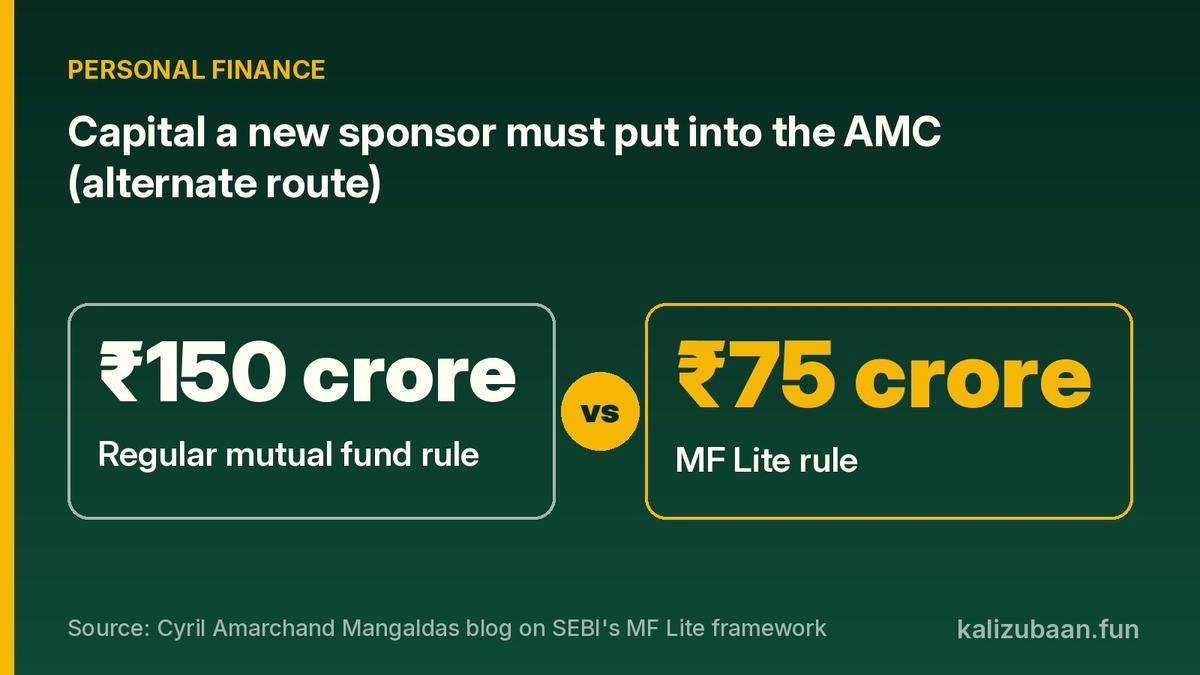
Source: Cyril Amarchand Mangaldas blog on SEBI's MF Lite framework
Under that route, the sponsor's initial stake is locked in for three years instead of five. The AMC itself needs a minimum net worth of ₹50 crore, and its key staff need combined experience of at least 20 years, as Cafemutual reports.
On the main route, for sponsors with a sound track record, the MF Lite AMC needs a net worth of ₹35 crore. It can be relaxed to ₹25 crore after five straight profitable years. The sponsor's average profit over five years must be at least ₹5 crore, down from ₹10 crore.
Which funds can come under MF Lite
Not every passive product qualifies. In phase one, the SEBI circular covers:
- Funds tracking broad domestic equity indices with collective AUM of ₹5,000 crore and above.
- Government securities, T-bill and SDL-based target maturity debt funds, plus certain constant duration debt index funds.
- All gold ETFs, silver ETFs and fund of funds based only on them.
- Certain overseas ETFs and single-index fund of funds.
Fund of funds that invest in more than one index are not covered in phase one. MF Lite AMCs are also not allowed to run any business other than managing passive schemes.
What changes for you as an investor
Mint's report notes that more competition could widen the choice of index funds and ETFs and put pressure on costs. But it also warns that lower expenses or better returns are not guaranteed just because more fund houses enter.
There are some built-in protections. Cafemutual reports that MF Lite AMCs must set up a unit holder protection committee and a risk management and investor protection framework. Before any change that affects your scheme or its fees, they must give written notice and let you exit at the current NAV without an exit load.
For passive schemes, the scheme document must show tracking error, tracking difference and the name of the benchmark index. Those three items tell you how closely a fund actually follows its index.
How to compare a new index fund or ETF
When MF Lite schemes do launch, judge them the same way you judge any passive fund:
- Expense ratio: in a passive fund, lower cost is most of the edge.
- Underlying index: make sure you know exactly which index it tracks.
- Tracking error: a lower number means the fund follows its index more closely.
- Liquidity and trading costs (for ETFs): a thinly traded ETF can cost you on the buy-sell spread.
Remember that passive funds still carry market risk. If the index falls, your fund falls with it.
FAQs
Can I invest in a 1 Finance mutual fund today? No. It has only in-principle approval. Schemes can launch only after SEBI grants final registration, and the target is the fourth quarter of FY27.
Is an MF Lite fund riskier than a regular index fund? MF Lite eases entry and compliance rules for the fund house. The scheme still tracks an index, so it carries the same market risk as any passive fund. Check the sponsor and the scheme's tracking record.
Will MF Lite make index funds cheaper? It could add competition, which may push costs down. Mint notes this is not guaranteed, so compare expense ratios yourself.
Can existing fund houses move their index funds to MF Lite? Yes, existing mutual funds can transfer eligible passive schemes to the MF Lite structure, subject to SEBI's conditions.
This article is for education only and is not investment, tax or legal advice.
Sources
- Mint: 1 Finance gets in-principle SEBI approval for MF Lite
- The Economic Times: 1 Finance gets in-principle approval for India's first MF Lite AMC licence
- CNBC TV18: 1 Finance gets SEBI in-principle approval for MF Lite AMC licence
- Cafemutual: MF industry to see entry of more passive funds players
- Cyril Amarchand Mangaldas: SEBI's Mutual Funds Lite Framework
- Wikipedia: Index fund
Tagged Topics
Keep reading



Thanks for reading Kali Zubaan
Explore more articles in Personal Finance or return to the main publication feed.


