7,000 Steps a Day Is Enough for Most: Why Your Knees Agree
A Lancet review of 160,000 adults found most step benefits level off near 7,000 a day. An orthopaedic surgeon says 5,000 to 7,000 is a kinder target for knees.
Your phone buzzes at 9 PM: "You're 3,000 steps short." So you pace the corridor till midnight, knees aching, chasing 10,000.
Here's the twist. A review of more than 160,000 adults found that most of the health benefit of walking had already arrived by about 7,000 steps a day. And an orthopaedic surgeon in Gurugram says 5,000 to 7,000 steps is a more practical aim for people worried about their knees.
Quick answer
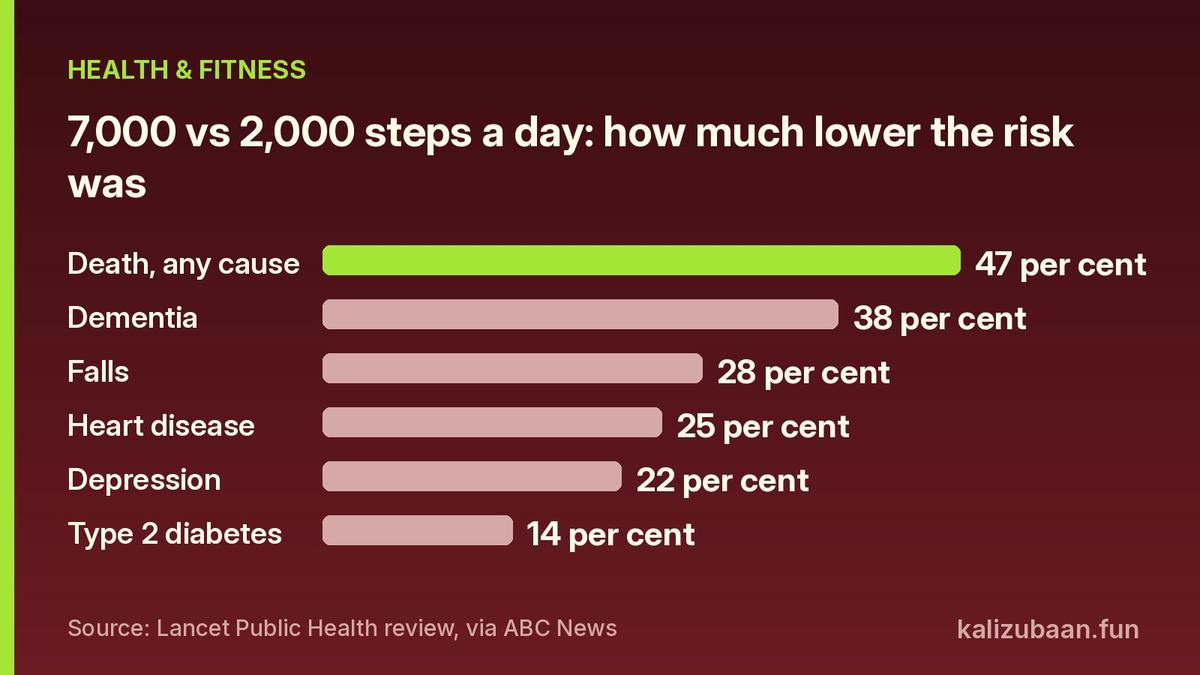
- Compared with 2,000 steps a day, 7,000 steps was linked to a 47 per cent lower risk of death from any cause in a Lancet Public Health review.
- For most outcomes, the benefits started to plateau around 7,000 steps.
- If your knees hurt, building up to 5,000 to 7,000 steps is a sustainable target, says Dr Gurdeep Avinash Ratra of Manipal Hospital, Gurugram.
- Strength work for the thighs and hips, a healthy weight and low-impact cardio matter as much as the step count.
Where did 10,000 steps even come from?
The 10,000 number feels scientific. It isn't, really.
National Geographic reports that scientists suspect the figure was created to market pedometers and was not based on actual data. As recently as 2020, experts writing physical activity guidelines did not have enough evidence to recommend a specific step target.
That left 10,000 as the public's holy grail, even as many people fell short. A University of Melbourne professor quoted by ABC News put it bluntly: the 10,000 goal is "not strictly evidence-based."
What the 160,000-person review found
The study, published in The Lancet Public Health and led by University of Sydney epidemiologist Melody Ding, pulled together 57 studies in which people wore step-counting devices.
The team compared people walking about 7,000 steps a day with people walking about 2,000. Here is how much lower the risks were in the 7,000-step group.
Source: Lancet Public Health review, via ABC News
Even 4,000 steps a day was linked to better health than 2,000. Benefits rose with each extra 1000 steps, then flattened.
After 7,000 steps, the risk of death from any cause was almost the same as at 10,000. Going all the way to 10,000 added an extra 7 per cent cut in dementia risk and an extra 8 per cent cut in type 2 diabetes risk. So more steps still help for a few conditions, but the gains get small.
The researchers flagged limits too. Only a few studies existed for outcomes like falls and cancer, so those findings are "exploratory". They also could not check how results differ for people with a higher BMI or for older adults.
Why more is not always better for your knees
Walking is low-impact, but it is not zero-impact. Dr Ratra told HT Lifestyle that more walking doesn't always mean better health, especially for people with knee osteoarthritis.
Knee osteoarthritis happens when the protective cartilage at the ends of the bones slowly wears away, so the bones rub against each other. It is common. Worldwide, osteoarthritis affected about 237 million people, or 3.3% of the population, as of 2015, according to Wikipedia's summary of the research.
Among people over 60, about 10% of men and 18% of women are affected. Ageing is the biggest risk factor, but extra body weight, old knee injuries, jobs with a lot of squatting or kneeling, and weak thigh muscles all raise the odds.
Warning signs your knees want you to slow down
Dr Ratra lists these signs:
- Knee pain during or after walking that keeps coming back
- Stiffness in the morning or after sitting for a long time
- Swelling around the knee
- Trouble climbing stairs or getting up from a chair
- A grinding, clicking or cracking feeling when you move
- Less flexibility, or weak muscles around the knee
- Pain even at rest, in advanced stages
If several of these sound familiar, that's a reason to see a doctor, not to push for a bigger number on your watch.
A practical step plan for Indian routines
You don't need a gym or a treadmill. You need a target you can repeat.
Start where you are. Instead of jumping straight to 10,000 steps, Dr Ratra suggests building up gradually to 5,000 to 7,000 steps.
Split it up. The WHO guide shared by HT says short bouts add up. A brisk 10-minute walk after lunch, the stairs at the metro station and an evening walk around the colony all count.
Think in minutes, not just steps. The WHO asks adults aged 18 to 64 for 150 to 300 minutes of moderate activity a week, or 75 to 150 minutes of vigorous activity.
Add strength twice a week. The WHO also asks for muscle-strengthening work on two or more days a week. Squats, push-ups and resistance bands are enough. Strong thighs, hips and legs absorb shock and support the knee, Dr Ratra says.
Mix in other low-impact cardio. Swimming and cycling keep joints moving without the same pounding.
Over 65? WHO adds balance training on three or more days a week, like yoga or single-leg stands, to cut fall risk.
Who should be careful
People who already have knee pain, swelling, an old ligament or cartilage injury, or a diagnosis of osteoarthritis or rheumatoid arthritis should ask a doctor or physiotherapist before raising their step count.
The same goes for anyone carrying extra weight. Extra body weight puts more stress on the knee and raises the chance of cartilage breaking down, so a gentler, gradual plan makes more sense.
Dr Ratra's other advice: get knee injuries like ligament tears treated early, since timely care can help stop long-term damage.
FAQs
Is 7,000 steps a day enough? For most outcomes in the Lancet Public Health review, yes. Benefits largely levelled off around 7,000 steps, though 10,000 gave small extra gains for dementia and type 2 diabetes.
Can walking too much damage my knees? Walking is good for joints, but more isn't always better if you have knee osteoarthritis or warning signs like persistent pain or swelling. A gradual build-up to 5,000 to 7,000 steps is more practical, says Dr Ratra.
Do steps count toward the WHO's 150 minutes? Brisk walking is moderate activity, and short bouts across the day add up to the WHO's weekly 150 to 300 minutes.
Should I stop walking if my knees hurt? Not necessarily, but don't push through pain. Talk to a doctor, and lean on strength work and low-impact options like swimming or cycling.
This article is for information only and is not medical advice. Talk to a doctor before changing your diet or training.
Sources
- Hindustan Times: Walking is great for overall health but more isn't always better for your knees
- ABC News: 7,000 steps a day linked to reduced risk of chronic disease and death
- National Geographic: Forget about 10,000 steps a day
- Hindustan Times: WHO's age-by-age exercise guide
- Wikipedia: Knee osteoarthritis
Tagged Topics
Keep reading

Thanks for reading Kali Zubaan
Explore more articles in Health & Fitness or return to the main publication feed.


