6.80% FD for 555 Days: Indian Bank Hikes Rates After Repo Hike
Indian Bank raised FD interest rates on its 555-day Ind Grow and 777-day Ind Prosper deposits by 15 basis points. New rates, senior citizen extras, tax and whether to lock in now.
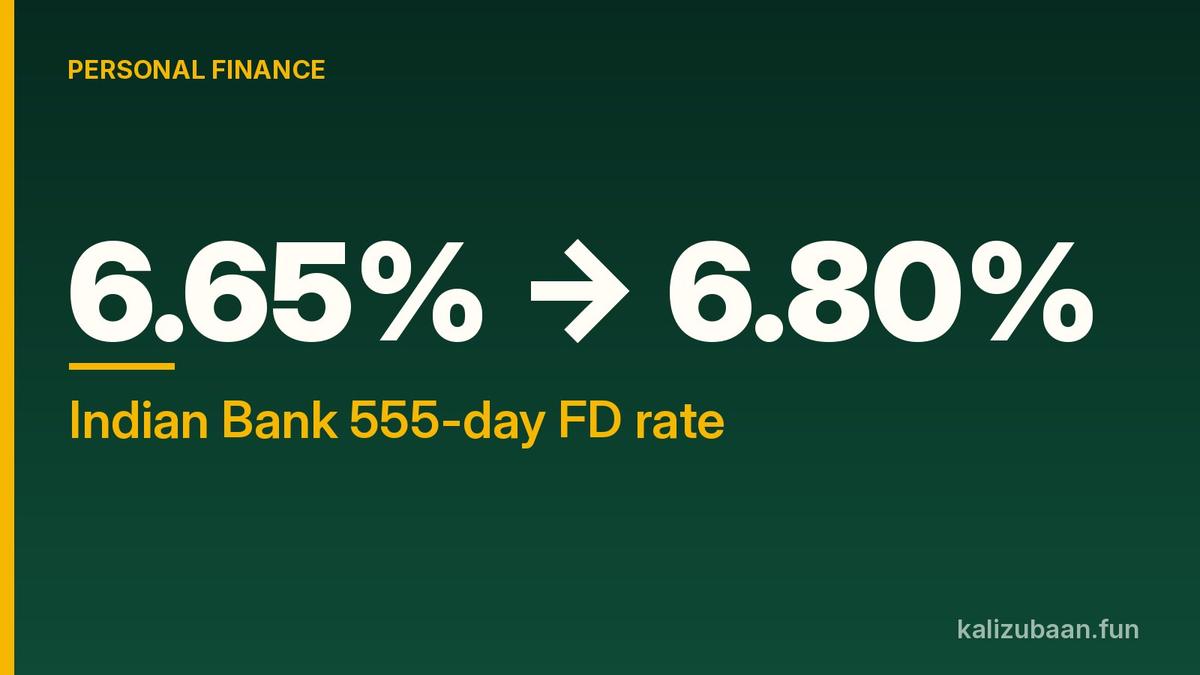
For the first time since February 2023, the RBI raised the repo rate this month. Now FD interest rates are starting to follow. Indian Bank has lifted its 555-day special deposit to 6.80% from 6.65%, and the new rate is already live. If you have money sitting in a savings account, this is the kind of change worth a few minutes of your time.
Quick answer
- Indian Bank raised rates by 15 basis points on two special FDs from October 23, 2026, Mint reports.
- The 555-day Ind Grow deposit now pays 6.80% a year, up from 6.65%.
- The 777-day Ind Prosper deposit now pays 6.75%, up from 6.60%.
- Senior citizens get an extra 0.5 percentage point, and super senior citizens an extra 0.75 percentage point, on these schemes.
Why FD rates are moving now
On October 7, the Reserve Bank of India raised the repo rate by 25 bps to 5.50% from 5.25%. Mint notes this is the first such increase since February 2023.
The repo rate is what banks pay to borrow from the RBI. When it goes up, money gets costlier for banks. To attract deposits, they often raise what they pay savers too.
Indian Bank is one of the first lenders to pass this on, at least on its special-tenure schemes. Rates on its other listed tenures remain unchanged.
But don't expect every bank to follow on the same day. Mint points out that the impact of a repo change on deposit rates is not always immediate or the same across banks. It depends on each lender's liquidity, funding needs and competition.
The new Indian Bank FD rates
Here is what changed for general customers.
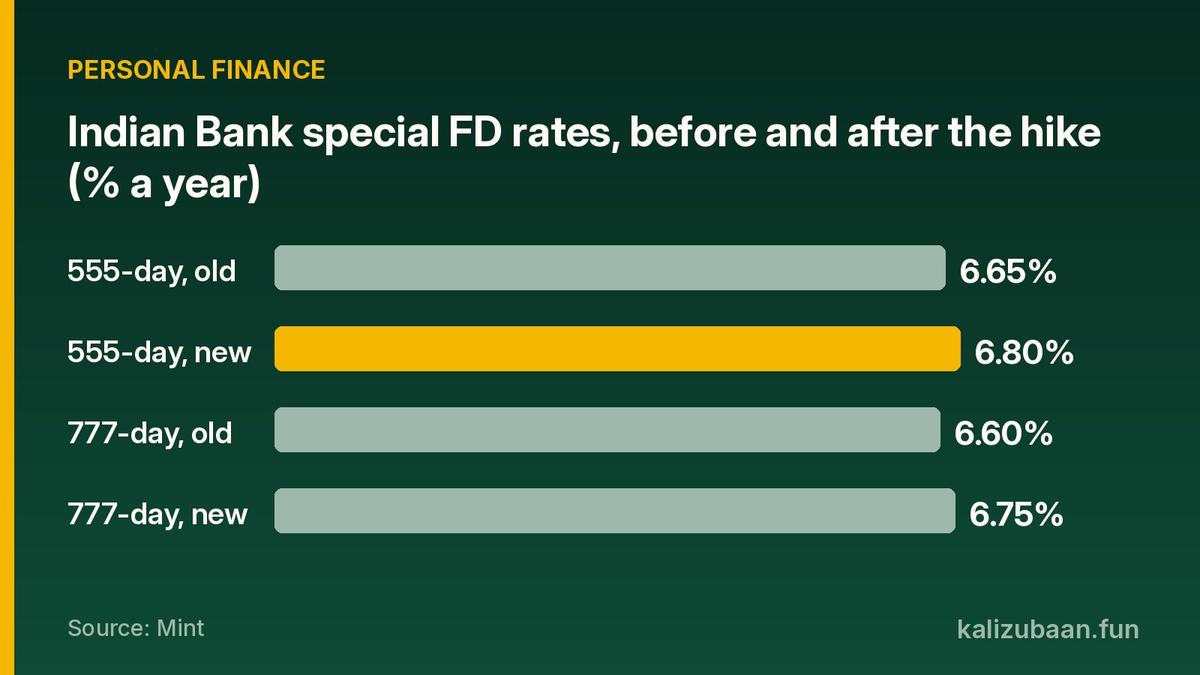
Source: Mint
Ind Grow (555 days): 6.80% a year, up from 6.65%.
Ind Prosper (777 days): 6.75% a year, up from 6.60%.
Notice something odd? The shorter 555-day deposit pays more than the longer 777-day one. That is not a mistake. Wikipedia's explainer on fixed deposits notes that a bank may offer a lower rate for a longer period if it expects rates to dip in the future.
For you, it means a longer lock-in is not automatically better. Always compare the exact tenures a bank is pushing.
Who should look at these deposits
These schemes make the most sense for a few kinds of savers.
- Retirees and older parents. The extra 0.5 percentage point for senior citizens, and 0.75 percentage point for super senior citizens, can make these special deposits attractive for predictable income.
- People with a known goal about 1.5 to 2 years away. A wedding, a car down payment or college fees. A fixed tenure matches a fixed date.
- Savers parked in a savings account. FDs pay a higher interest rate than a regular savings account in exchange for locking your money in.
If you may need the cash suddenly, think twice. Special-tenure deposits are built for people who can leave the money alone till maturity.
What to check before you book
Mint lists a few things to verify on Indian Bank's official website or at a branch before you invest.
- The exact rate on the day you book. Rates can change again. Your FD locks in the rate on the booking date.
- Callable or non-callable. Callable FDs may allow premature withdrawal, but the bank can charge a penalty and recalculate interest for the period the money stayed in. Non-callable FDs generally have stricter limits on early withdrawal.
- Eligibility. Confirm whether you qualify for the senior or super senior extra.
- Cumulative or payout. In a cumulative FD, interest is reinvested and paid at maturity. In a simple FD, interest is usually paid out every three months, as Wikipedia explains.
- Other banks' offers. Compare public sector banks, private lenders and small finance banks before you decide.
Don't forget the tax
FD interest is not tax-free. It is taxed at your income tax slab rate.
Tax may also be deducted at source if your interest crosses ₹50,000 a year for general citizens, or ₹1,00,000 a year for senior citizens, according to Mint.
If your total income is below the taxable limit, Wikipedia notes you can submit Form 15G (below 60 years of age) or Form 15H (60 and above) to the bank to avoid TDS. Do this at the start of each financial year.
Common mistakes to avoid
- Chasing the longest tenure. Here, the 555-day deposit pays more than the 777-day one.
- Breaking the FD early. If a deposit is withdrawn early, interest is paid at the rate applicable for the shorter period, and a penalty may apply. Wikipedia gives the example of a 5-year deposit at 8% withdrawn after 2 years, paid at 5 percent instead.
- Ignoring TDS. Submit Form 15G or 15H on time if you qualify, or claim the tax back in your return.
- Forgetting auto-renewal. Many banks renew a matured FD at whatever rate applies on the renewal date, not your old special rate.
- Putting emergency money in a long FD. Keep a separate cushion you can reach easily.
FAQs
Has Indian Bank changed all its FD interest rates? No. Mint reports only the 555-day Ind Grow and 777-day Ind Prosper special deposits were revised. Other tenures are unchanged.
From when do the new rates apply? From Friday, October 23, 2026.
Will other banks raise FD rates too? Possibly, but not on a fixed timeline. After the October 7 repo hike, each bank decides based on its own funding needs and competition.
Can I take a loan instead of breaking my FD? Many banks offer loans against FDs, often up to 80 to 90 percent of the deposit value, at 1 to 2 percent above the deposit rate, per Wikipedia. Check your bank's actual terms.
This article is for education only and is not investment, tax or legal advice.
Sources
Tagged Topics
Keep reading
Thanks for reading Kali Zubaan
Explore more articles in Personal Finance or return to the main publication feed.


