40x, Yet 1 in 10 Odds: How to Check IPO Subscription Status
Here is how to check IPO subscription status on NSE, BSE or your broker app, what QIB, NII and retail multiples mean, and why 40 times subscribed can still mean 1 in 10 odds for you.
An IPO can be subscribed 40 times and still give a retail applicant a 1 in 10 chance of getting shares. That gap confuses almost everyone who refreshes a subscription page during IPO week.
The fix is simple once you know where the numbers come from, what each category means and which number actually decides your allotment.
Quick answer
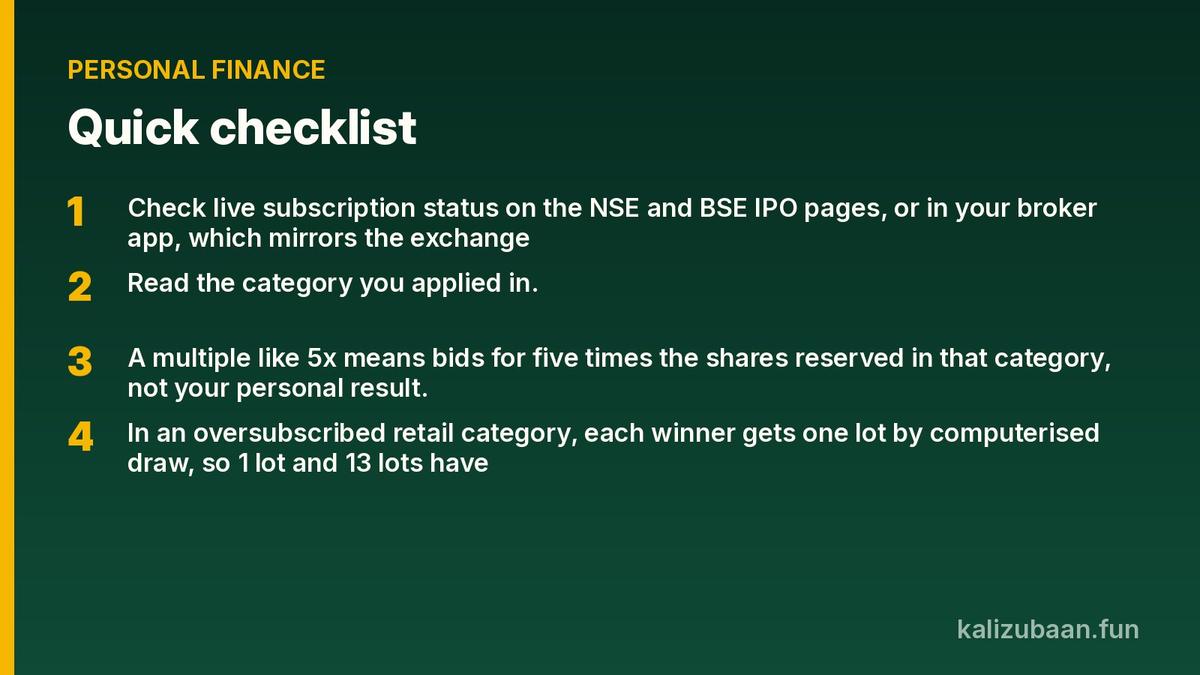
- Check live subscription status on the NSE and BSE IPO pages, or in your broker app, which mirrors the exchange data.
- Read the category you applied in. Retail means bids up to ₹2 lakh; NII means above ₹2 lakh; QIB means institutions.
- A multiple like 5x means bids for five times the shares reserved in that category, not your personal result.
- In an oversubscribed retail category, each winner gets one lot by computerised draw, so 1 lot and 13 lots have the same chance.
This guide is for education only and is not investment advice. Check the offer document and, if you need help, a SEBI-registered adviser before you apply for any IPO.
How do you check IPO subscription status?
You check IPO subscription status on the NSE or BSE IPO pages, or in the IPO section of your broker app, by picking the open issue and reading its category-wise multiples.
The exchanges are the original source. Rupeezy notes that the NSE and BSE websites publish live, category-wise numbers throughout the bidding window, and that most broker platforms mirror this data, so you do not have to visit the exchange directly (Rupeezy).
Here is the routine that works for any mainboard or SME issue:
- Open the IPO page on NSE or BSE, or the IPO tab in your broker app.
- Select the issue that is open for bidding.
- Read the total multiple, then the separate rows for QIB, NII, retail and any employee or shareholder quota.
- Note the time of the update. Figures move fast, especially on the last day.
- Come back after the issue closes for the final figure.
5paisa lists the same set of places: the NSE or BSE websites, recognised financial websites, the registrar's website for issue-related updates and your broker's platform (5paisa). It also points out that a mainboard issue is usually open for 3 working days, while an SME issue can run for 4-5 working days.
Third-party trackers are fine for a quick look. IPO Market, for example, says its own tracker updates every 15 minutes during market hours, while NSE and BSE publish updated data at regular intervals through each bidding day. If two sites disagree, trust the exchange.
If you are new to IPOs in general, start with our complete guide to investing in IPOs in India, then come back to this page during the bidding window.
What do QIB, NII and retail subscription numbers mean?
Each row shows demand from one group of investors against the shares reserved only for that group, so a 20x QIB row and a 3x retail row describe two separate contests.
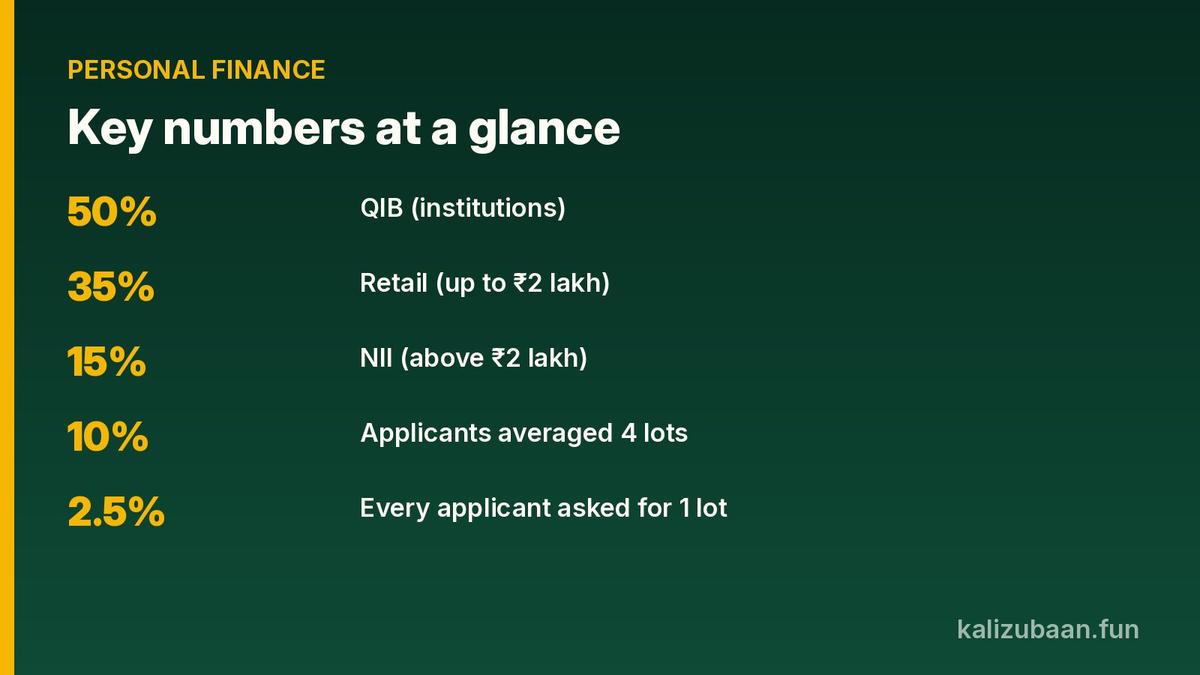
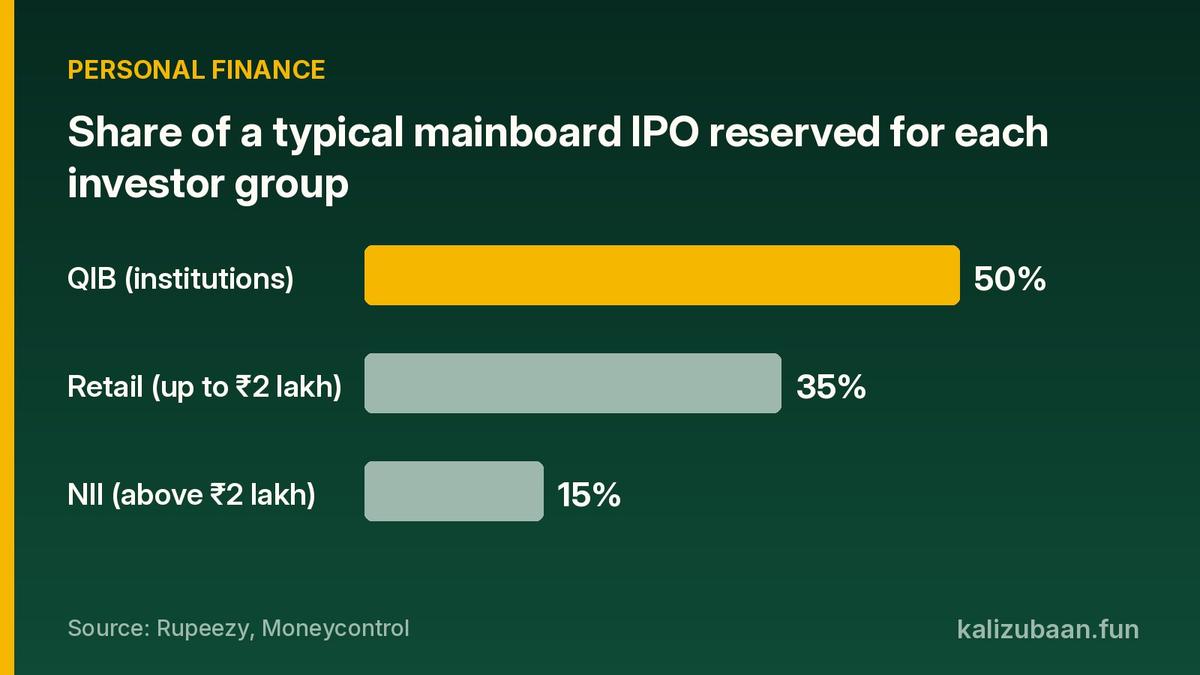
In a typical mainboard book-built issue, QIBs get 50%, non-institutional investors usually get 15%, and retail individual investors get the remaining 35% (Rupeezy). Moneycontrol describes the same split: 35 percent for retail, 15 percent for NIIs and up to 50 percent for QIBs, including the anchor book (Moneycontrol).
Source: Rupeezy, Moneycontrol
What each group is:
- Retail (RII): individuals applying for up to ₹2 lakh. This is where most first-time investors sit.
- NII: individuals, companies and others applying for more than ₹2 lakh. Since April 2022, one third of the NII part is for applications up to ₹10 lakh (small NII, or sNII) and two thirds for larger ones (big NII, or bNII), according to TradingMaths.
- QIB: mutual funds, insurers, banks and foreign portfolio investors. Part of their share can go to anchor investors, who are allotted shares one working day before the issue opens.
- Employee and shareholder quotas: small reserved slices in some issues. Groww notes these can still matter in certain issues (Groww).
The split is the reason one IPO can show very different numbers at the same moment. Groww gives the example of an issue showing 2x in retail, 12x in NII and 18x in QIB together.
Be careful with old explainers on NII. Some still say NII shares are spread proportionately. Since April 2022, each NII winner gets the minimum NII application size, the fewest lots worth more than ₹2 lakh, and a draw of lots picks the winners when demand is high.
How do you read a times-subscribed number?
A times-subscribed number is total shares bid for divided by total shares offered in that category, so 3x means bids for three times the reserved shares.
Groww puts the formula plainly: subscription ratio equals total shares bid for divided by total shares offered. Its example has 10 lakh retail shares on offer and bids for 30 lakh shares, which makes the retail portion 3x subscribed (Groww).
Take a sample update from IPO Market:
| Category | Subscription |
|---|---|
| QIB | 23.45x |
| sNII | 12.80x |
| bNII | 45.67x |
| Retail | 8.34x |
| Total | 18.92x |
Reading it row by row, institutions bid for 23.45 times their quota, small HNIs for 12.8 times and large HNIs for 45.67 times. Retail bids came to 8.34 times the retail quota. The total says the whole issue drew bids for nearly 19 times the shares on offer.
The total is the least useful row for a retail applicant. It mixes institutional, HNI and retail demand into one figure, and the bNII row can be inflated by borrowed money. IPO Market says many bNII applicants use IPO financing at 10-16 percent annualised interest for 7-10 days.
Timing matters too. IPO Market describes a common pattern:
- Day 1: eager retail investors apply; QIB and NII numbers are low, and total subscription is often only 0.5x to 2x.
- Day 2: more retail and NII bids arrive; popular issues often reach 3x to 8x.
- Day 3: QIBs place most of their bids, often in the last few hours.
Final numbers come out 1-2 hours after the issue closes, and small revisions can follow as applications are validated or rejected. So a low QIB figure on day one is normal, not a warning sign.
A real example from Groww's live table shows why you should read each row. Antala Industries, an SME issue that closed on 05 Nov 2026, showed QIB at 66.72x but retail at only 5.10x, with a total of 12.09x.
What does retail subscription mean for your allotment chances?
Your chance is the number of retail lots available divided by the number of valid retail applications, which is usually better than one divided by the times-subscribed figure.
TradingMaths explains the rule: when retail bids exceed the shares, each winning applicant gets the minimum lot, and a computerised draw picks the winners. The number of winners is the retail shares divided by the lot size, and the chance for one application is that number divided by the valid applications (TradingMaths).
Its worked example:
- Company ABC keeps 35,00,000 shares for retail in lots of 50 shares, which is 70,000 lots.
- Retail is subscribed 40 times: bids for 28,00,000 lots.
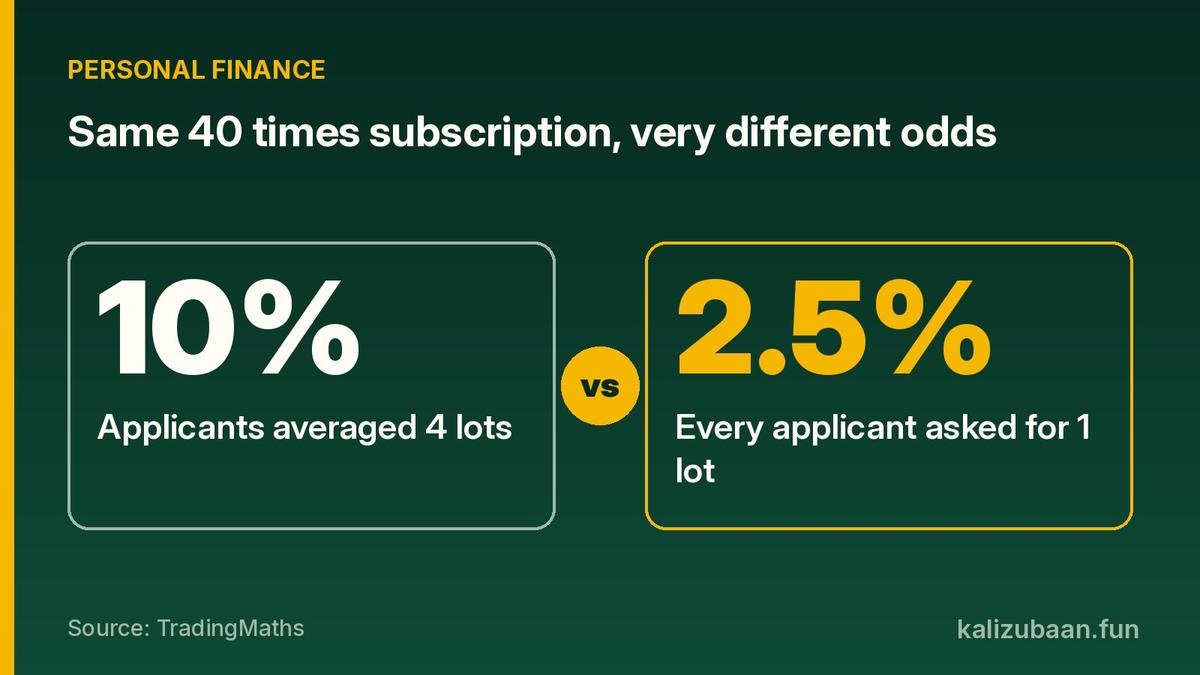
- The basis of allotment shows 7,00,000 valid retail applications, asking for 4 lots each on average.
- The chance for one application is 70,000 divided by 7,00,000, or 10%.
If every applicant had asked for just one lot, the chance at 40 times would have been 2.5%, the lowest it can be at that level.
Source: TradingMaths
Moneycontrol's real-world example points the same way. In the CAMS IPO, the retail portion was bid 5.55 times over: 63,22,435 shares were set aside for retail, bids came in for 3,50,98,056 shares and one lot was 12 shares (Moneycontrol). That left room for 5,26,869 allottees against 21,08,682 applications, an allotment ratio of 4:1.
What most guides miss: the popular shortcut of "one in the times-subscribed figure" is only the worst case. CAMS retail was 5.55 times subscribed, yet the real ratio was one winner in four applications, because many applicants asked for more than one lot. So during bidding, the retail multiple tells you the floor of your odds, and the application count in the basis of allotment tells you the real number.
What is the difference between subscription status and allotment status?
Subscription status is market-wide demand while bidding is open; allotment status is your own result after the issue closes, checked with your PAN or application number.
Rupeezy sets them side by side. Subscription updates live during the 3 to 5 day bidding window on NSE, BSE and broker apps. Allotment is finalised after the issue closes, typically the next working day, on the registrar's website or the NSE and BSE status pages (Rupeezy).
Groww adds a third term, application status, which only confirms that your bid was recorded correctly. An IPO can be subscribed 20x, your application can be valid, and you can still get no shares.
The timeline is short now. Since 1 December 2023, issues must list within three working days of closing, according to TradingMaths:
- T: the issue closes; the last bids and UPI approvals come in.
- T+1: the basis of allotment is finalised and the result can be checked.
- T+2: shares reach the demat accounts of those allotted; blocked money is released for the rest.
- T+3: the shares list and start trading.
If you are not allotted, you do not need to ask for a refund. Rupeezy says unsuccessful applicants get their blocked ASBA funds released automatically. We walked through a real result check in our BLS Polymers IPO allotment status guide.
What should you do with the subscription number?
Use it to judge demand and set realistic expectations about allotment, not as proof that the company is good or that the listing will be strong.
Rupeezy warns that a hot subscription number reflects demand, not quality, and that plenty of oversubscribed IPOs have listed flat or below the issue price (Rupeezy). Groww makes the same point: high subscription does not guarantee allotment or listing gains.
A practical checklist:
- Apply for one lot if you are in retail and expect heavy demand. IPO Market notes that 1 lot has the same chance as 13 lots, the most that fits under the ₹2 lakh limit, and blocks far less money.
- Bid at the cut-off price. Retail investors can agree to pay whatever issue price is fixed inside the band; the bank blocks money at the top of the band.
- Use one application per PAN. Two applications under the same PAN count as multiple applications, and all of them can be rejected.
- Separate family applications help, but each blocks money. TradingMaths works out that three applications from three family members, each with a 10% chance, give a 27.1% chance that at least one gets a lot.
- Do not rush on day one. Bidding early does not improve your odds; only a valid bid at or above the cut-off price counts.
- Watch QIB demand, but read the business too. Low institutional interest near the close is worth noting, but valuation, risks and the offer document still matter more.
Also remember the floor. Moneycontrol notes that SEBI wants an issue subscribed at least 90 percent for it to list; if it falls short, the IPO is scrapped and money goes back to bidders. If you want to understand the payment side, our explainer on the ₹5 lakh UPI cap for IPO bids covers it.
FAQs
Where can I check live IPO subscription status?
On the NSE and BSE IPO pages, or in the IPO section of your broker app, which mirrors the exchange data. Third-party trackers are handy, but the exchange figure is the reference.
What does 10x subscribed mean in an IPO?
It means investors bid for ten times the shares on offer in that category. It describes total demand, not how many lots any single person applied for.
Does applying for more lots increase my IPO allotment chances?
Not in an oversubscribed retail category. Each winner gets one lot by computerised draw, so 1 lot and 13 lots have the same chance; more lots only block more money until T+2.
When is the final IPO subscription status available?
IPO Market says NSE and BSE publish final numbers 1-2 hours after the issue closes, with minor revisions possible over the next day.
Is subscription status the same as allotment status?
No. Subscription status is live market demand while bidding is open. Allotment status, out on T+1, shows whether your own application got shares.
Expert review: pending.
This article is for education only and is not investment advice. IPO investments carry market risk; read the offer document carefully before you apply.
Related reading
- How to Invest in IPO in India: Allotment, GMP and Tax
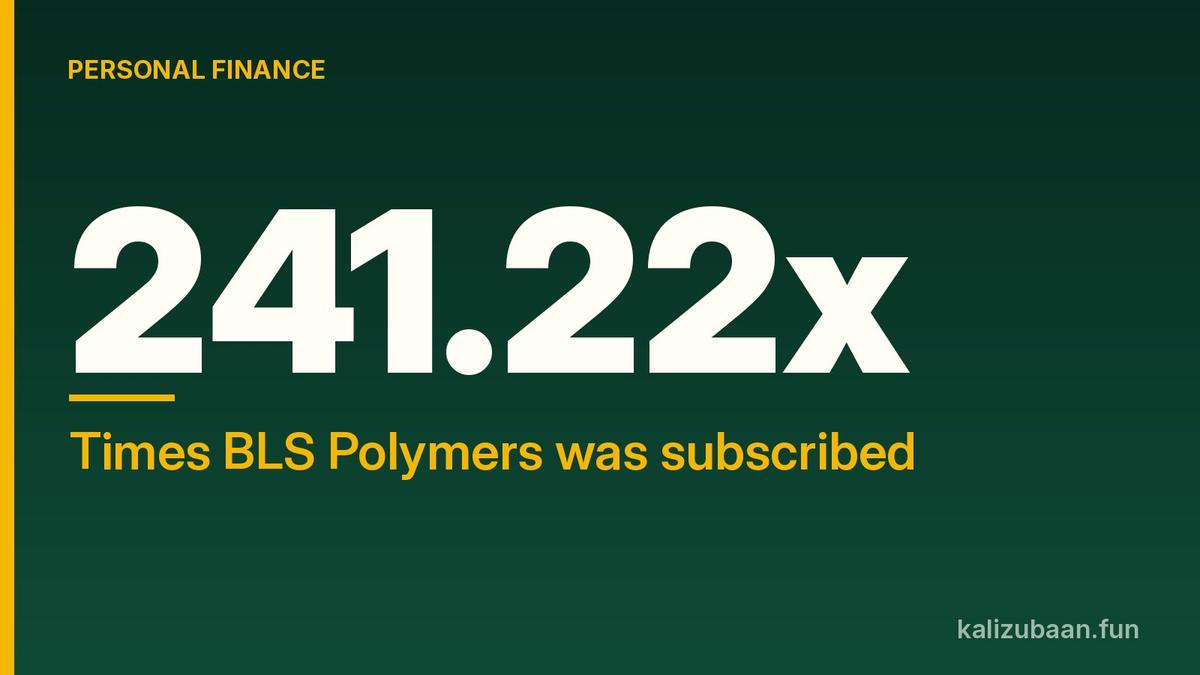
- 241x Subscribed: BLS Polymers IPO Result and Allotment Status
- Jio IPO Last Day: 5.82x Subscribed, but Retail Only 1.67x. Apply?
Sources
- Groww: IPO Subscription – Check IPO Subscription Status Online
- IPO Market: IPO Subscription Status 2026 — How to Read QIB, NII, Retail Data
- Rupeezy: IPO Allotment vs Subscription Status: What's the Difference?
- Moneycontrol: Explained | IPO allotment: How are shares allotted when an IPO is oversubscribed
- 5paisa: Live IPO Subscription Status
- TradingMaths: How IPO Allotment Works: Categories, Lottery and T+3
Tagged Topics
Keep reading


Thanks for reading Kali Zubaan
Explore more articles in Personal Finance or return to the main publication feed.


