₹5 Lakh UPI Cap: IPO Full Form in Share Market
IPO means Initial Public Offering — a private company selling shares to the public for the first time. Here is the full form, how book building works, the ₹5 lakh UPI cap, and how allotment fits in.

IPO full form in the share market is Initial Public Offering: the first time a private company sells ownership shares to the public and gets listed on an exchange.
That one expansion answers the search most beginners type. The rest of this guide walks through what happens after the letters — primary vs secondary market, book building, the ₹5 lakh UPI bid limit, and how allotment works — with rules from SEBI and NSE.
Quick answer
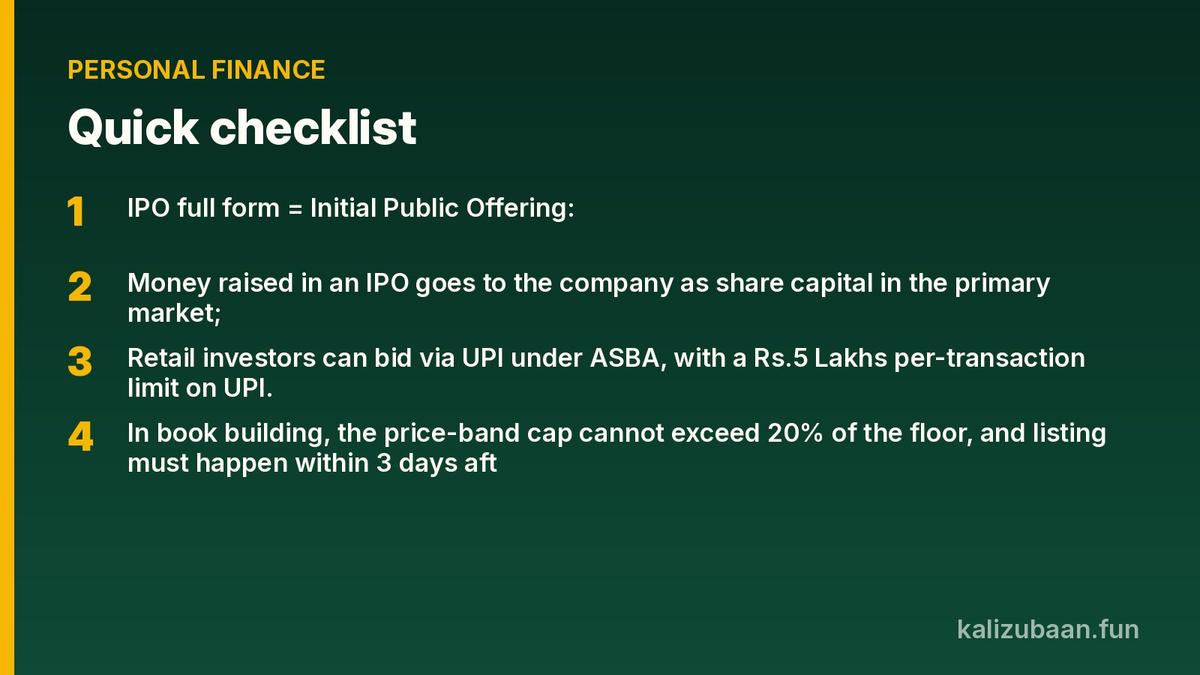
- IPO full form = Initial Public Offering: a private company offers shares to the public for the first time.
- Money raised in an IPO goes to the company as share capital in the primary market; later buying and selling happens in the secondary market.
- Retail investors can bid via UPI under ASBA, with a Rs.5 Lakhs per-transaction limit on UPI.
- In book building, the price-band cap cannot exceed 20% of the floor, and listing must happen within 3 days after closure.
This is general education about how IPOs work in India, not a recommendation to buy or sell any issue; check with a SEBI-registered adviser before you invest.
What is the IPO full form in the share market?
IPO full form is Initial Public Offering — the process where a privately held company becomes publicly traded by offering its shares to the public for the first time.
Angel One states the same expansion clearly: IPO means Initial Public Offering, and through that offer the company gets its name listed on the stock exchange (Angel One).
Zerodha's glossary frames the timeline in three stages: before an IPO the company is private; during the IPO it offers ownership shares to anyone who can apply; after listing, investors can buy and sell those shares on the stock market through a broker (Zerodha Support Portal).
When people search "ipo full form in share market", they usually want that expansion plus the India process — SEBI filings, price band, ASBA/UPI, allotment and listing — not a one-line dictionary answer.
How does an IPO sit in the primary vs secondary market?
An IPO is a primary-market sale: the company sells securities to the public, and the money flows to the company as share capital; later trading happens in the secondary market.
NSE describes the capital market as two linked parts — the primary market for new issues and the secondary (stock) market for ongoing trading — and defines an Initial Public Offer as selling securities to the public in the primary market (NSE India).
NSE also notes that after the first IPO, shareholders can exit through the secondary market. That is why brokers, Demat accounts and exchange sessions matter after listing, even though the original offer was a one-time primary issue.
For a full walk-through of application, GMP and tax after you understand the full form, use our pillar guide How to Invest in IPO in India: Allotment, GMP and Tax.
What is book building, and what do the 20% and ₹120-₹144 numbers mean?
Book building lets investors bid inside a price band so the company can discover a cut-off price from demand; SEBI caps that band at 20% above the floor.
Angel One says that in a book-building offering the stock price is offered in a 20 per cent band and investors bid within that range (Angel One). SEBI's investor page states the same rule in percent terms: the price band cap cannot exceed 20% of the floor price (SEBI).
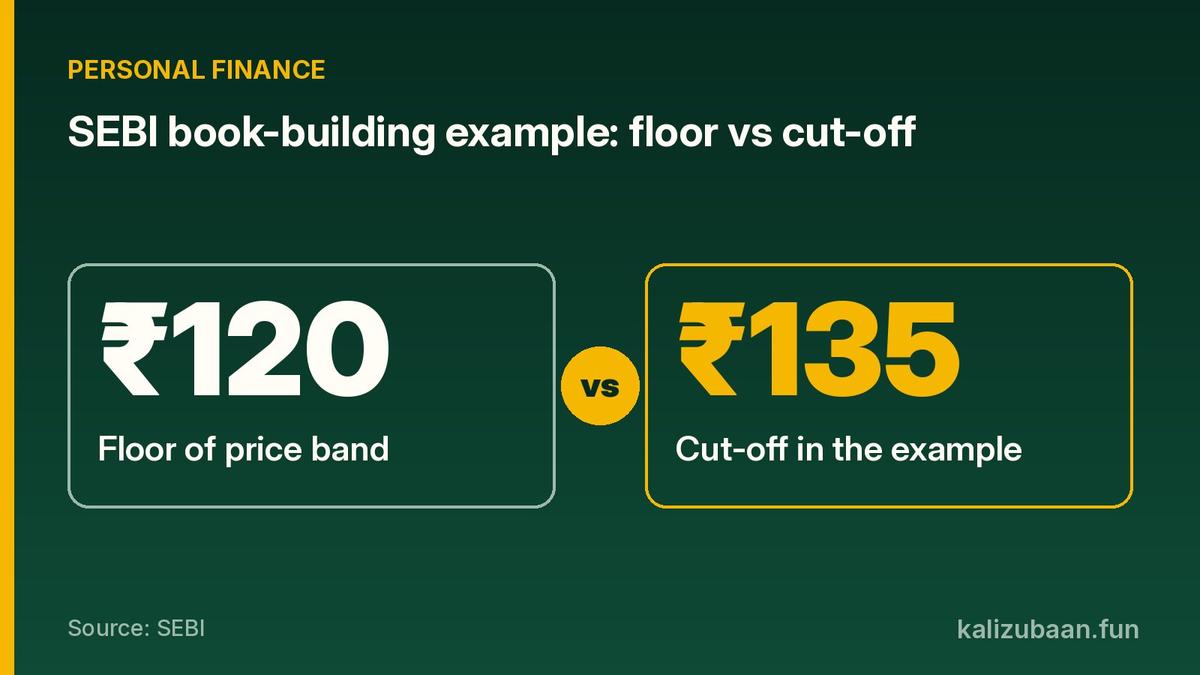
SEBI's worked example uses a price band of ₹120-₹144 for 5,000 shares, with the cut-off set at ₹135 — the lowest price at which all shares are fully subscribed — so bids at ₹135 and above receive shares in that example (SEBI).
Source: SEBI
What most guides miss: SEBI's own example puts the band at ₹120-₹144 while also stating the cap cannot exceed 20% of the floor. The textbook numbers and the 20% rule are the same idea written two ways — many full-form posts quote only one of them.
Retail investors can often bid at the cut-off price so they receive shares at whatever final price the book discovers, instead of guessing a number inside the band.
What is the ₹5 lakh UPI limit when you apply for an IPO?
For retail investors using UPI under ASBA, SEBI sets the IPO application limit at Rs.5 Lakhs per transaction.
SEBI's ASBA-through-UPI page states that the limit for IPO application is Rs.5 Lakhs per transaction on UPI and is available only for retail individual investors (SEBI).
The same page warns that a third-party UPI ID or a third-party bank account will not be considered for allocation, and that you should use only SCSB banks and UPI apps listed on SEBI's site. The money is blocked, not debited up front — that is the ASBA idea — and unblocked if you get no allotment.
NSE's e-IPO FAQs also note category rules that now talk about an Individual Investor who applies for 2 lots with a minimum application size of above Rs 2 lakhs under the amended SEBI ICDR framework (NSE India). Read the current RHP for each issue; category labels and lot maths can change with the circular in force.
When do shares list, and what about allotment and lock-ins?
After an IPO closes, SEBI expects listing on NSE or BSE within 3 days, while oversubscription means you may get fewer shares than you applied for.
SEBI's book-building page says the IPO must be listed on a recognized stock exchange (NSE/BSE) within 3 days after closure (SEBI). If demand is above the offer size, allotment can be lottery or pro-rata depending on the rules Zerodha lists under oversubscription (Zerodha Support Portal).
Anchor investors face a lock-in: 50% for 30 days and 50% for 90 days on SEBI's page (SEBI). That lock-in is about anchors, not every retail allottee — another detail many full-form explainers skip.
NSE also notes one bid per PAN in its e-IPO FAQs, so multiple apps under the same PAN are a technical-rejection risk (NSE India).
FAQs
What is the IPO full form in share market?
IPO full form is Initial Public Offering — the first public sale of a private company's shares, after which the stock can trade on exchanges such as NSE and BSE.
Is IPO a stock or a share?
IPO is the process of offering shares, not a stock ticker by itself. After listing, those shares trade like any other equity on the secondary market.
What does the ₹5 lakh UPI limit mean?
SEBI caps retail IPO applications via UPI at Rs.5 Lakhs per transaction. Larger bids may need other ASBA channels your bank or broker supports.
How is the IPO price decided in book building?
Investors bid inside a price band. The company and its book-running lead manager set a cut-off from demand; SEBI says the band cap cannot exceed 20% of the floor price.
Expert review: pending.
This article is for education only and is not investment, tax or legal advice.
Related reading
- How to Invest in IPO in India: Allotment, GMP and Tax
- 241x Subscribed: BLS Polymers IPO Result and Allotment Status
- ₹14,985 per Lot: EAAA IPO Dates, Allotment Check and GMP Truth
Sources
Tagged Topics
Keep reading



Thanks for reading Kali Zubaan
Explore more articles in Personal Finance or return to the main publication feed.