Part of our guide: IPO Investing in India
How to Invest in IPO in India: Allotment, GMP and Tax
A plain guide to applying for an IPO in India through UPI or ASBA, how the allotment lottery works, what GMP really tells you, the T+3 listing timeline and how listing gains are taxed.

Before HDB Financial had even announced its price band, its shares were changing hands at ₹1,225 in the grey market, Mint reported. The upper end of the band later came in at ₹740, and the grey market premium fell by 40%. That gap is a good first lesson about IPOs: the buzz you hear before an issue opens is not the price you pay, and it is not the price you will get on listing day.
This guide walks you through the whole process in order. You will learn what you need before you apply, how bidding works, who gets shares when an issue is oversubscribed, how far to trust GMP, what happens in the days after the issue closes, and how your listing gain is taxed.
Quick answer
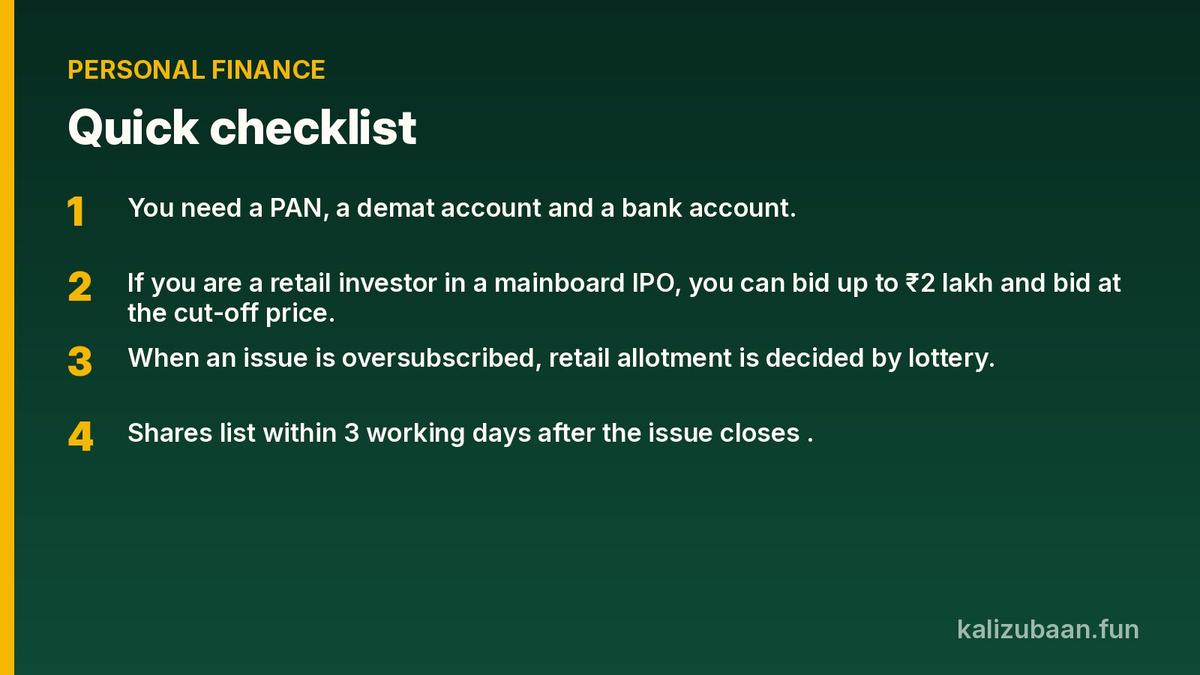
- You need a PAN, a demat account and a bank account. You apply through your broker's app using a UPI mandate, or through your bank's net banking using ASBA.
- If you are a retail investor in a mainboard IPO, you can bid up to ₹2 lakh and bid at the cut-off price. One application per PAN.
- When an issue is oversubscribed, retail allotment is decided by lottery. You get at most one lot if you win, so applying for more lots does not improve your odds.
- Shares list within 3 working days after the issue closes (T+3). If you sell within 12 months, the gain is taxed as short-term capital gain at 20%.
This is general education, not investment advice and not a recommendation to apply for any IPO. Check with a SEBI-registered adviser before you invest.
How to invest in IPO in India, step by step
To invest in an IPO in India, open a demat account, choose the issue, bid through your broker with a UPI mandate or through your bank with ASBA, approve the mandate, and then check allotment.
SEBI describes the UPI route in three steps: you place the bid, the amount is blocked in your bank account, and it is debited only if shares are allotted to you (SEBI investor site).
Here is the full sequence in practice:
- Get the basics ready. You need a PAN, a demat account with a broker, and a bank account that supports UPI or net banking ASBA.
- Read the issue details. Check the price band, lot size, issue dates and the objects of the issue in the red herring prospectus (RHP).
- Place your bid. In your broker's app, enter the number of lots and your UPI ID. Retail investors in a mainboard IPO can tick "cut-off price".
- Approve the UPI mandate. A request appears in your UPI app. Until you accept it, your bid is not complete.
- Wait for allotment. The money stays in your account, blocked, until the basis of allotment is finalised.
- Check status and listing. Check your allotment with the registrar, then watch for the shares in your demat account before listing day.
A few rules trip up first-timers. SEBI says the UPI limit for IPO bids is Rs.5 lakh per transaction, and applications made with a third-party UPI ID or bank account are not considered. Use your own UPI ID, linked to a bank account in your own name, through a bank and app that SEBI lists as eligible.
If you prefer not to use UPI, you can apply through your bank's net banking. NSE explains that under ASBA, the bank verifies the application, blocks the bid amount, uploads the bid to the exchange system and unblocks the money once the basis of allotment is finalised (NSE: ASBA procedure). ASBA has been mandatory for public issues since 2016, so the old practice of sending a cheque with a form is gone.
Timing matters on the last day. For SME IPOs, NSE's FAQ says bidding closes at 4:00 PM and UPI mandates must be confirmed by 5:00 PM. Do not leave the mandate for the final hour, because a missed approval means no application.
How the price band, lot size and cut-off price work
Most Indian IPOs are book-built: the company sets a price band, investors bid within it, and the final issue price is fixed after bidding closes.
SEBI's investor page says the cap of the price band cannot be more than 20% above the floor, and if the band is revised, the issue must stay open for at least 3 more days (SEBI: book building).
SEBI gives a simple example. Say the band is ₹120-₹144 and the final price is set at ₹135. Bids at or above ₹135 are valid. Bids below ₹135 get no shares.
That is why the cut-off option exists. When you bid at cut-off, you agree to pay whatever final price is fixed within the band. Your broker blocks the amount at the top of the band, and any excess is released after allotment. For most retail investors, bidding at cut-off is the simplest way to avoid a rejected bid.
The lot size is the minimum number of shares you can apply for. You can only bid in whole lots. The RHP and your broker's app show the lot size and the value of one lot at the upper end of the band.
The price band and lot size also tell you whether you count as retail. In a mainboard IPO, a retail application must stay within ₹2 lakh. If the value of your bid goes above that, it is treated as a non-institutional (NII) bid with different rules.
Who gets IPO shares: investor categories and quotas
Every IPO splits its shares between categories, and the category you apply in decides your chances, your limits and whether you can bid at cut-off.
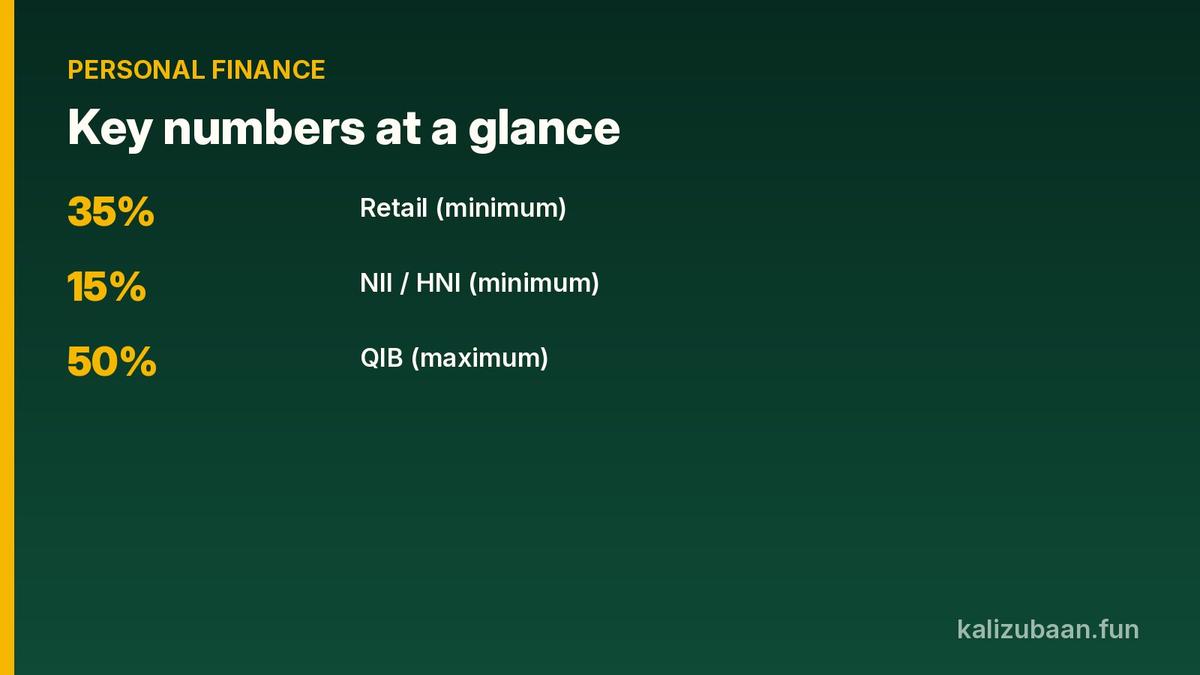
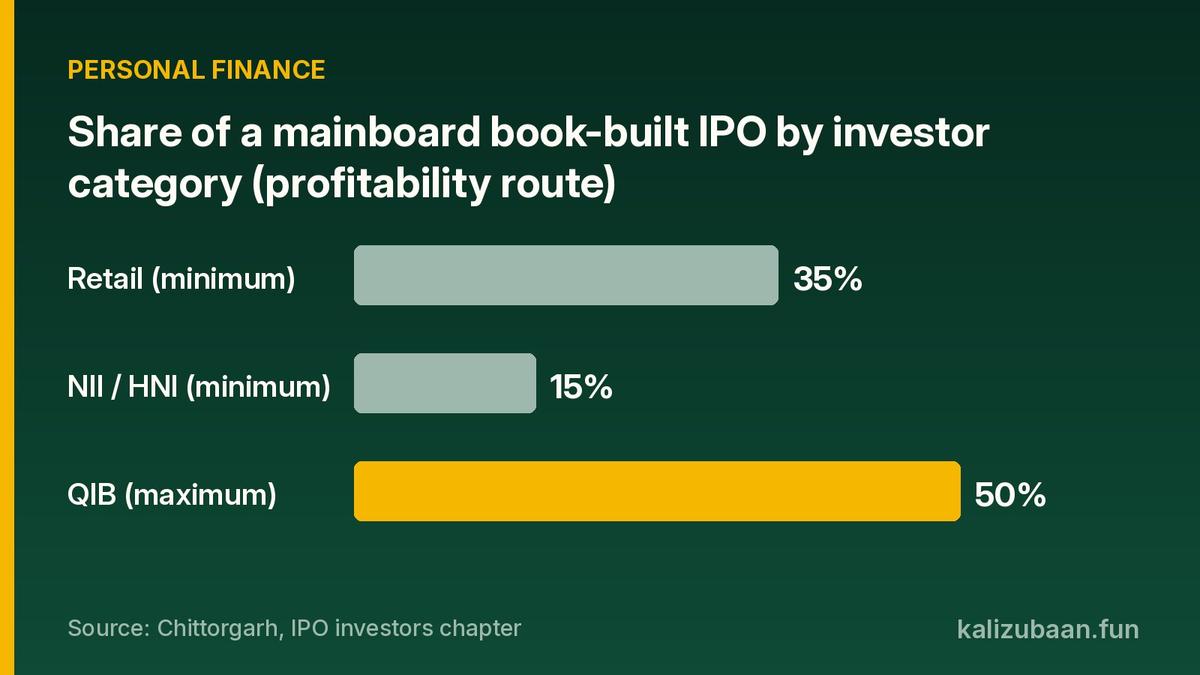
Chittorgarh's guide to investor categories notes that in a book-built mainboard IPO on the profitability route, retail gets not less than 35%, NIIs not less than 15% and QIBs not more than 50% (Chittorgarh: IPO investors).
Source: Chittorgarh, IPO investors chapter
Here is what each category means for you:
- Retail individual investors (RII): individuals, NRIs and HUFs bidding up to ₹2 lakh in a mainboard IPO. They can bid at cut-off and can withdraw bids while the issue is open.
- Small NII (sNII): bids from ₹2 lakh to ₹10 lakh.
- Big NII (bNII): bids above ₹10 lakh.
- QIBs: mutual funds, banks, insurers and foreign portfolio investors registered with SEBI.
- Anchor investors: QIBs who bid a day before the issue opens, with a minimum of Rs 10 crore in a mainboard IPO.
Within the NII share, Chittorgarh notes the split for compulsorily book-built issues as 10% for bids above Rs 10 lakh and 5% for smaller bids. Companies on the QIB route keep retail to not more than 10%, so read the RHP to see which route an issue follows.
Some issues also have an employee quota or a shareholder quota. If you held shares of the parent company on the record date, you may be able to apply in both the shareholder and the retail category. Our post on the Jio IPO subscription and shareholder quota shows how this plays out in a real issue.
Anchor investors matter to you after listing. Their shares are locked in: 50% for 30 days and the remaining 50% for 90 days from allotment, per SEBI. When those lock-ins end, more shares can come up for sale.
How IPO allotment works in India (is it random?)
If an IPO is undersubscribed, every valid bid gets what it asked for. If it is oversubscribed, retail allotment is done by a computerised lottery, so yes, it is random.
Mint's explainer says that when an issue is oversubscribed, the registrar runs a lottery to distribute shares among applicants, and SEBI's T+3 norm sets the pace for the whole process (Mint: how IPO allotment works).
The logic is simple. Mint's example: a company issuing 100,000 shares with a lot size of 10 has 10,000 lots. In the retail category, the aim is to give as many applicants as possible one lot each. When valid applications outnumber the lots available, a lottery picks who gets that one lot. Everyone else gets nothing and their money is unblocked.
Other categories work differently:
- QIBs get shares in proportion to their bids. Mint quotes an example: if the QIB portion is subscribed 10 times, each QIB gets roughly one-tenth of what it asked for.
- NIIs first get the minimum application size, subject to availability, through a draw. Chittorgarh gives an example: if the sNII portion is subscribed 2 times, about 1 out of 2 applicants gets the minimum application.
- Retail gets at most one lot per winning application when the issue is heavily oversubscribed. Any shares left after that are allotted proportionately.
A few things get your application thrown out before the lottery even runs. NSE's e-IPO FAQ is clear that only one bid per PAN is allowed, and multiple bids under the same PAN are likely to be rejected at allotment (NSE: e-IPO FAQs). Other common reasons are a bid below the final price, a UPI mandate that was never approved, or a name or PAN mismatch between your demat and bank accounts.
How to increase your IPO allotment chances (legally)
You cannot buy better odds in the retail lottery. What you can do is make sure every application is valid and, where you are eligible, apply in more than one category.
The NSE FAQ confirms that each PAN can place only one bid in an issue, so a second application from the same PAN through another broker does not double your chances (NSE: e-IPO FAQs).
What actually helps:
- Apply at the cut-off price. It removes the risk of bidding below the final price.
- Apply early and approve the mandate the same day. Late mandates are one of the easiest ways to miss out.
- Family members can apply on their own PAN. Each person needs their own demat account and their own UPI ID or bank account. Remember that a third-party UPI ID is not accepted.
- Use the shareholder quota if you qualify. If you hold shares of a listed parent company on the cut-off date in the RHP, you may be eligible for a separate quota.
- Check your details match. Your demat, PAN and bank account should all be in the same name.
What most guides miss: in an oversubscribed retail book, a bid for 1 lot and a bid for 5 lots go into the lottery with the same chance, because a winner gets one lot either way. The 5-lot bid only blocks more of your money for longer. If your goal is allotment rather than a bigger position, the minimum bid at cut-off is usually enough.
For a live example of checking allotment and what the numbers mean, see our post on EAAA IPO dates, allotment check and GMP.
What is IPO GMP, and how far can you trust it?
GMP, or grey market premium, is the extra price that unofficial dealers say they will pay for an IPO's shares before they list. It is a rumour market, not an exchange price.
The Economic Times explains it with an example: if the issue price is Rs 500 and shares trade at Rs 520 in the grey market, the GMP is Rs 20 (ET explainer on GMP).
What you need to know about how it works:
- It is unregulated. Mint's primer says the grey market is not regulated by SEBI and deals happen outside NSE and BSE, often in cash (Mint primer on the grey market).
- There is no protection. If the other side backs out, you have no exchange or regulator to complain to.
- It moves with demand. ET notes that higher subscription usually goes with a higher GMP, and a weak subscription can pull it down fast.
- It can be manipulated. ET quotes market participants warning that GMPs can be pushed up, especially in small and SME issues.
Mint also explains two grey market terms you will hear. "Kostak" is a fixed price paid for an IPO application regardless of whether it gets shares. "Subject to sauda" is a deal that only goes through if the application is actually allotted.
How accurate is GMP? An expert quoted by ET put it at about 70-80% accurate in predicting the listing price, within a 5% margin, and said a stock usually lists in the range of 15-20% around its GMP. Those are one person's estimates, not measured statistics, and the HDB Financial case above shows how much a quoted premium can fall before an issue even opens.
The sensible way to use GMP is as a rough mood indicator. Do not apply just because GMP is high, and do not treat it as a promise of a listing gain. Our Special Steels IPO GMP post shows how to read GMP alongside the company's numbers instead of on its own.
What happens after the IPO closes: the T+3 timeline
After the issue closes, the registrar finalises allotment, money is debited or unblocked, shares are credited to demat accounts, and the stock lists within 3 working days. This is called T+3, where T is the closing day.
A BSE notice on SEBI's circular says the time to list shares after an issue closes was cut from 6 working days (T+6) to 3 working days (T+3), and the change became mandatory for public issues opening on or after December 1, 2023 (BSE notice).
What this means for you:
- Allotment comes quickly. Within a couple of days of the issue closing, the registrar publishes the basis of allotment.
- Unallotted money is released. If you do not get shares, the blocked amount is unblocked in your bank account. If you get shares, only the amount for those shares is debited.
- Shares arrive before listing. Allotted shares are credited to your demat account before trading starts.
- The RHP lists exact dates. Every offer document has to disclose its T+3 timeline, so check it for the allotment, refund and listing dates.
To check your status, use the registrar's (RTA's) allotment page with your PAN or application number. NSE's FAQ also points to an IPO bid verification tool on the NSE website, where bid data is available for 6 days after the issue closes, so you can confirm your bid was recorded. BSE runs its own allotment status check for issues where it is a listing exchange.
If your UPI mandate request failed, NSE's FAQ says your broker can re-initiate the bid only once during the issue period, and only after bidding has closed for that day. Once the issue itself has closed, it cannot be fixed.
How IPO listing gains are taxed in India
Profit from selling IPO shares is a capital gain. If you sell within 12 months of allotment, it is short-term and taxed at 20%. If you hold longer, it is long-term and taxed at 12.5% above an annual exemption.
Mint's tax guide says listed shares sold within 12 months attract short-term capital gains tax at 20%, while gains on shares held longer than 12 months are taxed at 12.5% on the amount above ₹1.25 lakh in a financial year (Mint: tax rules for listed shares).
A few points that catch first-time IPO investors:
- Listing-day selling is short-term. If you sell on listing day, the gain is short-term capital gain, not salary or business income. It is taxed at the special 20% rate.
- Intraday trades are different. Mint notes that intraday trading is treated as speculative business income, taxed at your slab rate. Selling shares you were allotted is not intraday trading.
- The rates are the same in both regimes. The Economic Times says capital gains tax rates for FY 2026-27 are unchanged after Budget 2026 and are the same under the old and new tax regimes (ET: capital gains rates for FY 2026-27).
- The rebate does not cover these gains. ET also notes that the Section 87A rebate is not available on tax on income charged at special rates, such as short-term gains on listed shares. So even if your other income is low, you may still owe tax on a listing gain.
- Losses can be set off. If you sell below the issue price, the loss can be set off against capital gains under the tax rules. Keep your contract notes.
Tax rules change, and your situation may differ. Speak with a qualified tax professional before you file.
Mainboard vs SME IPOs: what changes for you
SME IPOs are smaller company listings on the NSE Emerge and BSE SME platforms. They come with bigger minimum bids, fewer protections and more GMP hype, so treat them as a separate, riskier product.
The NSE FAQ says that for SME issues, the retail category is replaced by an "Individual Investor" category, which must apply for at least 2 lots with an application size above Rs 2 lakhs (NSE: e-IPO FAQs).
Key differences, per NSE and Chittorgarh:
- Minimum bid: at least 2 lots, worth more than ₹2 lakh, under SEBI's revised SME rules effective 1 July 2025.
- No cut-off option: individual investors in SME IPOs cannot bid at cut-off.
- NII starts at 3 lots: SME NII bids start from 3 lots.
- Earlier close: bidding closes at 4:00 PM on the last day, with mandates due by 5:00 PM.
- Thinner markets: fewer buyers and sellers after listing means prices can swing sharply.
The Economic Times flags that GMP manipulation is a bigger risk in SME issues. If an SME IPO is getting heavy social media attention, read the RHP more closely, not less.
Before you apply: a checklist and red flags
Before applying, read the RHP's objects of the issue, the risk factors and the financials, and decide whether you would hold the shares even if the listing is flat.
SEBI's book building page explains that the RHP carries the price band and issue details, so that is the document to read, not a social media summary of it (SEBI: book building).
A simple checklist:
- Why is the company raising money? A fresh issue funds the business. An offer for sale (OFS) only pays existing shareholders.
- What are the risk factors? The RHP lists them. Read at least the first few pages.
- How does the valuation compare? Compare the price-to-earnings ratio at the top of the band with listed peers.
- Who are the anchors? Known mutual funds and insurers in the anchor book are a better sign than unknown names, but they are no guarantee.
- When do lock-ins end? The 30-day and 90-day anchor lock-in dates can bring selling pressure.
Red flags worth slowing down for:
- GMP tips on WhatsApp or Telegram from people you do not know.
- Anyone offering to "guarantee" allotment for a fee.
- Requests to apply using someone else's PAN, UPI ID or bank account.
- An issue that is mostly OFS, with weak or falling profits.
Our IPO guides for issues open now
Use this guide for the process, then check our issue-by-issue posts for dates, lot values and GMP context on current IPOs.
Each post covers one issue in detail and lists its own sources. For live subscription numbers, NSE's e-IPO FAQs list the exchange tools you can use yourself.
- Which IPO is best to buy today in India: a side-by-side look at the issues open this week.
- Jio IPO subscription and the shareholder quota: how category-wise subscription works in a large issue.
- EAAA IPO dates, allotment check and GMP: checking allotment step by step.
- Special Steels IPO GMP today: reading GMP with the company's numbers.
- MK Sons Fine Jewels IPO review: a smaller issue and what to check before you apply.
Once the site update ships, this list will also live on a dedicated IPO topic page.
FAQs
How to apply for an IPO through UPI?
Open your broker's app, choose the IPO, enter your lots and UPI ID, and submit. Then approve the mandate in your UPI app. The money is blocked, and it is only debited if shares are allotted.
Is IPO allotment random in India?
For oversubscribed retail portions, yes. The registrar runs a computerised lottery, and each winner gets one lot. Applying for more lots does not raise your chance.
Can I apply for the same IPO twice?
Not with the same PAN. NSE says only one bid per PAN is allowed, and duplicates are likely to be rejected. Family members can apply with their own PAN, demat and bank account.
What happens if an IPO is not allotted?
The blocked amount is released back to your bank account, and nothing is debited. Under T+3, this happens within days of the issue closing.
Is GMP legal and reliable?
The grey market is unofficial and not regulated by SEBI, so there is no protection if a deal goes wrong. GMP is a rough mood indicator, not a forecast you can rely on.
How is IPO listing gain taxed?
If you sell within 12 months, the gain is short-term capital gain taxed at 20%. After 12 months, it is long-term and taxed at 12.5% on gains above ₹1.25 lakh in a year.
Expert review: pending.
Kalizubaan publishes general financial education. This page is not investment advice and not a recommendation to buy or sell any security. Figures come from the linked sources; check the RHP and consult a SEBI-registered adviser before you invest.
Related reading
- Which IPO is best to buy today in India
- EAAA IPO dates, allotment check and GMP
- Jio IPO subscription and shareholder quota
Sources
- SEBI: Apply in IPO through ASBA
- SEBI: Book-building process
- NSE: FAQs on e-IPO
- NSE: ASBA procedure
- BSE: Notice on SEBI's T+3 listing timeline
- The Economic Times: Grey market premium, all you need to know
- Mint: Inside the world of pre-IPO trading
- Mint: How the IPO process works for share allotment
- Mint: Tax rules for listed shares, intraday and F&O
- The Economic Times: Capital gains tax rates for FY 2026-27
- Chittorgarh: IPO investors
Tagged Topics
Keep reading


Thanks for reading Kali Zubaan
Explore more articles in Personal Finance or return to the main publication feed.