11,071 Hearts Scanned: Night Light Linked to Heart Changes
A European Heart Journal study of 11,071 people linked bedroom light above 3 lux to a thicker, weaker-pumping heart. What it found, what it does not prove, and simple ways to keep nights dark.
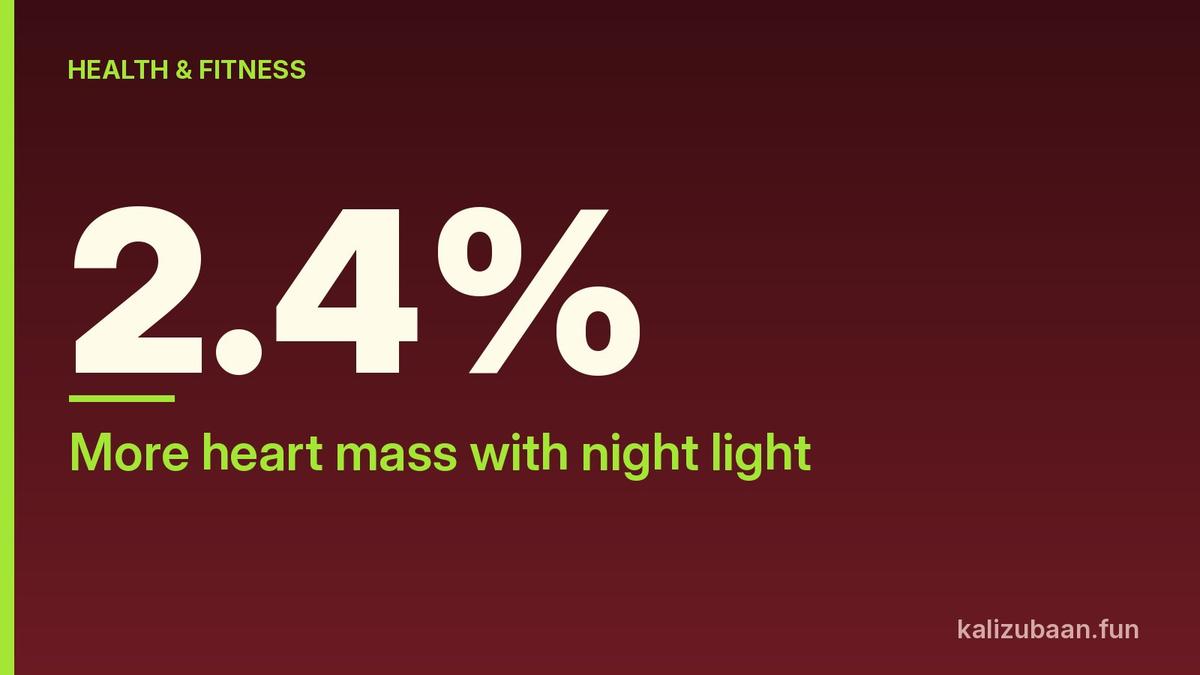
Falling asleep with the TV on feels harmless. But in a study of 11,071 people, those exposed to nighttime light above 3 lux had 2.4% more left ventricular mass when their hearts were scanned about three years later.
That is a small number with a big message. Researchers say even modest light at night may be linked to the kind of heart changes usually seen under chronic stress.
Quick answer
- A study in the European Heart Journal tracked night light for 11,071 UK Biobank participants, then scanned their hearts with MRI about three years later.
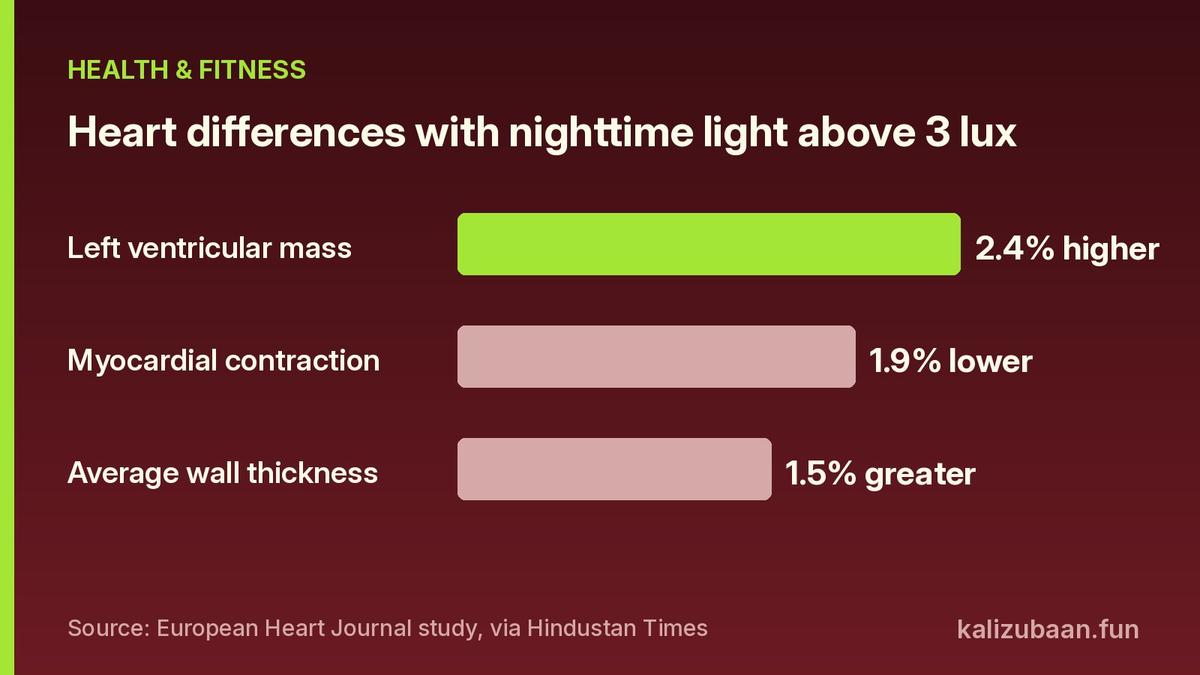
- People with nighttime light above 3 lux had 2.4% higher left ventricular mass, 1.5% greater wall thickness and 1.9% lower myocardial contraction fraction.
- Shorter sleep statistically explained around 24% to 49% of the link.
- It is an association, not proof that your TV damages your heart. Simple fixes are a sleep timer, curtains and switching off unnecessary lights.
What the study did
The research was led by Professor Lu Qi of Tulane University in the USA and published in the European Heart Journal, according to the European Society of Cardiology.
All 11,071 participants wore a light sensor on their wrists for seven days to measure how much light reached them overnight. Three years later, they had a cardiac MRI scan, which let researchers look closely at the structure and function of the heart.
The team then compared people exposed to light levels of more than three lux at night with people exposed to almost no light.
Professor Qi said previous observational studies had already linked nighttime light with a higher risk of cardiovascular disease, but little was known about what actually changes in the heart. This study set out to fill that gap.
What changed in the heart
Hindustan Times summarised the headline differences for people with nighttime light above 3 lux. Their left ventricular mass was 2.4% higher, average wall thickness was 1.5% greater, and myocardial contraction fraction was 1.9% lower.
Source: European Heart Journal study, via Hindustan Times
In plain words, the left ventricle is one of the heart's chambers. The European Society of Cardiology says people with high exposure to nighttime light had thickening of its wall, which reduces the space inside the chamber.
There were also signs that the heart muscle's ability to flex during a heartbeat was reduced. The society calls this an early indicator of heart dysfunction.
Changes showed up elsewhere too, in the right ventricle and the left atrium. Researchers described the overall pattern as concentric cardiac remodelling.
Why remodelling matters
Professor Qi explained that cardiac remodelling is when the structure and function of the heart change, something typically seen in response to chronic stress or injury.
"It's our body's way of adapting to that stress, but ultimately it weakens the heart and can lead to heart failure," he said.
He also called light pollution an emerging risk factor for cardiovascular disease. He said cutting nighttime light exposure should be considered by clinicians and policy makers as one possible strategy for preventing heart disease.
Sleep may be a big part of the story
One of the most interesting findings is about sleep. Shorter sleep duration statistically explained a substantial part of the link between nighttime light and the heart changes.
The researchers estimated that shorter sleep mediated around 24% to 49% of the observed associations. So light may matter partly because it cuts into sleep.
That fits how the body clock works. Hindustan Times explains that the circadian rhythm responds strongly to light and darkness. Darkness supports the natural release of melatonin, a hormone that helps regulate sleep, and artificial light at night can interfere with this.
It is not only about the TV
Dr (Col) Anil Dhall, Head of Cardiology at Shalby International Hospital, Gurgaon, told Health Shots the association should be taken seriously.
"Even a minimal light exposure can affect you. This is not limited to television viewing specifically. Light sources can include TVs, streetlights, lamps, and other sources," he said.
He added that the real concern may be the disruption of the natural nighttime environment: light, disturbed sleep and the effect on our body clock. More research is still needed to work out how much each factor contributes.
That matters in Indian cities, where streetlights, shop signs and lit building corridors can spill into bedrooms even when the TV is off.
What it does not prove
This was an observational study. It shows that more light at night was associated with measurable heart differences. It does not prove that a TV on at night directly caused them in any one person.
The differences were also small in size. They are best read as an early warning sign rather than a diagnosis.
Simple ways to keep your nights darker
Dr Dhall says you do not need to throw the television out of the bedroom. The advice from the sources is practical and cheap:
- Use a sleep timer if you fall asleep to the TV, instead of leaving it on all night.
- Switch off unnecessary lights before bed.
- Cut screen time close to bedtime.
- Use curtains or blinds to block bright outdoor light, such as streetlights.
An editorial accompanying the study, by Professor Thomas Münzel and colleagues, adds a few more: blackout curtains, warm-coloured bedside lighting and covering the small standby LEDs on household electronics.
The editorial also suggests doctors start asking patients about their sleep environment: how dark the bedroom is, whether they work night shifts and how much screen use happens after sunset.
FAQs
Is sleeping with the TV on bad for your heart? A study of 11,071 people linked nighttime light above 3 lux to measurable heart differences. It shows an association, not direct proof that the TV caused the changes.
How much light counts as too much? The study compared people exposed to more than 3 lux at night with people exposed to almost no light. Experts say even minimal light from TVs, lamps or streetlights may play a role.
Is it the light or the lost sleep? Both may matter. Shorter sleep statistically explained around 24% to 49% of the link, so poor sleep looks like an important part of the story.
What is the easiest fix? Set a TV sleep timer, switch off extra lights, use curtains or blinds, and cover standby LEDs on electronics.
This article is for information only and is not medical advice. Talk to a doctor before changing your diet or training.
Sources
Tagged Topics
Keep reading
Thanks for reading Kali Zubaan
Explore more articles in Health & Fitness or return to the main publication feed.


