$998 Stuck: Earn Money Water Sort Puzzle, Real or Fake?
Water Sort Puzzle cash games promise PayPal payouts, but players report balances frozen just under the $1,000 threshold and fees to withdraw. How the trap works, the Indian angle and what to do.
You pour coloured water between bottles, a coin sound plays, and the cash counter climbs. Then it stops at $998, two steps short of a $1,000 cash-out that, according to players, never arrives (My Room Is My Office).
That is the whole story of most "earn money water sort puzzle" games. The puzzle is real and can be fun. The money is the bait.
Quick answer
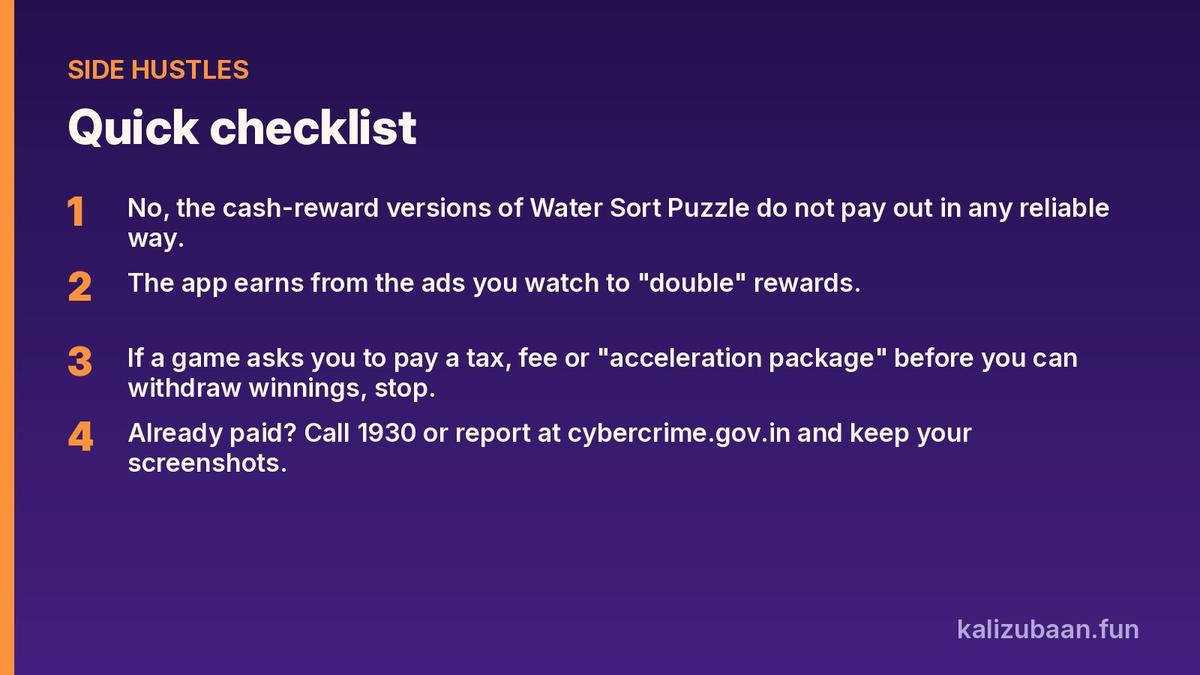
- No, the cash-reward versions of Water Sort Puzzle do not pay out in any reliable way. Reviewers and players report balances stuck at $998 against a $1,000 withdrawal threshold.
- The app earns from the ads you watch to "double" rewards. Your virtual dollars are not money, and nothing obliges the developer to send them.
- If a game asks you to pay a tax, fee or "acceleration package" before you can withdraw winnings, stop. That is the point where a fake game turns into a scam.
- Already paid? Call 1930 or report at cybercrime.gov.in and keep your screenshots.
This guide is general information about online earning claims, not legal or financial advice. Results vary, and nothing here is a promise of income.
Does earn money water sort puzzle really pay?
No, there is no credible evidence that the cash-reward Water Sort Puzzle games pay players the amounts they display. Independent reviews and complaint boards describe the same pattern: the counter rises fast, then freezes just below the payout line.
One detailed review of a Water Sort Puzzle app lists the payout threshold as $1000 and gives the game an overall rating of 1/5, concluding that you will not receive any payment because the app "will never let you reach $1,000" (My Room Is My Office). The same review notes that 1 million coins are worth $1, and that a $50 cash-out in coins needs at least $50 worth of coins.
The game itself is ordinary. You pour liquids between glass bottles until each bottle holds one colour. Every time you close a bottle, you may get virtual cash, coins or puzzle pieces, and you can double the reward by watching an ad.
That last part is how the developer gets paid. Each "double it" tap plays a commercial. You supply the attention; the advertiser pays the app. The dollar figure on your screen is a game score dressed up as a wallet.
There are also prize pieces. The review says you need to collect 30 fragments to claim gifts such as an iPhone 13, a MacBook Pro or even a Tesla Model S, and that players report never getting the last fragment (My Room Is My Office).
Why does the balance get stuck at $998?
The balance stalls because the game controls the maths, not you. Many players report that their cash balance got stuck at $998 despite earning more, so the $1,000 withdrawal line is never crossed (My Room Is My Office).
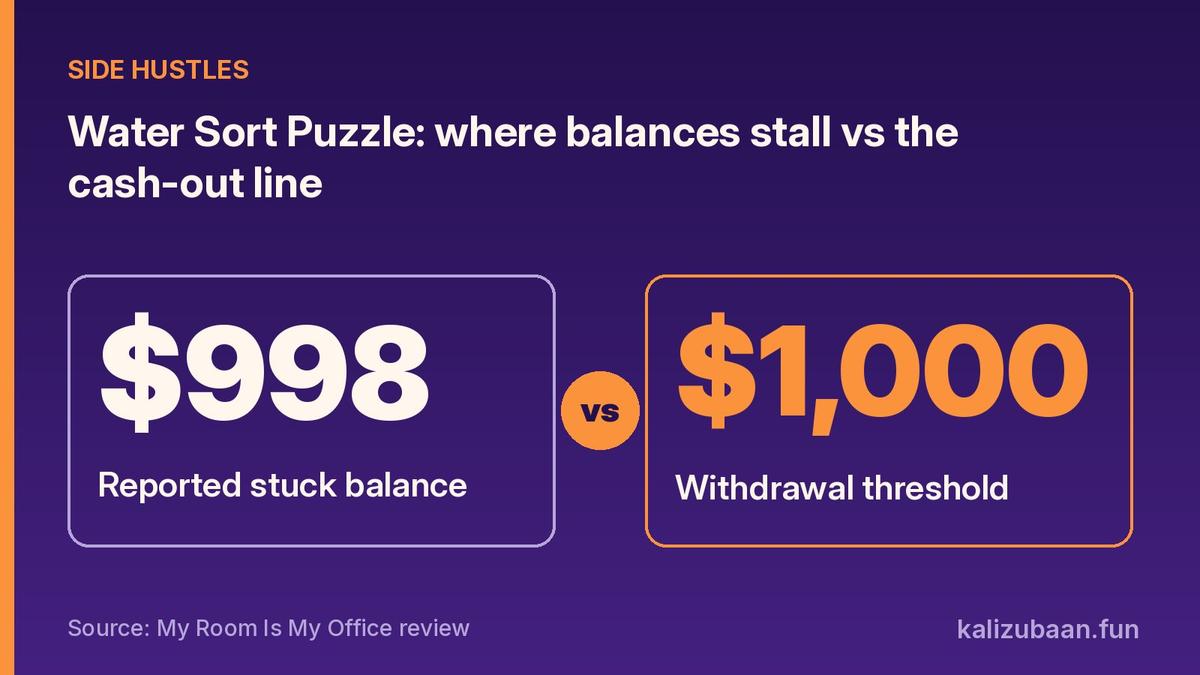
Source: My Room Is My Office review
Think about how this works from the developer's side. Rewards early in the game are generous, so you feel close to the goal within a few hours of play. As you approach the line, each bottle pays a smaller amount, the increments shrink, and the last step never lands.
This is a common design in "reward" games, and it is easy to copy. The same review notes there are probably hundreds of similar games on Google Play, and that many developers copy someone else's game and add dollar signs to attract players.
Even honest puzzle versions of the game lean hard on ads. Complaints about one ad-supported Water Sort Puzzle app include ads after nearly every puzzle, an undo button that resets only after an ad, and a player who paid $2.99 to remove ads still being shown extra-ad offers (ComplaintsBoard). If the plain version is built around ad views, the "earn money" version is built around them even more.
What happens when you try to withdraw?
When players finally try to withdraw, the reported pattern is a request for money in the other direction: a tax, a fee or a paid "acceleration" to move up a payout queue. This is where a time-wasting game becomes a money-losing scam.
A complaint filed on the Better Business Bureau's Scam Tracker describes a water sort game that showed "YOUR CASH IS READY" with PayPal and Cash App options, then left the payout "in progress" for weeks (BBB Scam Tracker). The withdrawal progress showed only 25.04%, with the player told they were 74.96% away. The game offered an "acceleration package" to speed up the queue. The player paid twice, reported $33 lost, and said customer service was a bot.
The same complaint says the app disabled screenshots, which makes it harder to keep proof. It also suggests that many water sort games appear to be linked and follow the same routine.
A complaint on ComplaintsBoard describes the same path: a large win on opening the app, then a demand to pay first at withdrawal, then more payments for "tax and acceleration of queue", with a claimed loss of 1800 in 2 weeks (ComplaintsBoard).
The lesson is simple. A real payout never needs money from you first. If any app tells you to pay to receive your own winnings, the money only moves one way.
Can players in India even cash out from these games?
Often not, even on paper. The Water Sort Puzzle app reviewed by My Room Is My Office lists eligibility for legal residents of the United States, Canada, Hong Kong and the United Kingdom only, so an Indian player was never eligible for that app's prizes (My Room Is My Office).
Indian ads for these games still show PayPal and dollar payouts, which is a red flag in itself. Read the in-app rules before you spend hours on levels. If India is not listed, your "balance" is decoration.
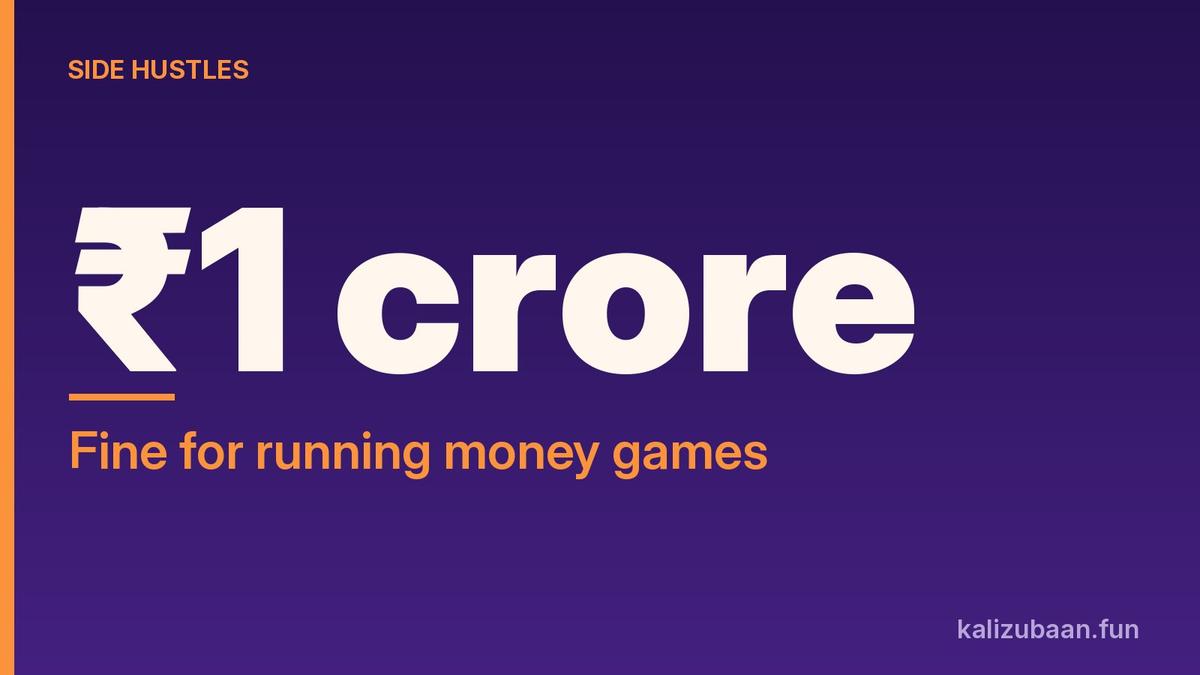
India's gaming law adds another layer. The Promotion and Regulation of Online Gaming (PROG) Act, 2025 has banned online money games since 1 May 2026, while online social games are allowed but "can't pay users out", according to a founder's guide to the law (Entrepreneur Bus). Offering or facilitating an online money game can mean up to 3 years in prison, a fine up to ₹1 crore, or both, and advertising one can mean up to 2 years and a fine up to ₹50 lakh.
Under the rules, the new Online Gaming Authority of India looks at four things when it classifies a game: whether users pay stakes, whether they expect money winnings, how the game earns revenue, and whether in-game assets can be turned into value outside the game (Entrepreneur Bus). A free puzzle game that charges a "withdrawal fee" for cash winnings sits uncomfortably close to those tests, and the guide notes that enforcement targets operators, advertisers and promoters, not players.
How is this different from WhatsApp task scams?
It is the same trap with a different front. Task scams pay small amounts first and then ask for deposits; fake water sort games skip the real payment and ask for fees at the withdrawal screen.
The Ministry of Home Affairs described the task-scam playbook when the Indian Cybercrime Coordination Centre identified over 100 websites tied to task-based part-time job frauds, which MeitY then blocked (PIB). Victims are reached through targeted ads using phrases like "Ghar baithe job", given small tasks and a little commission, then asked to invest more until their deposits are frozen.
Police in Bhopal describe the "watch and earn" version: scammers first send small amounts ranging from Rs 50 to Rs 200, and in some cases up to Rs 10,000, then ask for registration fees or investments that range from Rs 5,000 to several lakhs (Free Press Journal).
What most guides miss: the water sort version is cheaper for the scammer than a task scam. A Telegram task gang has to pay you a little to win trust, while a reward game pays you nothing at all; the fake dollar counter does the trust-building, and the ad views fund it. The demand at the end, a fee before you can withdraw, is the same in both.
If you want to compare, our earlier pieces on earn money watching ads apps and the earn money online task scam show the task-scam side in detail.
How can you tell a real reward app from a fake one?
A real reward app has a low, reachable cash-out, names the payout method that works in India, and never charges you to withdraw. A fake one shows a huge balance fast, sets a far-off threshold, and adds fees or "missing pieces" near the end.
Use these checks before you play for money (My Room Is My Office, BBB Scam Tracker):
- Threshold far above the reward pace. A $1,000 line on a puzzle game is a warning sign.
- Balance stalls near the target. Reports of a stuck $998 mean the end point is designed, not earned.
- Fees at withdrawal. Tax, processing, queue or acceleration charges before payout point to a scam.
- Prize pieces you never complete. If the last of 30 fragments never drops, the prize is a hook.
- Your country is not eligible. Check the rules page for India.
- Heavy permissions. The reviewed app could access storage and read phone status and identity, which is more than a puzzle needs.
- Bot-only support and blocked screenshots. Both make it harder to complain or prove a loss.
If the game is fun, play it as a game. Uninstall any version that turns every level into an ad break and dangles cash you cannot reach.
What should you do if you already paid a fee?
Report it fast, keep proof, and stop paying. Every extra "tax" or "acceleration" payment is another loss, not a step closer to your money.
The Home Ministry advises citizens to report phone numbers and handles used by fraudsters on the National Cybercrime Reporting Portal at cybercrime.gov.in, and notes that complaints come in through the 1930 helpline (PIB). Bhopal's Cyber Crime Branch also tells victims to preserve screenshots as evidence and never share banking details or OTPs (Free Press Journal).
A short checklist:
- Call 1930 and file at cybercrime.gov.in with the app name, payment IDs and screenshots.
- Tell your bank or UPI app about the transaction in writing.
- Check the receiver name in your UPI history. The PIB note warns that a random individual as the receiver may be a mule account.
- Report the app on Google Play or the App Store so others see the warning.
- Do not pay anyone who offers to "recover" your money for a fee.
FAQs
Is earn money water sort puzzle real or fake?
The puzzle game is real, but the cash rewards are not reliable. Reviews and complaints describe balances stuck at $998 against a $1,000 threshold and no payment received.
Has anyone been paid by Water Sort Puzzle?
We found no credible proof of a full cash-out. The complaints we checked describe payouts stuck "in progress" or demands for fees before withdrawal.
Why does Water Sort Puzzle ask for tax or an acceleration fee?
Those fees are how the scam versions make money from you directly. A genuine payout never needs a payment from you first.
Is it legal to play water sort cash games in India?
Free puzzle games are fine to play, and the PROG Act's enforcement targets operators and promoters, not players. But paying any money to "unlock" winnings puts your own money at risk.
Where do I complain about a fake earning game in India?
Call the 1930 helpline or file a complaint on cybercrime.gov.in, then inform your bank and report the app on the store where you downloaded it.
Results vary; nothing here is a promise of income.
Related reading
- ₹13 an Hour: Earn Money Captcha Typing, Real or Scam?
- ₹1 to ₹3 a Reward: Is This Earn Money App Real or Fake?
- ₹1 Crore Fine: Is an Earn Money APK Game Legal in India Now?
Sources
- My Room Is My Office: Water Sort Puzzle app review, stuck at $998
- BBB Scam Tracker: Water sorting game payout complaint
- ComplaintsBoard: Water Sort Puzzle reviews and complaints
- PIB: MHA on blocking over 100 task-based part-time job fraud websites
- Entrepreneur Bus: Online gaming ban in India, what founders must know
- Free Press Journal: Cyber Crime Branch warns against watch and earn scam
Tagged Topics
Keep reading
Thanks for reading Kali Zubaan
Explore more articles in Side Hustles or return to the main publication feed.