USD 73 vs USD 19: How to Earn Money in Dollars in India
A practical guide for Indian freelancers paid by foreign clients: which payment route costs least, what a FIRA is, the RBI rules from 1 October 2026, and how GST and income tax apply.

A client in Berlin or Austin approves your invoice and asks how to pay you. Your answer decides how much of the money actually lands in your account.
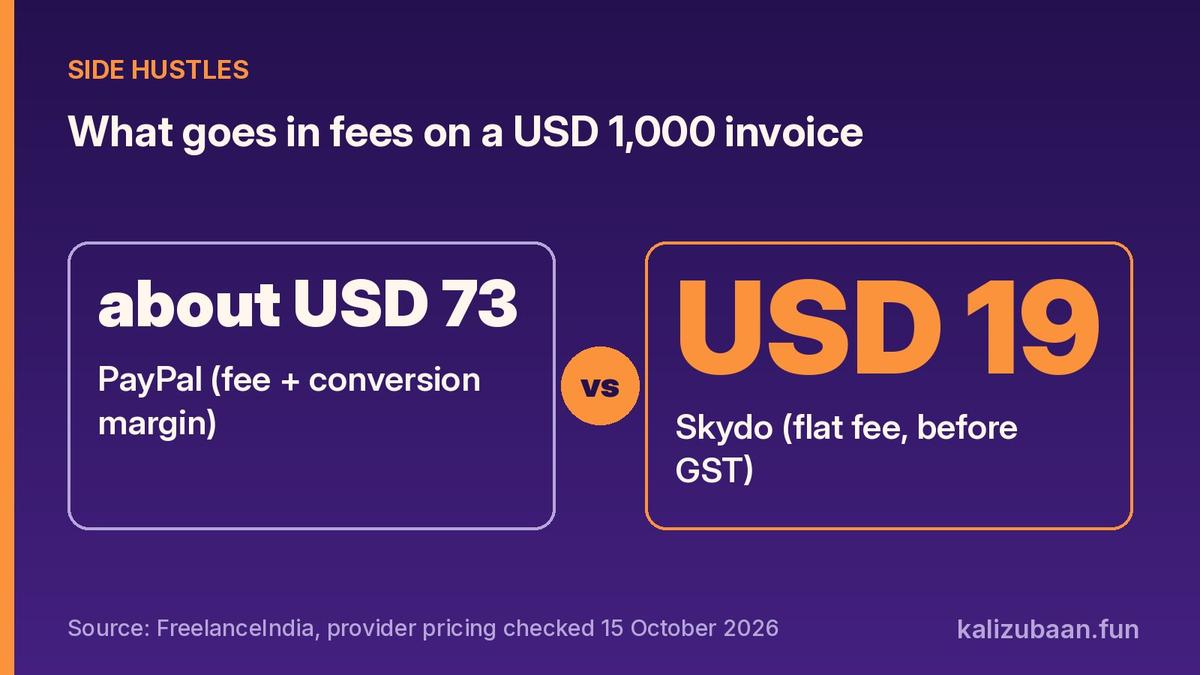
On a USD 1,000 invoice, PayPal's fees and conversion margin take about USD 73. Skydo's flat fee on the same invoice is USD 19, plus GST on the fee. Same work, same client, very different payout.
Quick answer
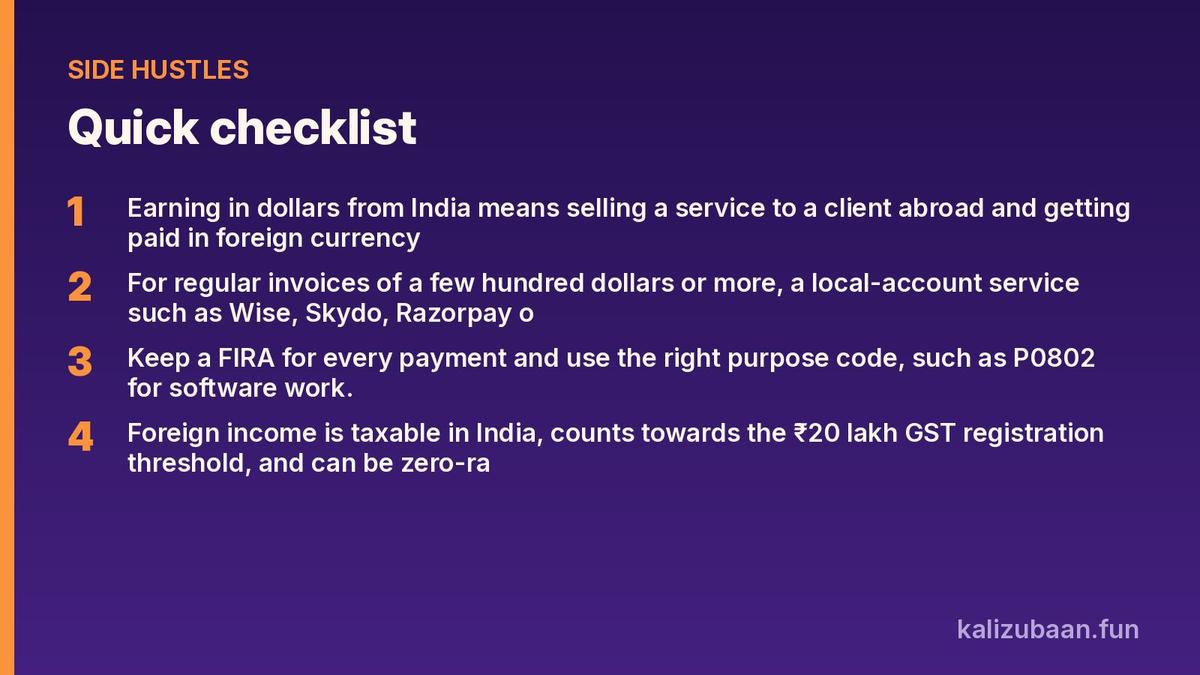
- Earning in dollars from India means selling a service (code, design, writing, consulting, marketing) to a client abroad and getting paid in foreign currency through an RBI-authorised bank or payment provider.
- For regular invoices of a few hundred dollars or more, a local-account service such as Wise, Skydo, Razorpay or Payoneer usually costs far less than PayPal.
- Keep a FIRA (Foreign Inward Remittance Advice) for every payment and use the right purpose code, such as P0802 for software work.
- Foreign income is taxable in India, counts towards the ₹20 lakh GST registration threshold, and can be zero-rated for GST once you file a Letter of Undertaking.
This guide is general education, not tax, legal or financial advice. Fees and rules change, so confirm with your CA or bank before you set up payments.
How do you earn money in dollars in India legally?
You earn dollars legally by exporting a service to a client outside India and receiving the payment through an authorised dealer bank or an approved payment provider, in foreign currency, with the correct purpose code.
You do not need RBI permission to work with foreign clients; you need to receive the money through an authorised dealer (AD) bank, in foreign currency, with the correct purpose code, and keep proof of every payment (Infinity: RBI rules for freelancers).
The work itself can come from anywhere. Marketplaces such as Upwork, Fiverr, Freelancer.com and Toptal are common starting points, and so are direct clients found through referrals or LinkedIn. If you are choosing a marketplace, our comparison of Fiverr and Upwork for beginners in India covers the trade-offs.
What matters for the money side is the same whichever route you take:
- The client is outside India.
- The work is not tied to a place in India.
- You are paid in foreign currency through a regulated channel.
- You keep the paperwork that proves all three.
Get those right and dollar income is ordinary professional income. Get them wrong and the same money can look like a gift, a loan or an unexplained credit to your bank.
Which payment method costs the least for freelancers in India?
For most freelancers billing a few hundred dollars or more each time, a service that gives you a local US, UK or EU account costs least, and PayPal usually costs the most.
PayPal charges 4.40% plus USD 0.30 per payment, plus 3% above its base rate when converting to rupees, while Skydo charges USD 19 up to USD 2,000 with no FX margin (FreelanceIndia: cross-border pay playbook).
Here is how the main options compare on their own published pricing, as checked on 15 October 2026:
- Bank wire (SWIFT): your bank's conversion margin and inward charges, plus any fees deducted by banks along the way. Good for large one-off payments.
- Wise Business: the mid-market rate plus a conversion fee that varies by currency, with 18% GST on Wise's fees. A sole trader account needs your PAN, an INR bank account in your name and video KYC with Aadhaar.
- Skydo: USD 19 up to USD 2,000, USD 29 from USD 2,001 to 10,000, and 0.3% above that, with 18% GST on the fee. Suits invoices of USD 1,000 and up.
- Razorpay MoneySaver Export Account: 1% plus GST on bank transfers, no FX markup, and a flat ₹1,000 fee on transfers below ₹1 lakh.
- Payoneer: withdrawal to INR at 1–4%, and USD 29.95 a year if you receive under USD 6,000 in 12 months. Often the default when a marketplace already pays through it.
- PayPal: easiest for the client, most expensive for you. Keep it for small one-off jobs or clients who will pay no other way.
Stripe is invite-only for new Indian accounts, so most freelancers cannot use it. If your client pays through Upwork, Deel or a similar platform, that platform's own withdrawal fees and payout partners apply instead.
Source: FreelanceIndia, provider pricing checked 15 October 2026
A wider comparison tells the same story at a bigger size. On a USD 5,000 receipt, PayPal's cost works out to about 7.27% to 8.23%, against 1% to 4% for Payoneer (Service Export Guide: PayPal, Wise or Payoneer).
What most guides miss: PayPal's fee is a percentage, so it grows with every invoice, while Skydo's is a fixed USD 19 up to USD 2,000. That means the bigger your typical invoice, the more a flat-fee route saves you, and the only case where PayPal's convenience is cheap is the small one-off job.
What is a FIRA and why does every freelancer need one?
A FIRA is the record proving a payment came from abroad in foreign currency, and you need one for each foreign payment to back your GST export claim, answer bank queries and file your return.
A Foreign Inward Remittance Advice records who sent the money, how much, in which currency, the exchange rate and the purpose code; banks used to issue a certificate (FIRC) instead, and either one works as evidence (FreelanceIndia).
You will use it for three things:
- proving to the GST department that an export was paid for in foreign exchange, one of the conditions for charging 0%
- answering a bank or tax query about a large foreign credit
- matching payments to invoices when your CA prepares your return
Wise, Skydo, Razorpay, Payoneer and PayPal now issue digital FIRAs. With a plain bank wire, you may have to ask your bank for one, sometimes for a fee.
Pick the right purpose code
Every foreign payment into India carries an RBI purpose code. It tells the bank the money is payment for services you exported, not a gift or a loan. Common codes are:
- P0802: software implementation or consultancy (software, apps, websites)
- P0803: database and data processing (data entry)
- P1006: business and management consultancy and public relations
- P1007: advertising, market research and public opinion polling
P0806 is sometimes given out as a consulting code, but it covers other information services such as subscriptions. For design, writing or video work, ask your bank or platform which code it uses, and avoid gift or family-maintenance codes, which can make your income look like something it is not.
What RBI rules apply to freelancers paid in dollars?
RBI's export rules, in force since 1 October 2026, expect the full invoice value within nine months of the invoice date, and resident individuals now meet the export declaration requirement simply by giving their bank the payment details.
The full invoice value should be received within nine months of the invoice date, or twelve months if you invoice in rupees, under RBI's new export regulations (FreelanceIndia).
The rules also asked service exporters to file an Export Declaration Form (EDF) with their bank within 30 days from the end of the month in which the invoice was raised. A later amendment made this much easier for individuals.
Under the Gazette notification dated 2 November 2026, a resident individual is deemed to have submitted the EDF once they give their bank the information needed to credit the payment, so freelancers, YouTubers and independent professionals do not have to file it separately (Mint: RBI amends EDF rules).
For exporters who are not resident individuals, the same relief applies when a single inward remittance does not exceed ₹10 lakh. We covered that change in detail in RBI's ₹10 lakh rule for freelancers paid abroad.
The practical takeaway: answer your bank's questions about each payment fully, and put payment terms in writing. Nine months is the regulatory outer limit, not a target. Your contract should ask for payment within 15 days.
Do you pay GST on dollar income from foreign clients?
You pay no GST on qualifying export work, but foreign income counts towards the ₹20 lakh registration threshold, and once registered you file a Letter of Undertaking each year to invoice at 0%.
GST registration is mandatory once aggregate turnover crosses ₹20 lakh in a financial year, and foreign receipts count towards that total even though exports are zero-rated (BookMyCA: freelancer tax on Upwork and Fiverr).
Many freelancers assume zero-rated means "not counted". It does not. A freelancer billing mostly overseas can still cross the line and need to register. The higher ₹40 lakh limit applies only to suppliers of goods, not to service providers or IT freelancers (CAclubindia: GST on freelance service exports).
For work to count as an export of services, five tests must all hold:
- You, the supplier, are in India.
- The client is outside India.
- The place of supply is outside India.
- You are paid in convertible foreign exchange (or rupees where RBI permits).
- You and the client are not just two branches of the same entity.
Once registered, you file a Letter of Undertaking in Form GST RFD-11 and your export invoices go out without IGST. Without it, you pay 18% IGST first and claim a refund later, which ties up cash. The LUT is valid for one financial year, so file a fresh one before the first export invoice each April.
One more reason to register: Upwork and Fiverr charge GST on their own service fee to Indian freelancers who have not given a GSTIN, so registration also saves that 18%, according to BookMyCA.
If a payment never arrives, the LUT obliges you to pay the IGST with interest. Chase overdue foreign invoices as firmly as Indian ones.
How is dollar income taxed under income tax?
Dollar income is taxed as income from business or profession, and many freelancers can use the presumptive scheme under Section 44ADA, which treats 50% of gross receipts as taxable profit.
The Section 44ADA limit is ₹75 lakh of gross receipts if cash receipts are 5% or less of the total, and ₹50 lakh otherwise, applying from AY 2024-25 onwards (ClauseAudit: freelancer tax thresholds).
A few points trip people up:
- It is not salary. Whatever the platform pays you, the receipt is income from business or profession.
- Gross means before commission. Gross receipts are what the client paid, before the platform's cut. Under 44ADA the commission sits inside the 50%; if you keep books, you deduct it as an expense.
- No Indian TDS from foreign clients. Foreign clients and platforms do not deduct Indian TDS, so plan for advance tax. Under 44ADA it can be paid in one instalment by 15 March.
- Foreign wallet balances are foreign assets. Balances in Payoneer, PayPal, Wise or a foreign bank account go in Schedule FA, which is in ITR-3, not ITR-4.
- Separate tax systems. 44ADA decides your income-tax profit; GST registration and the LUT follow GST law independently.
If a foreign client withholds tax in their own country, keep their tax certificate and ask your CA about claiming credit for it.
How do you set up dollar payments step by step?
Set up once, then repeat the same checklist for every invoice: pick a route, agree currency and fees, invoice in dollars, and file the FIRA against the invoice.
The simplest single action, per the FreelanceIndia playbook, is to open your last three foreign payments, find the FIRA for each, and check the purpose code is right (FreelanceIndia).
- Choose your route. A local-account service for regular clients, Payoneer for marketplace payouts, a bank wire for large one-offs, PayPal only as a backup.
- Agree the terms in writing. Settle the currency and who pays the fees before the first invoice. On an international wire, "OUR" means the sender pays all bank charges, while "SHA" splits them and usually means you receive a short payment.
- Invoice in the client's currency. Build a small buffer for exchange-rate movement into your rate instead of arguing about it later.
- Set the purpose code once at setup, or on each payment if the provider asks.
- Download the FIRA after every payment and file it with the invoice.
- Watch your yearly total against the ₹20 lakh GST threshold, and register before you cross it.
- Plan your tax, including advance tax, since no Indian TDS is deducted.
Before you start pitching clients, it also helps to know what the market pays. Our look at what freelancing websites pay freelancers in India is a useful reference for setting your first rate.
FAQs
Can I receive dollar payments in a savings account?
Yes. Indian banks credit foreign remittances to savings accounts, and Wise, Skydo, Payoneer and PayPal all pay out to one. Some banks prefer a current account once volumes grow; what matters most is the right purpose code and a FIRA for each payment.
Is PayPal the best way to get paid in dollars in India?
Usually not. On a USD 1,000 invoice its fees and conversion margin take about USD 73, while local-account services cost much less. PayPal is best kept for small one-off jobs or clients who insist on it.
Do I need GST registration to earn in dollars?
Only once your aggregate turnover, including foreign receipts, crosses ₹20 lakh in a financial year. Below that, registration is optional and you charge no GST to foreign clients.
How long can a foreign client take to pay me?
Under RBI's export rules in force from 1 October 2026, the full value should arrive within nine months of the invoice date, or twelve months if invoiced in rupees. Your contract should ask for much sooner.
What is the difference between FIRC and FIRA?
Both prove money came into India from abroad. Banks used to issue the FIRC certificate; for export payments they largely moved to the FIRA advice, which records the sender, amount, currency, exchange rate and purpose code. Either works as evidence.
Expert review: pending.
This article is for education only and is not tax, legal or financial advice. Results vary; nothing here is a promise of income.
Related reading
- RBI's ₹10 lakh rule for freelancers paid abroad
- Fiverr vs Upwork for beginners in India
- What freelancing websites pay freelancers in India
Sources
- FreelanceIndia: How to receive international payments in India
- Service Export Guide: PayPal, Wise or Payoneer, which charges least in India (2026)
- Mint: RBI amends EDF rules for service exporters, freelancers under FEMA
- BookMyCA: Freelancer tax India, 44ADA, GST, Upwork/Fiverr
- ClauseAudit: Section 44ADA limit, GST and LUT for freelancers in India 2026
- CAclubindia: GST implications on freelance service exports
- Infinity: RBI rules for freelancers in India, 2026 guide
Tagged Topics
Keep reading


Thanks for reading Kali Zubaan
Explore more articles in Side Hustles or return to the main publication feed.