₹630 Bait, ₹10 Lakh Lost: The Earn Money Online Task Scam
A man deposited ₹500, got ₹630 back, and went on to lose more than ₹10 lakh. How earn money online without investment offers turn into task scams, and the warning signs to spot.

A Telegram message offered a 38-year-old man in Visakhapatnam easy money for posting Google reviews. He was paid ₹120 per task. Then he deposited ₹500 and got ₹630 back. He deposited ₹3,000 and got ₹4,300.
It felt like the perfect way to earn money online without investment. By the time he tried to withdraw, he had put in more than ₹10 lakh, and he got none of it back.
Quick answer
- Task scams start with real but tiny payouts, then ask you to deposit money to "unlock" bigger tasks or withdraw your balance.
- More than 20 residents of Visakhapatnam allegedly lost a combined ₹1 crore in a month to one such scheme, Mint reports.
- Similar cases this month in Roorkee, Chandigarh and Chennai followed the same path through Instagram, WhatsApp and Telegram.
- If a "job" asks you to pay before you earn or before you withdraw, stop. Report it on cyber helpline 1930.
How the ₹630 bait works
Mint, citing a Times of India report, describes the pattern step by step. The victim got a Telegram message offering ₹100 to 200 for each task, and was added to a group where people posted reviews and sent screenshots as proof.
A person calling himself a customer manager paid him ₹120 per task at first. Then came the pitch to deposit money for higher returns. The small wins, ₹500 turning into ₹630 and ₹3,000 into ₹4,300, built his trust.
Next, a so-called operations manager moved him to an online trading platform with promises of bigger profits. When he tried to withdraw, he was told trading errors had frozen his account.
A third person, a "withdrawal manager", then demanded more payments and claimed he had to improve his credit score before the money could be released. Individual victims in the case reportedly lost between ₹2 lakh and ₹9 lakh.
The same script, in city after city
This is not one gang's trick. Reports from the last few weeks show the same steps across India.
In Roorkee, a woman received a link on Instagram on 14 September. It led to a WhatsApp number, then Telegram accounts that assigned her tasks. Money kept leaving her bank account until she had allegedly lost 1.97 lakh rupees, Khatima News reports.
In Chandigarh, Times of India reports that a 24-year-old woman from Kathua clicked an Instagram job ad. She was offered part-time work rating restaurants, moved to Telegram and an outside website, and asked for a "refundable" 2,000-rupee registration deposit. When she tried to withdraw her balance, she was asked for processing fees, and she made multiple transfers before realising it was a scam.
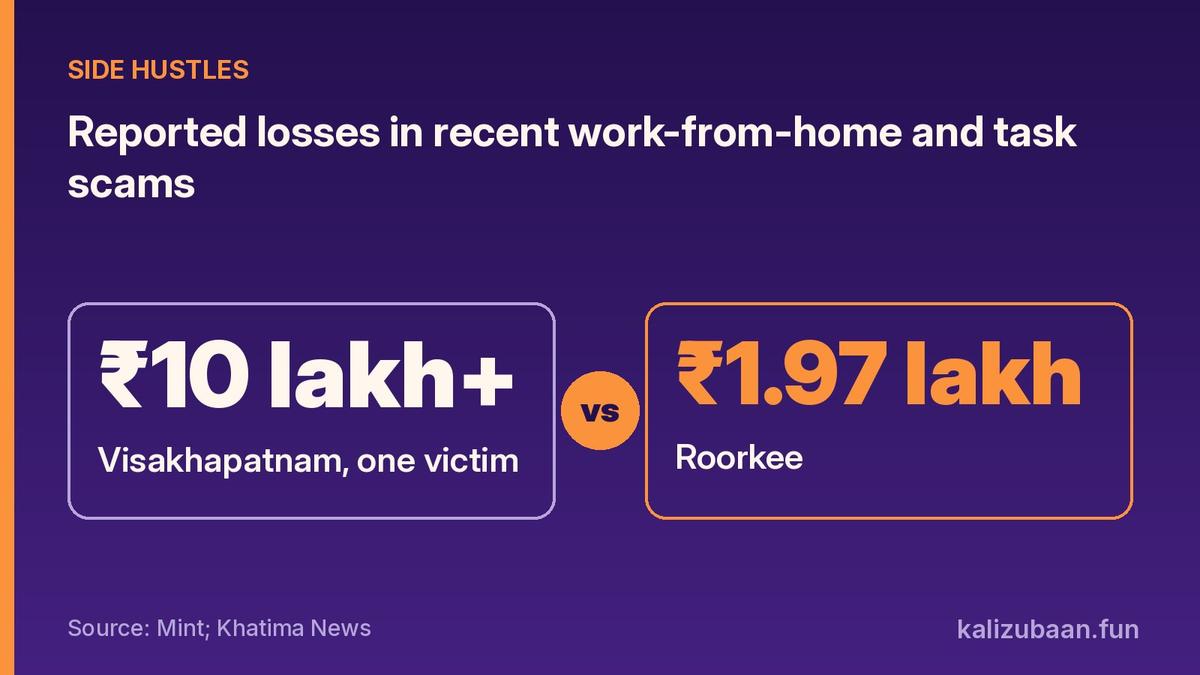
Source: Mint; Khatima News
In Chennai, the trick was offline at first. The Hindu reports that a 26-year-old woman looking for a work-from-home job was told by a self-described HR executive to pay ₹4,500 in advance to install software on her laptop. No job followed.
Police arrested three men in that case on October 6 and October 7, and seized ₹2.49 lakh and a mobile phone from the prime accused. Police said the gang collected money as "advance payments" and "registration fees".
Why smart people fall for it
The first payout is real. That is the whole design.
As Mint explains, fraudsters begin with simple work and pay small amounts so the opportunity feels genuine. Then they introduce higher-paying tasks or investment plans that need bigger deposits.
Once someone has sent a large sum, every new demand is framed as the only way to recover it: a tax, a processing fee, a frozen account, a credit score. People keep paying because stopping feels like losing everything.
Warning signs before you pay a single rupee
The Indian Cyber Crime Coordination Centre (I4C) has warned about fake online task-based jobs that lure people with easy earnings and then ask for upfront fees, Mint reports. Its advisory lists withheld payments, blocked withdrawals and repeated demands for extra charges as warning signs.
Here is a simple checklist drawn from these cases:
- The offer arrives out of nowhere on Instagram, WhatsApp or Telegram, and the "recruiter" keeps moving you to new apps or accounts.
- The work is oddly easy, like liking videos, posting reviews or rating restaurants, for quick cash.
- You are asked for a "refundable" deposit, registration fee or software fee before you start.
- You must deposit more to unlock tasks, or to withdraw money already shown in your account.
- New "managers" keep appearing, each with a new reason to pay.
If you see even one of these, walk away. Mint's key warning is simple: being asked to pay more money to withdraw funds already in an account is a red flag.
What real earning looks like
Genuine side hustles pay you. They do not ask you to invest so you can be paid.
Real platforms for freelancing or delivery may need your time, a skill, a phone or a vehicle. They do not need a deposit to "activate" your account, and they do not hold your earnings hostage for a fee.
When you search to earn money online without investment, treat that phrase as a filter. The moment an offer asks for money, it has failed its own promise.
If you have already paid
Act fast. The Roorkee woman first reported her case on cyber helpline 1930, then went to the police, who registered an FIR.
Keep your chats, links, UPI IDs and payment screenshots. In the Kathua case, the complaint asked police to trace the mobile numbers, Telegram accounts, domain links and receiving bank accounts or UPI IDs.
Do not pay any "recovery" fee. Anyone promising to get your money back for a charge is usually the same scam, round two.
FAQs
Can you really earn money online without investment? Yes, through skills like freelancing, tutoring or content work, but it takes time. Any offer that asks for a deposit to start or withdraw is a red flag.
Why did the scammers pay me first? Small payouts like ₹120 per task are used to build trust before asking for larger deposits, as in the Visakhapatnam case reported by Mint.
Is a refundable registration deposit ever normal? In these cases, the "refundable" deposit was the first step of the fraud. Genuine employers do not charge you to give you work.
Where do I report a task scam? Call cyber helpline 1930 and file a complaint on the National Cyber Crime Reporting Portal, then go to your local police.
Results vary; nothing here is a promise of income.
Have you ever received one of these "easy task" offers? Share what it looked like in the comments so others can spot it.
Sources
- Mint: Google Review scam, over 20 people reportedly lose ₹1 crore in a month
- Khatima News: Roorkee woman loses 1.97 lakh in online job scam
- Times of India: Kathua woman falls for work from home scam reported in Chandigarh
- The Hindu: Three persons arrested for cheating job seekers with fake work-from-home offers
Tagged Topics
Keep reading



Thanks for reading Kali Zubaan
Explore more articles in Side Hustles or return to the main publication feed.


