9.5% Below Its Peak: Is the AI Bubble Going to Burst?
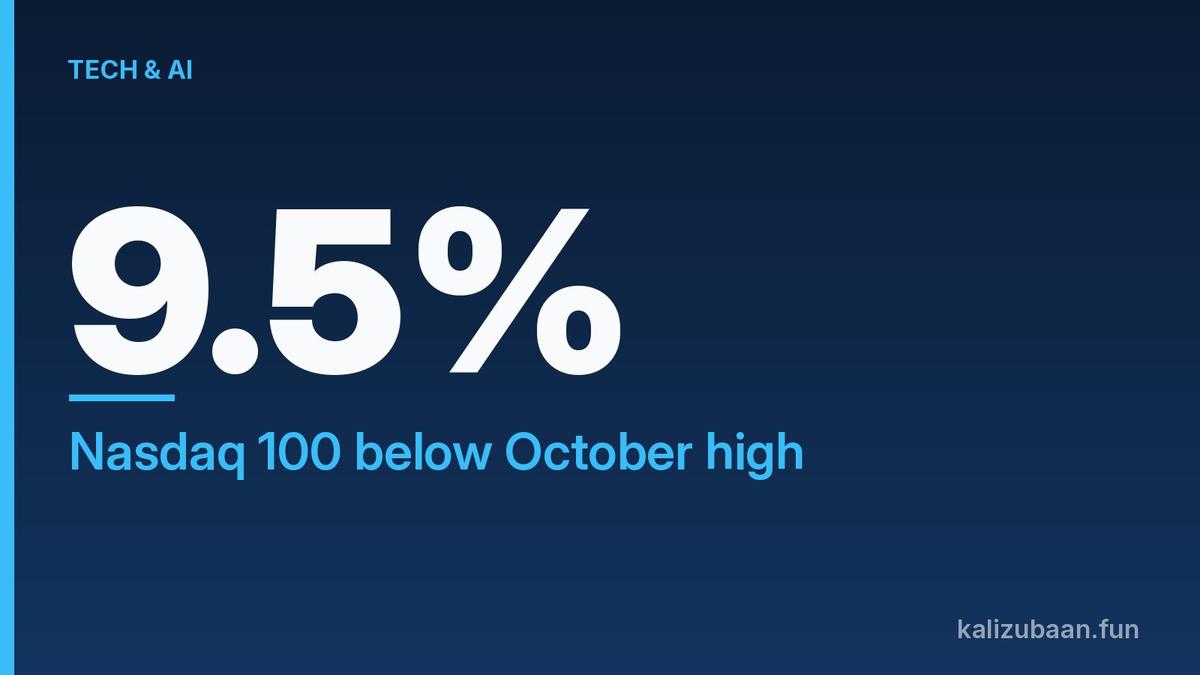
Is the AI bubble going to burst? The Nasdaq 100 is 9.5% below its October high and Big Tech cash flow has turned negative. Here is what the data says, and what it does not.
Intel shares fell 29 per cent after one weak revenue forecast. Alphabet dropped 13 per cent in a day, its biggest single-day fall ever. And these were not small, risky startups: they are some of the companies building the AI boom.
That is why "is AI bubble going to burst" is now climbing Google's search suggestions in India. The honest answer is that nobody can time it, but the warning signs are now much easier to see.
Quick answer
- The Nasdaq 100 is 9.5% below its October high, says Barclays, after falling 6.7 per cent in October alone, its worst month since March 2025.
- Investors are not doubting AI demand. They are doubting who will pay for the data centres, as three of the four biggest cloud companies reported negative free cash flow.
- Oxford Economics says a sharp correction does not need AI to fail, only to disappoint, and sees these risks rising into 2027.
- Nobody can give you a date. Treat any "crash next week" claim as a guess.
This post is general information, not investment advice. Talk to a SEBI-registered adviser before you buy or sell anything.
Is the AI bubble going to burst right now?
Not clearly: the AI trade is in a sharp correction, but analysts describe a funding scare, not a collapse in demand for AI.
The Nasdaq 100 fell 3.5% on Friday, October 30, taking its October drop to 6.7 per cent, its worst month since March 2025 (Business Standard). The S&P 500 fell 1.8 per cent the same day.
Barclays Private Bank says the index is now 9.5% below its October high, which it calls "hardly extraordinary" after a strong rally (Barclays). What worries it is where the selling is happening, and that good news has stopped lifting AI stocks.
Asia felt it too. South Korea's Kospi fell 3.48 per cent and Japan's Nikkei 225 dropped 2.1 per cent, Business Standard reported.
Which AI stocks fell the most?
Chipmakers and Big Tech took the hardest hits after their latest quarterly results.
Intel fell 29 per cent after a revenue forecast below estimates, AMD dropped 11 per cent and Nvidia 4.2 per cent, while Alphabet fell 13 per cent and Amazon 5.6 per cent over two days (Business Standard).
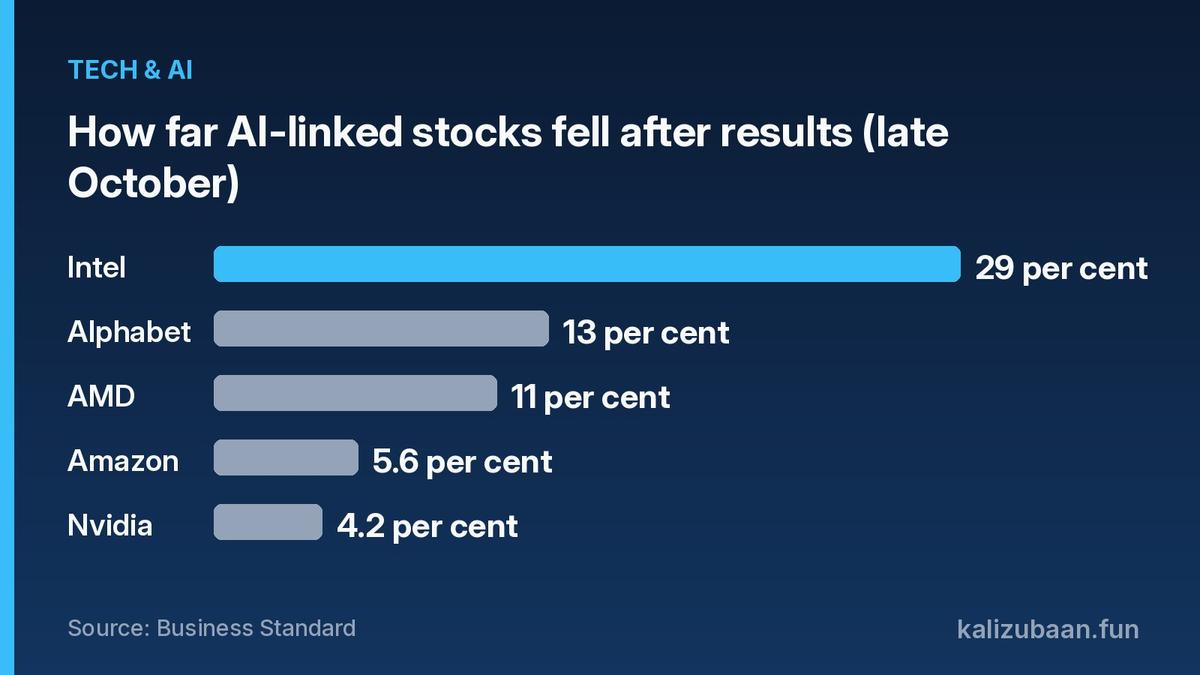
Source: Business Standard
Barclays adds a telling detail. Chipmakers and the big platforms are falling together, which means investors are stepping away from AI as a whole, not just swapping one AI stock for another. The Philadelphia Semiconductor Index had its longest losing streak since 2008.
Outside AI, the market held up. Over the last month the equal-weighted S&P 500 rose 5.0% while the normal, size-weighted index fell 0.9%, Barclays says.
Why are investors suddenly worried about AI?
The worry is money: AI companies are spending so much on data centres that their free cash flow has turned negative, and they now depend on borrowing.
Three of the four biggest cloud companies, Amazon, Meta and Alphabet, reported negative free cash flow in the latest quarter. Amazon's deficit reached nearly $35 billion, against positive free cash flow of $430 million a year earlier (Business Standard). Microsoft was the exception, with $18.6 billion of positive free cash flow.
The future bills are even bigger. Meta's spending commitments rose to $825 billion, and Alphabet's passed $1 trillion.
Barclays calls this a self-reinforcing loop (Barclays). If funding gets harder, fewer data centres are built. Fewer data centres mean slower earnings growth, which makes investors less willing to fund the next round.
What most guides miss: the sharpest swing is Amazon's. Going from $430 million of free cash flow to a deficit of nearly $35 billion in one year shows how fast AI spending has changed Big Tech from cash machines into heavy borrowers. That shift, not any single chatbot, is what the market is now pricing.
What are credit markets saying?
Debt markets are flashing earlier warnings than stocks, with the cost of insuring tech company debt at record highs for some names.
Five-year credit default swaps on Broadcom rose to 175.4 basis points, their highest close on record, according to Bloomberg data cited by Business Standard. A credit default swap is insurance against a company failing to repay its debt, so a higher price means more fear.
Trading in this kind of protection on the 10 largest cloud companies and chipmakers rose more than eightfold in 2026, to $176 billion. A Nikkei Asia study also put the off-balance-sheet commitments of Alphabet, Microsoft, Amazon, Meta and Oracle at $1.65 trillion, more than their $1.35 trillion of reported debt.
Barclays notes that bonds of the most indebted AI infrastructure firms now yield in the mid-teens. Reports that Anthropic's IPO valuation was cut from around $2tn to around $1.5tn added to the pressure.
What do experts say about an AI crash?
Most experts say a correction is likely at some point, but nobody can predict the timing.
Oxford Economics says AI-related spending made up an estimated 27% of US fixed investment in the second quarter, and only the UK railway mania of the 1840s saw a bigger investment surge (Oxford Economics). Most earlier tech booms ended abruptly, it notes, even when the technology was useful.
Its key point: a sharp fall does not need AI to be worthless, only for results to disappoint against very high hopes. Possible triggers include weak profits, poor productivity data, regulation and rising US interest rates, and Oxford Economics expects these risks to grow as we enter 2027.
Indian fund managers are saying something similar. At a Business Standard summit in Mumbai, ICICI Prudential AMC's chief investment officer Sankaran Naren said: "The problem is not that AI is real. It is just an implied growth assumption model of investing, which is a problem."
Barclays is more hopeful. It expects sharp rebounds and believes that once spending falls to what can actually be funded, the AI theme can "find a second wind".
What should Indian investors do about the AI bubble?
Do not panic-sell or chase dips based on headlines; check how much AI exposure you already have.
If you own US tech through international mutual funds or US stock apps, check the mix. If a large part of your portfolio is in a handful of AI names, a correction like this one hits harder, as the Business Standard numbers show.
A few calm checks help. Know what your funds hold, keep an emergency fund outside the market, and avoid borrowing to buy "cheap" AI stocks after a fall. Big rallies and big falls often come close together, as Barclays points out.
FAQs
Is AI bubble going to burst in 2026?
Nobody can say when. The Nasdaq 100 is 9.5% below its October high, and Oxford Economics sees correction risks rising into 2027, but a correction is not the same as a full crash.
Is demand for AI falling?
Not according to Barclays. ASML and TSMC reported strong AI demand and full order books. The worry is about funding the build-out, not about people using AI.
Why did Intel and Alphabet shares fall so much?
Intel fell 29 per cent after a weak revenue forecast. Alphabet fell 13 per cent after weaker search revenue and a second quarter of negative free cash flow, Business Standard reported.
Will an AI crash affect Indian stocks?
Last week's sell-off spread across Asia, with Korea's Kospi down 3.48 per cent and Japan's Nikkei 225 down 2.1 per cent. Indian investors with international or US tech funds are the most directly exposed.
Expert review: pending.
This is general information, not a recommendation to buy or sell; check with a SEBI-registered adviser before you invest.
Related reading
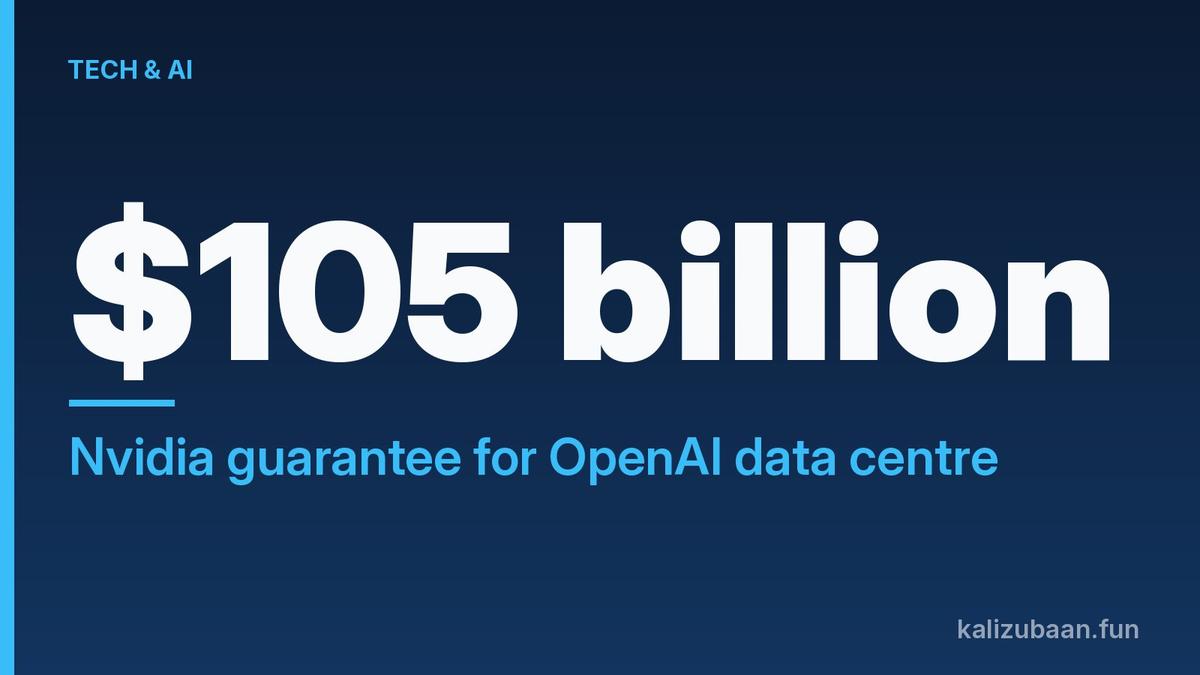
- $105 Billion Guarantee: Is Nvidia Fuelling an AI Bubble?
- 1,96,000 Tech Layoffs in 2026: What It Means for Indian Freshers
- $10 Billion Cut: Why OpenAI's Funding Round Valuation Fell
Sources
Tagged Topics
Keep reading

Thanks for reading Kali Zubaan
Explore more articles in Tech & AI or return to the main publication feed.


