$105 Billion Guarantee: Is Nvidia Fuelling an AI Bubble?
Nvidia now backs OpenAI, Anthropic, xAI, CoreWeave and Meta with stakes, loans and guarantees worth billions. Is Nvidia an AI bubble risk or a smart bank for the AI boom? Here is what experts say.
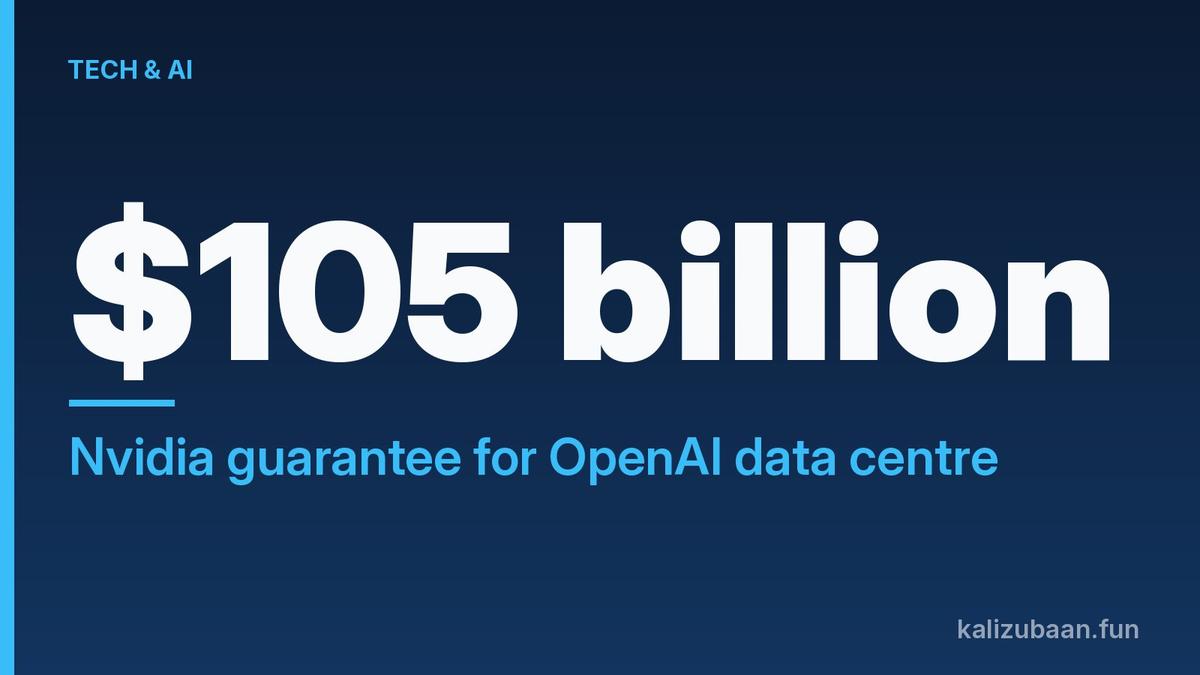
This week Nvidia put $3 billion into Meta's share sale. That is small next to its other promises: a guarantee of up to $105 billion linked to an OpenAI data centre, according to US media.
So is Nvidia an AI bubble risk, or the smartest bank in tech? Analysts now call the chip giant the "central bank" of the AI boom, and the answer depends on whose demand you trust.
Quick answer
- Nvidia holds stakes in OpenAI, Anthropic, xAI, CoreWeave, Nebius, Mistral and Wayve, and has offered financial backstops on top.
- Its backstops include up to $6.3 billion of unused CoreWeave capacity and around $36 billion in cloud backstops.
- Supporters say it is a smart use of huge profits. Critics call it circular financing, like the dot-com era.
- The biggest risk is concentration: two customers made up 22 percent and 14 percent of Nvidia's revenue in its 2026 fiscal year.
This is general information about the AI industry, not investment advice. Speak to a SEBI-registered adviser before buying any stock or fund.
What is Nvidia investing in?
Nvidia is putting money into the AI labs and cloud companies that buy its chips, plus some startups in Europe and Asia.
Nvidia has taken stakes in OpenAI, Anthropic and Elon Musk's xAI, now part of SpaceX, and in "neocloud" firms CoreWeave and Nebius, which rent out computing power built on Nvidia chips (The Economic Times).
Outside the US, it has backed French AI developer Mistral and British self-driving startup Wayve. In Asia, it has teamed up with South Korea's SK Group to build data centres.
The Meta deal, announced on Tuesday, is the newest piece of this web.
How big are Nvidia's AI backstops?
Nvidia's guarantees are far bigger than its headline stakes, with one OpenAI-linked guarantee reaching up to $105 billion.
Beyond equity, Nvidia acts as a customer of last resort. For CoreWeave, it committed to buy up to $6.3 billion of unused computing capacity if no other customer takes it (The Hindu).
It also has around $36 billion in cloud backstops, according to US media.
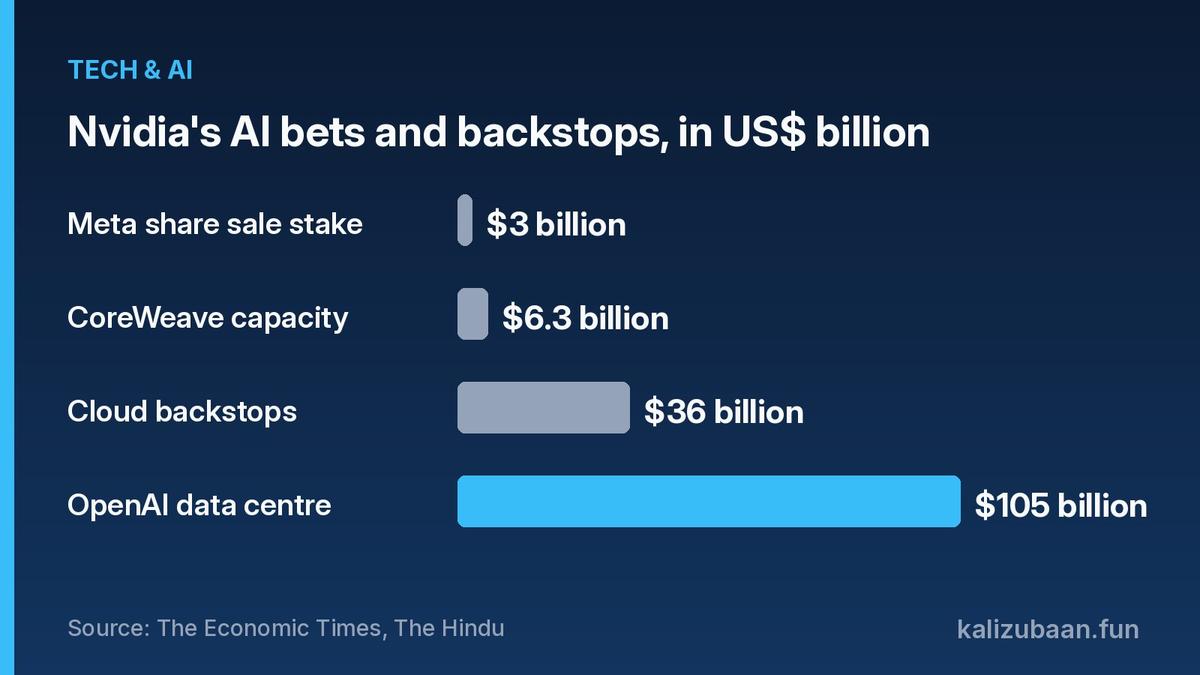
Source: The Economic Times, The Hindu
This is on top of a $100 billion investment into OpenAI that Nvidia announced in September 2025, on the expectation that OpenAI would fill new data centres with Nvidia GPUs (Wikipedia).
What most guides miss: the $105 billion OpenAI guarantee is 35 times the $3 billion Meta stake that made this week's headlines. And the two biggest direct customers together make up 36 percent of Nvidia's revenue, more than a third. The real exposure sits in guarantees and a few buyers, not in the stakes.
Why is Nvidia doing this?
Experts say Nvidia earns so much that recycling cash into its own customers is one of its few good options.
"They're essentially becoming a bank," said Michael Cusumano, a professor at the MIT Sloan School of Management. He called channelling money back into infrastructure tied to Nvidia purchases "a smart thing" (The Economic Times).
The alternative, running its own data centres, would put Nvidia in competition with its biggest customers. Cusumano said that "might also trigger a whole bunch of antitrust complaints."
Gil Luria of D.A. Davidson said Nvidia spots parts of the AI ecosystem that are not investing enough and fills the gaps. "It's unprecedented, but it appears to be working," he said.
Jensen Huang argues frontier AI labs are the first startups that need tens of billions of dollars just to get started. Nvidia's money buys them time.
Is Nvidia's investing circular financing?
Partly, yes, and that is the core of the AI bubble worry: some of the demand for Nvidia chips is paid for with Nvidia's own money.
Critics compare it to the dot-com era, when companies inflated growth by funding startups that then bought their products. Paulo Carvão of the Harvard Kennedy School said, "the closer these relationships are, the harder it is for one to assess true sustainable demand" (The Hindu).
Luria draws a line between kinds of demand. Nvidia funding CoreWeave to buy Nvidia chips is weaker than Microsoft buying chips to serve OpenAI, which serves paying business customers.
What are the risks if AI demand slows?
The main risk is contagion: if one weaker partner stumbles, losses could hit chipmakers, data-centre builders and lenders together.
That fear is already showing. Shares of Nvidia-linked neoclouds CoreWeave, Nebius and IREN fell at least 30 percent in October on worries about tighter credit for AI projects (The Economic Times).
Asia has seen how fast it can turn. In June and July 2026, South Korea's KOSPI dropped 44% in 40 days, erasing $2.18 trillion, after a sell-off in Samsung Electronics and SK Hynix (Wikipedia).
Not everyone sees a bubble. Goldman Sachs, Morgan Stanley and JPMorgan have argued that AI gains are backed by real earnings and revenue.
How long will demand for Nvidia chips last?
Experts quoted this week expect strong demand for at least another year, with estimates running from 12 months to five years.
Carvão estimated demand would keep growing for another 12 to 18 months before levelling off, because AI chips are still limited by supply. Cusumano expects high demand for three to five years (The Hindu).
For Indian readers who hold US tech stocks or international funds, three signals are worth watching:
- Share prices of neoclouds like CoreWeave, Nebius and IREN.
- Any news that a backstop is actually being used.
- How much of Nvidia's revenue still comes from its two biggest buyers.
FAQs
Is Nvidia an AI bubble?
Nobody can say for sure. Nvidia's demand is real, but critics warn that some of it is funded by Nvidia's own stakes and guarantees, which makes true demand harder to judge.
What is circular financing in AI?
It is when a supplier invests in or guarantees its customers, who then use that money to buy the supplier's products. Critics compare Nvidia's deals to dot-com era vendor financing.
How much has Nvidia guaranteed for OpenAI?
US media report a guarantee of up to $105 billion linked to an OpenAI data centre, separate from the $100 billion investment announced in September 2025.
Which companies has Nvidia invested in?
OpenAI, Anthropic, xAI, CoreWeave, Nebius, Mistral and Wayve, plus a $3 billion stake in Meta's share sale. It also works with SK Group on data centres.
Company deals and figures change fast. Check the latest filings and news before making any decision. This is not investment advice.
Related reading
- 91% Demand Jump: Why Samsung Now Uses TSMC for Nvidia's HBM
- 85% of AI Code Is PyTorch. Google and Amazon Want It Off Nvidia
- 2x Throughput: Why AI Cloud Modal Picked Nvidia's Vera CPU
Sources
Tagged Topics
Keep reading
Thanks for reading Kali Zubaan
Explore more articles in Tech & AI or return to the main publication feed.