₹7–10 Lakh a Year From Fish Cages: A Homemaker's Reservoir Plan
Sujata Bhuyan, a homemaker in Sambalpur, now produces 25-30 tonnes of fish a year in Hirakud reservoir cages. Here is how training and PMMSY support built her income.

Sujata Bhuyan was a homemaker in Odisha's Sambalpur district who wanted to add to her family's income. She started fish farming in 2022, in cages floating in the Hirakud reservoir.
Today she produces about 25 to 30 metric tonnes of fish a year. The Indian Council of Agricultural Research (ICAR) puts her annual income at ₹7–10 lakh, and Prime Minister Narendra Modi featured her on Mann Ki Baat.
Quick answer
- Sujata Bhuyan rears fish in cages inside the Hirakud reservoir under the Pradhan Mantri Matsya Sampada Yojana (PMMSY).
- Training from ICAR-CIFRI, Barrackpore, with the Odisha Fisheries Department helped her fix early problems with water quality, feed and disease.
- Within 2-3 years her output reached 25-30 metric tonnes a year.
- Her income is reported between ₹7 and ₹10 lakh a year, depending on who you ask.
Who is Sujata Bhuyan?
Sujata is from Sambalpur district in Odisha. YourStory, which this week rounded up the women entrepreneurs featured on Mann Ki Baat this year, describes her as a homemaker who went into fish farming to supplement her family's income.
She did not dig a pond. She chose cage culture, which means rearing fish in enclosed cages placed inside a natural water body.
Her water body is a big one. The Hirakud Dam on the Mahanadi near Sambalpur is the longest earthen dam in the world, and behind it stretches a 55 km long lake, the Hirakud Reservoir.
The numbers, and why they differ
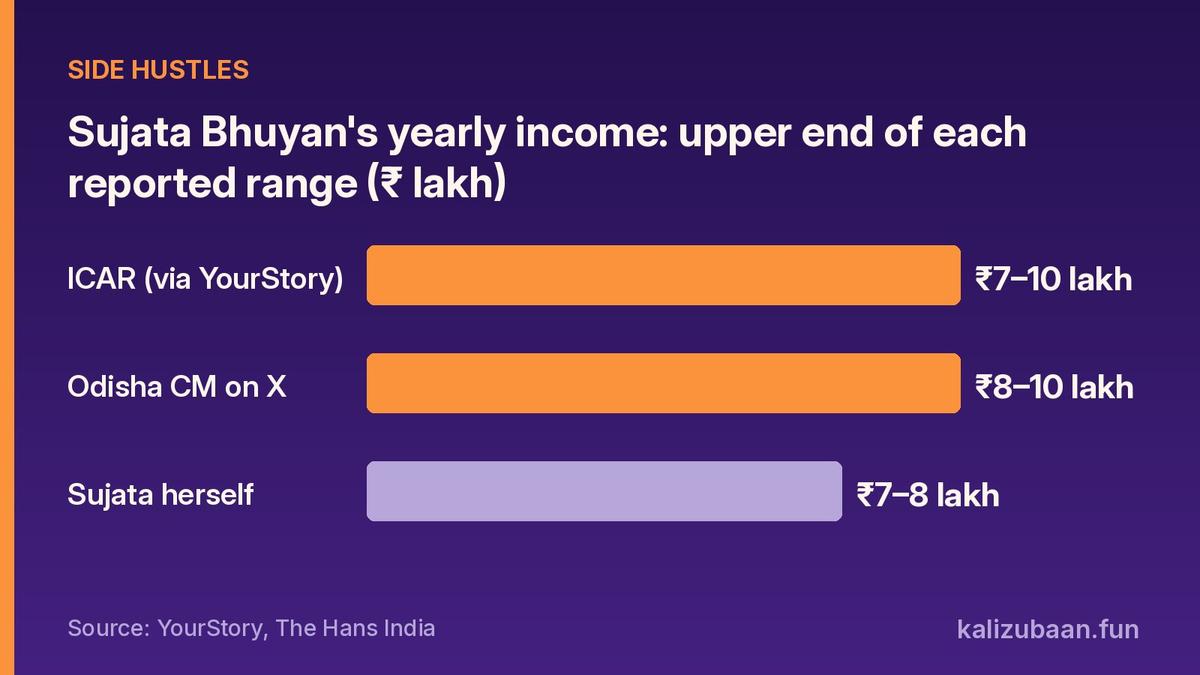
Three sources describe her income, and they don't match exactly. That is worth knowing before you plan anything around it.
Source: YourStory, The Hans India
According to ICAR, quoted by YourStory, her annual fish production rose to 25-30 metric tonnes, earning her ₹7–10 lakh a year.
Odisha Chief Minister Mohan Charan Majhi wrote on X that she produces about 25 to 30 metric tonnes and earns ₹8 to 10 lakh a year.
Sujata's own words, reported by The Hans India, are the most modest. "I have started fish farming in 2022 and now earning Rs 7 to 8 lakh per annum," she said.
When the person doing the work gives the lowest number, take that one as your planning figure. None of the sources say whether these are profit or revenue, or what she spent on cages, seed and feed.
What the early days were really like
It was not smooth. PM Modi said in the broadcast that weather changes, arranging food for the fish and balancing household duties were all challenges.
YourStory lists the same problems in more practical terms: managing water quality, managing fish feed, and juggling the business with home responsibilities.
The turning point was training. ICAR's Central Inland Fisheries Research Institute (ICAR-CIFRI) in Barrackpore worked with the Odisha Fisheries Department to train her in reservoir cage culture.
She learned scientific fish stocking, water quality management, disease control and how to run cages. That knowledge, more than money, is what let her expand.
The government scheme behind it
Her farm runs under the Pradhan Mantri Matsya Sampada Yojana, or PMMSY. It was announced in the Union Budget on 5 July 2019 to fill infrastructure gaps in fisheries.
According to Wikipedia, the government later announced a ₹20,000 crore outlay for fisheries through the scheme. It offers money to fish farmers for building ponds, cages, hatcheries and nurseries, and a credit-linked subsidy to help them start fish farming as a business.
That is the key point for anyone copying this idea. Cage culture in a public reservoir is not something you just start on your own; it runs through the fisheries department and its schemes.
Other women Mann Ki Baat featured this year
Sujata is not the only one. YourStory's roundup of Mann Ki Baat stories from this year includes several small, skill-based businesses.
Vesalu Puro of Phek district, Nagaland, planted gladiolus bulbs on just a quarter-acre after training at her local Krishi Vigyan Kendra. According to ICAR, her first crop gave around 5,400 marketable flower spikes, gross income of ₹81,000 and net income of ₹52,070.
Payal Munjpara from Surendranagar, Gujarat, finished a four-month Solar PV Technician course and now installs rooftop solar systems across neighbouring districts.
Babita Sharma, a street vendor in Ghaziabad, grew a small stall into a proper shop using PM SVANidhi working-capital loans. The government says women make up about 46% of that scheme's beneficiaries.
The common pattern is simple: a skill, a bit of formal training, and access to credit or a market.
How to explore cage fish farming in India
If this interests you, here is a sensible order of steps. These are general pointers, not a business plan.
- Visit your district fisheries office. Ask whether cage culture is allowed in a reservoir near you and how PMMSY support is applied for.
- Get trained first. Sujata's growth came after ICAR-CIFRI training. Ask about courses through fisheries departments or your local Krishi Vigyan Kendra.
- Plan around the lowest income figure. Use her own ₹7 to 8 lakh number, and remember costs are not reported.
- Line up buyers early. Fish is perishable, so know where you'll sell before harvest.
- Start with what you can manage. She balanced the farm with household work, which is why water quality and feeding routines mattered so much.
Tax note: income from fish farming may be treated differently from crop farming income. This is information only, so check with a CA.
FAQs
How much does Sujata Bhuyan earn from fish farming? ICAR puts it at ₹7–10 lakh a year, the Odisha CM said ₹8 to 10 lakh, and Sujata herself said ₹7 to 8 lakh.
What is cage culture? It means rearing fish in enclosed cages placed inside natural water bodies, such as the Hirakud Reservoir, instead of in a dug pond.
Which scheme supported her? She farms under the Pradhan Mantri Matsya Sampada Yojana (PMMSY), with training from ICAR-CIFRI and the Odisha Fisheries Department.
How long did it take her to grow? Within 2-3 years her production rose to 25-30 metric tonnes a year.
Would you try a farming side business if training and a subsidy were available near you? Tell us in the comments.
Results vary; nothing here is a promise of income.
Sources
Tagged Topics
Keep reading

Thanks for reading Kali Zubaan
Explore more articles in Side Hustles or return to the main publication feed.