₹2,000 a Kilo From a ₹5,000 Start: A Beed Moringa Powder Hustle
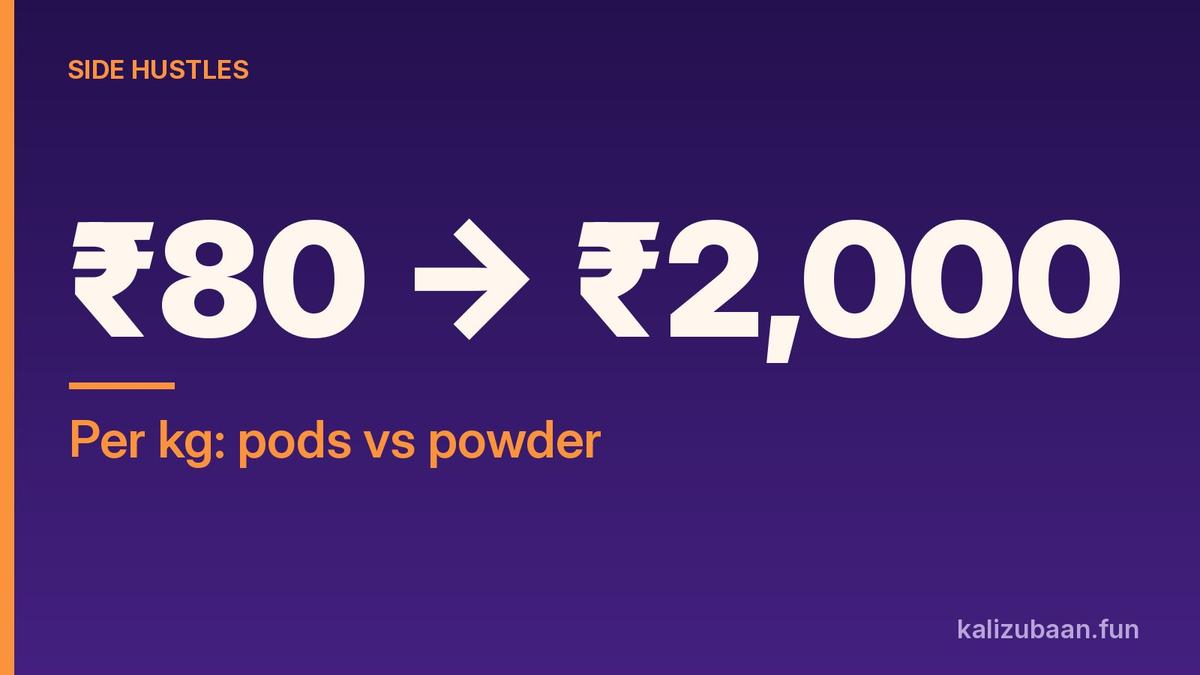
Dipali Raut sold drumsticks at ₹80 a kilo, then turned the same moringa leaves into powder priced near ₹2,000 a kilo, using a home mixer, Instagram and ₹5,000.
Dipali Raut lost her father while she was in Class 10. Her brother and sister were already studying in Pune and Latur, and she didn't want to leave her mother alone in their village in Beed, Maharashtra.
So she stayed and tried something on the family land. Today the same moringa tree that gives her drumsticks at ₹80 a kilo also gives her leaf powder that sells at nearly ₹2,000 a kilo. She started with ₹5,000, a regular kitchen mixer and an Instagram page.
Quick answer
- Dipali started moringa powder in 2024 with ₹5,000 for saplings, a mixer, a strainer, utensils and packaging.
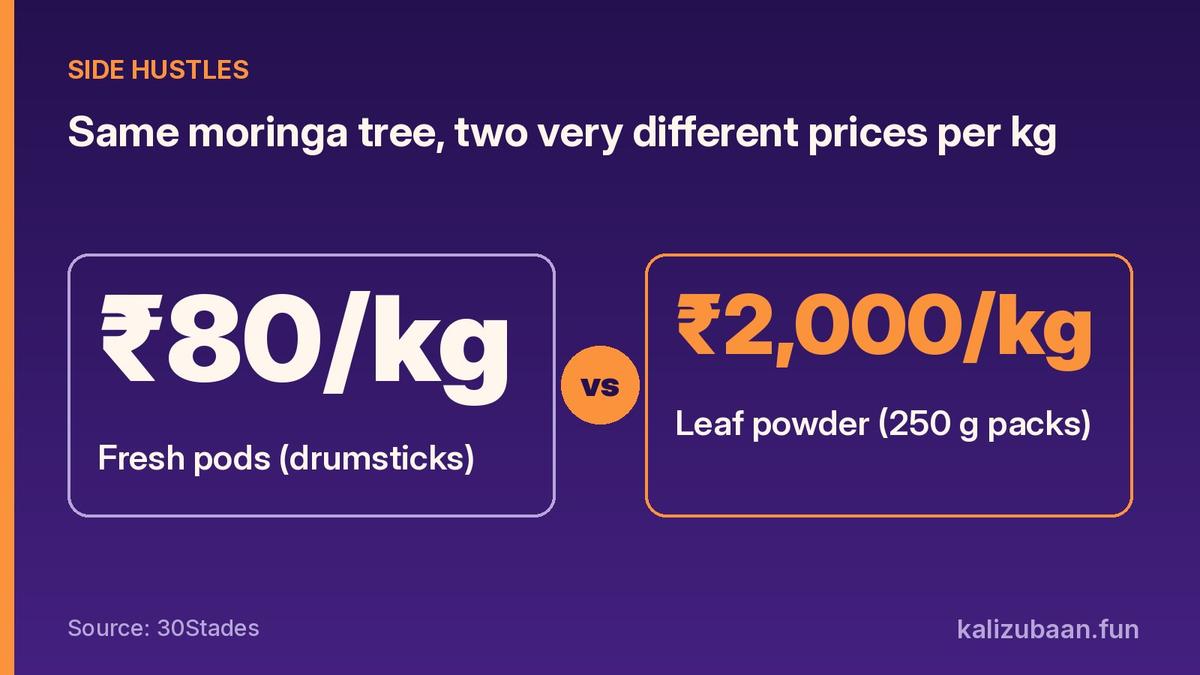
- She sells 250-gram packets at ₹499, which works out to nearly ₹2,000 per kg, against ₹80 per kg for fresh pods.
- She now sells around 60 to 70 kg of powder a month and has employed nine women.
- The lesson for side hustlers: the money moved when she processed the crop and sold it directly, not when she grew more of it.
The numbers behind the moringa powder business
Here is what 30Stades reported about how the business grew, step by step.
In February 2024, Dipali planted around 300 to 400 saplings on half an acre, with a 10-foot gap between plants. She picked the Valiyapatti and ODC-3 varieties and got the planting material from her aunt's nursery for ₹500.
The plants began giving drumsticks in about six months. She sold the fresh pods locally at ₹80 per kg, which she called a good rate.
Then she found a better product. Moringa powder has a longer shelf life and higher demand, so she started drying and grinding the leaves at home.
Her total starting investment was ₹5,000. That covered the saplings, a regular mixer, a strainer, some utensils and packaging.
She washed the leaves, dried them under a fan, ground them in the mixer, sieved the powder and packed it herself. Nothing fancy.
Why powder beats pods by a mile
The jump in price is the whole story. The same tree can be sold as a vegetable or as a packaged health product, and the packaged version earns far more per kilo.
Source: 30Stades
Drying and powdering is also an old, well-known use. Wikipedia notes that moringa leaves are commonly dried and crushed into a powder for soups and sauces, and that the leaves are the most nutritious part of the plant.
The crop also suits her region. Moringa is a fast-growing, drought-resistant tree, and Beed is a drought-prone district. Dipali says it needs watering only around two to three times a week.
One honest caution. The article does not report her monthly revenue or profit, so don't treat the per-kilo price as take-home income. Drying, grinding, packing, shipping and staff all cost money.
How Instagram got her the first orders
Making the powder was the easy part. Selling it was hard at first.
"I was not getting orders for moringa products in the beginning," she told 30Stades. Then she opened an Instagram page and started sharing her product, and local people gradually started ordering.
Word of mouth did the rest. As more people tried the powder, recommendations brought in more orders, and she kept her price at ₹499 for a 250-gram pack.
She also used social media to explain her organic farming methods. Her inputs include neem spray, jeevamrut, vermicompost and cow-dung manure.
That matters for any home food business in India. Buyers of health products want to know how the thing was made, and short videos showing the drying and grinding are free proof.
From a home mixer to a ₹35,000 grinder
She didn't buy machinery on day one. She built the business in stages and reinvested as demand grew.
In October 2025, once the kitchen mixer could not keep up, she spent ₹35,000 on a grinding machine. It raised her processing capacity to around 30 kg a day.
She has since expanded moringa to two acres, focused on powder production. She harvests leaves every two to three months.
She also added products from what the farm already had. With around 30 amla trees, she sells amla powder in 250-gram packets for ₹399, and she grows mint, curry leaves and lemons in smaller amounts.
Her business now employs nine women across social media, farming and processing. She also received the Rashtriya Yuva Chetana Puraskar, and still attends college seven km from the village.
How to try a moringa or leaf-powder side hustle in India
You don't need two acres to test this idea. Here is a careful way to start, based on what worked for Dipali.
- Start with what you can sell, not what you can grow. Check whether people around you, or on your Instagram, will buy a small pack before you plant anything.
- Test with kitchen equipment. Dipali used a regular mixer and a strainer before she spent on a grinder.
- Price per pack, not per kilo. Her 250-gram pack at ₹499 is easier for buyers to say yes to than a big bag.
- Show the process. Videos of washing, fan-drying and sieving build trust for an organic product.
- Reinvest in stages. Buy machinery only when orders clearly outgrow your current setup, as she did in October 2025.
- Add products from the same farm or kitchen. Her amla powder used trees the family already had.
Mistakes to avoid
- Copying her price without checking your own costs for drying, packaging and delivery.
- Making health claims you can't back up. Sell the product honestly and let the nutrition facts speak.
- Ignoring food-safety rules. Packaged food sellers in India usually need food licensing or registration, so check the rules for your scale before you sell widely.
Tax note: income from selling processed products is business income. This is information only, so check with a CA for your situation.
FAQs
How much did Dipali Raut invest to start? Her initial investment was ₹5,000, covering saplings, a regular mixer, a strainer, utensils and packaging materials.
What price does she sell moringa powder at? She sells 250-gram packets at ₹499, which she says works out to nearly ₹2,000 per kg.
How much moringa powder does she sell? She now sells around 60 to 70 kg of moringa powder a month, according to 30Stades.
Do I need farmland to start a powder business? Not to test it. Dipali's own lesson was to start small with simple equipment and grow in stages. Sourcing leaves from local growers is one option, but check quality and food rules first.
Would you pay ₹499 for a 250-gram pack of organic moringa powder? Tell us in the comments.
Results vary; nothing here is a promise of income.
Sources
Tagged Topics
Keep reading


Thanks for reading Kali Zubaan
Explore more articles in Side Hustles or return to the main publication feed.