₹4 Lakh a Month From an Old Poultry Shed: The Mushroom Math
A Bengaluru MBA turned down Paris job offers and turned his family's shut poultry shed into an oyster mushroom farm. Here is how the ₹4 lakh a month figure is built, and what it leaves out.

In January 2025, a Bengaluru man bought 2 kg of oyster mushroom spawn for ₹180 and packed it into 10 bags of free paddy straw. About 22 days later, the bags started sprouting.
Today the same idea runs out of his family's old poultry shed in Devanahalli. It produces around 1,350 kg of mushrooms a month and brings in about ₹4 lakh in monthly revenue.
The man is Prithviraj, who had job offers in Paris after a master's in international business at SKEMA Business School. He came home instead. Here is how his numbers stack up, and what they do not tell you.
Quick answer
- The ₹4 lakh is monthly revenue, not profit: about 45 kg a day sold at an average of ₹320 per kg, as reported by 30Stades and Moneycontrol.
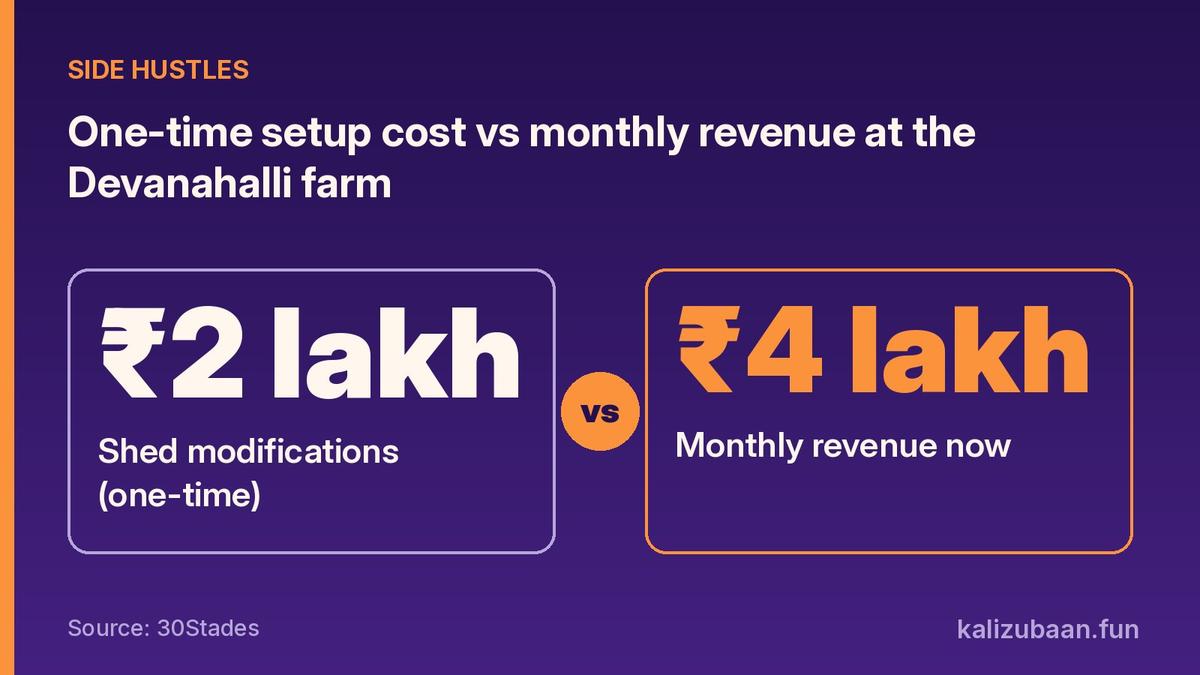
- His setup cost was about ₹2 lakh, because the shed and its tiled roof already existed.
- He tested with 10 bags at home before going commercial with 25 bags, and now keeps around 4,000 bags in rotation.
- Extra income comes from a ₹3,000 training course and from selling compost made from spent substrate.
The numbers behind ₹4 lakh a month
The headline figure is simple multiplication. The farm produces about 1,350 kg of oyster mushrooms a month, or nearly 45 kg a day.
At an average selling price of ₹320 per kg, that output works out to roughly ₹4 lakh in monthly revenue, according to 30Stades.
That is the top line. Neither report gives his monthly costs, such as spawn, straw, labour, packing and transport, so there is no sourced profit figure. Treat ₹4 lakh as what comes in, not what he keeps.
Why a dead poultry shed made the math work
The family's poultry farm in Devanahalli shut down in 2019. Prithviraj saw an unused building with a roof, land and space, and decided to reuse it rather than build new.
He spent about ₹2 lakh on modifications. That covered green mesh, shade nets, tarpaulins, roof-related work and fabrication.
The shed's tiled clay roof keeps it naturally cool, so he kept it. There is no air conditioner, no exhaust fan and not even a regular fan. Shade, water sprinklers and airflow through the mesh do the work.
Source: 30Stades
This is the part most copycat plans miss. His low setup cost depended on a building his family already owned. If you have to rent or build a shed, your starting bill will look very different.
From 10 bags to 4,000: how he scaled
He did not start big. He first took training from the Indian Institute of Horticultural Research (IIHR) in Bengaluru.
He looked at button mushrooms, then picked oyster mushrooms because they have a simpler production process and need a lower initial investment.
His home trial used 10 bags. Each bag gave around 800 grams, so he got roughly 8 kg, which he gave away to friends and relatives to learn the crop cycle and test demand.
On 6 March 2025, he started commercial production in the shed with 25 bags across about 50 sq ft. The first two flushes gave him 21 kg.
Now he keeps around 4,000 bags at different stages. About 900 to 1,000 sit in the dark room and around 600 in the light room, while the next batch is prepared.
The low-tech process, step by step
The process is mostly manual, which keeps costs down. Here is how 30Stades describes it:
- Paddy straw is cut with a chaff cutter and soaked in plain water for about 12 hours.
- The straw is steamed in drums, without a commercial boiler.
- It is dried in sunlight, then packed into polythene bags with oyster mushroom spawn.
- Bags move into dark and light rooms, where shade, sprinkling and natural airflow manage temperature and humidity.
The first flush usually appears between 18 and 26 days, depending on the weather. The second comes around the 32nd to 34th day.
He still buys spawn from IIHR, at around ₹100 per kg.
Selling is the real business
Oyster mushrooms have a short shelf life, and he has no refrigeration. So harvests are packed and sent to buyers the same day.
His buyers include local vegetable markets, supermarkets, retail outlets and companies. He also supplies Zepto, where his mushrooms go through quality checks before delivery.
That is why his ₹3,000 training programme covers marketing as well as growing. In his words, production alone is not enough; growers need to know where and how to sell.
Spent substrate is not thrown away either. It goes into composting and vermicomposting, which gives him another revenue stream.
Another mushroom story, for perspective
Prithviraj's farm is young. A longer example comes from Kerala, reported by Startup Pedia in 2024.
Shije started growing oyster mushrooms on her balcony in 2007 with ₹250 for beds and spawn. A year later, the couple invested about ₹50,000 to set up 600 beds on their farmland.
They launched the Coon Fresh brand in 2010. They now run a farm of 6000 beds producing 12 tons of mushrooms a year, along with value-added products and training, and reported annual revenue of Rs 80-90 lakh.
Their first few months brought in only Rs 2000-5000 a month. Growth came from building awareness and a brand over years, not from one good season.
Before you try this
- Start with a trial. Both growers tested small batches before scaling. A few bags will teach you the crop cycle cheaply.
- Get trained. IIHR is where Prithviraj learned, and he still sources spawn there.
- Find buyers first. With no cold storage, unsold mushrooms are lost money.
- Do your own cost sheet. Rent, labour, transport and wastage are not in these reports, and they decide your profit.
- Tax and licences. Farm and food-business rules can apply to you. This is information only, so check with a CA.
FAQs
Does Prithviraj make ₹4 lakh profit a month? No. The reports describe ₹4 lakh as monthly revenue, from about 1,350 kg sold at an average of ₹320 per kg. Costs are not disclosed.
How much did he invest to start? About ₹2 lakh on modifying an existing poultry shed, plus ₹180 for the spawn used in his first home trial.
Why oyster mushrooms and not button mushrooms? He said oyster mushrooms have a simpler production process and a lower initial investment.
Can I learn from him? He runs a training programme for ₹3,000 that covers cultivation and basic marketing, according to 30Stades.
Would you try a small mushroom trial at home first? Tell us what is stopping you.
Results vary; nothing here is a promise of income.
Sources
- 30Stades: This man left Paris to grow mushrooms in Bengaluru; earns Rs 4 lakh a month with a low-cost model
- Moneycontrol: Man rejects Paris job offers to start oyster mushroom farming in Bengaluru, now earns Rs 4 lakh a month
- Startup Pedia: Kerala couple started growing mushrooms at home with just ₹250, now make ₹90 lakh annually
Tagged Topics
Keep reading



Thanks for reading Kali Zubaan
Explore more articles in Side Hustles or return to the main publication feed.


