65.7% vs 58.2%: China's Moonshot AI Launch Takes On GPT-6
China's Moonshot AI launch of Kimi K3.1 Pro scored 65.7% on a coding test, ahead of GPT-6 Astra's 58.2%. Here's what it does, where Indians can use it, and what to watch.
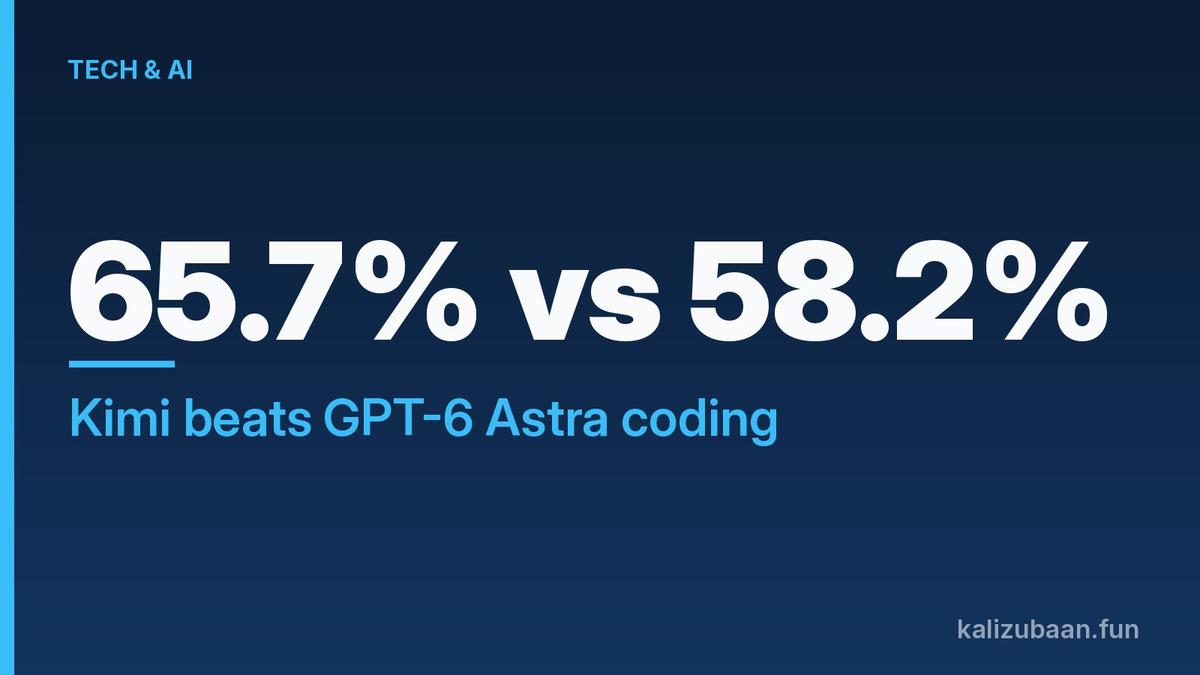
A Chinese startup just put out a free-to-download AI model that, by its own numbers, beats GPT-6 Astra at real coding work. China's Moonshot AI launch of Kimi K3.1 Pro scored 65.7% on Terminal-Bench 4.0, against GPT-6 Astra's 58.2%.
It also did something unusual. It deliberately made the model worse at hacking before giving it away.
Quick answer
- Kimi K3.1 Pro is a 3-trillion-parameter open-weight model from Beijing's Moonshot AI, with a 1-million-token context window.
- You can use it now on Kimi.ai, the Kimi mobile apps, Kimi Work, Kimi Code and the Kimi API. Full weights are due by November 4.
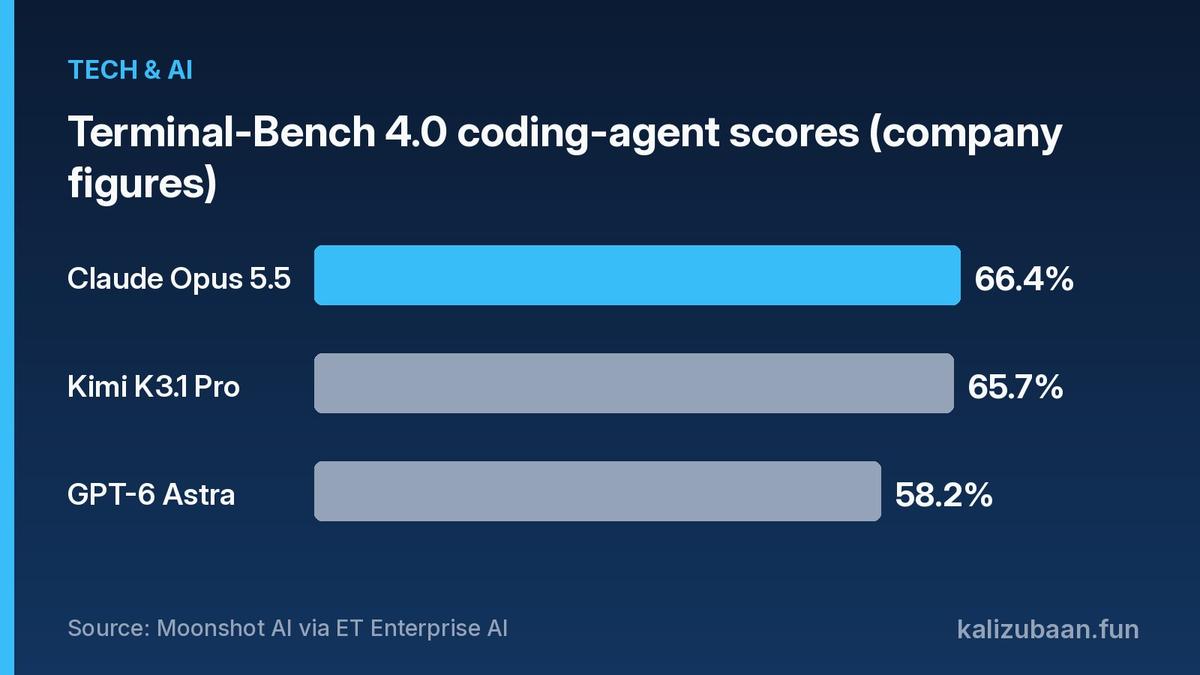
- On Moonshot's numbers it sits between GPT-6 Astra (58.2%) and Claude Opus 5.5 (66.4%) on coding agents. None of this has been independently checked yet.
- Moonshot cut cyber-attack training data, dropping its own hacking score from 90.5% to 81.0%.
Why the Moonshot AI launch is trending today
Moonshot announced Kimi K3.1 Pro on Saturday, October 24, according to Mint and ET. It is the company's first major model upgrade since Kimi K3 grabbed global attention in July 2026.
That earlier release mattered. Mint reports that K3's launch worried investors about how cheaply Chinese labs could build models that match established ones.
Since then, rivals such as Z.ai and DeepSeek have climbed industry leaderboards, Mint says. So this launch is Moonshot's attempt to take back the lead.
The company calls K3.1 Pro "our most capable 3T-class open-weight model to date." It is an upgraded Kimi K3 built with significantly more computing power during post-training, per the company statement carried by ET.
What Kimi K3.1 Pro actually does
Moonshot is pitching it at three jobs: coding, financial research and 3D creation, including game development.
On coding, the company says K3.1 Pro "covers the full range of coding work, from quick fixes in real codebases to full-project builds." It also claims the model can deliver complete financial workflows end to end.
The 1-million-token context window is the headline spec for everyday users. It means the model can read a very large amount of text in one go, such as a long report or a big codebase.
There is also a faster version, Kimi K3.1 Pro Highspeed. Moonshot says it runs 2-3x the speed of the standard model.
The benchmark numbers, side by side
Here is how Moonshot says K3.1 Pro did on Terminal-Bench 4.0, a test of coding agents doing real tasks in a terminal.
Source: Moonshot AI via ET Enterprise AI
So it beats GPT-6 Astra by a clear margin and trails Claude Opus 5.5 by less than a point.
On Moonshot's own internal test, Kimi Code Bench 3.0 Long-horizon, K3.1 Pro scored 61.2%, up from K3's 55.95. That test checks multi-step execution, tool use and end-to-end problem solving.
Keep one thing in mind. These are the company's own figures, and an internal benchmark is a test the company designed itself.
Why Moonshot made its model worse at hacking
This is the part most coverage is focused on. Moonshot says it stripped cyber-related data out of the training data and reinforcement-learning environments, while keeping general coding skills.
"We aim not to release open weights that would extend the absolute frontier of cyber capability," the company said, as reported by Reuters via ET.
The result, on Moonshot's internal cyber test of finding and exploiting software bugs in a controlled setup: K3.1 Pro scored 81.0%. A similar version without the safety changes scored 90.5%.
That is still higher than its predecessor, Moonshot admits. And the results have not been independently verified.
Why does this matter? Once open weights are out, the developer has much less ability to restrict access, monitor use or update safeguards than with a hosted service. Governments and security researchers worry that AI which can write code and run tools could make hacking easier and cheaper.
What it means for Indian users and developers
The model is already live on Kimi.ai, the Kimi mobile apps, Kimi Work, Kimi Code and the Kimi API, per the company. The sources do not mention any India-specific pricing or launch, so check the Kimi site before you plan around cost.
For Indian students and freshers learning to code, a strong open-weight model is useful in a different way. Once the weights are out by November 4, companies and colleges can run and modify it on their own systems without depending on Moonshot.
There is a catch for businesses. According to Wikipedia, Moonshot's earlier K3 licence required revenue sharing of up to 30% for inference providers earning over US$20 million a year. Read the K3.1 licence before building a product on it.
Kimi is also already inside tools you may use. Wikipedia notes that Kimi models were used as the base for other products, including Cursor's Composer 2 and Cognition AI's Devin AI.
Red flags to keep in mind
- Self-reported scores. Every benchmark above comes from Moonshot. Wait for independent tests before switching tools.
- Data and trust questions. Wikipedia records that Anthropic accused Moonshot in 2026 of distilling its Claude models, and that China's internet regulator opened an investigation. Be careful what company or client data you paste into any AI chatbot.
- Open weights cut both ways. Anyone can run the model, including people you would rather didn't.
The money behind it
Moonshot is not a small lab. Bloomberg, cited by Mint, says it recently raised money at about a $50 billion valuation, ahead of a possible Hong Kong listing in the first quarter of 2027.
The company crossed $1 billion in annual recurring revenue in August and is aiming for $2 billion in annualised revenue by the end of 2026, according to the same report.
FAQs
What is Kimi K3.1 Pro? It is Moonshot AI's newest open-weight AI model, with 3 trillion parameters and a 1-million-token context window, focused on coding, financial research and 3D creation.
Can I use Kimi K3.1 Pro in India? The company says it is available on Kimi.ai, the Kimi apps, Kimi Work, Kimi Code and the Kimi API. The sources do not list any India-specific restrictions or pricing.
Is Kimi K3.1 Pro better than GPT-6? On Terminal-Bench 4.0, Moonshot says it scored 65.7% versus GPT-6 Astra's 58.2%. These figures are company-reported and not independently verified.
When will the full model weights come out? Moonshot plans to release the full weights by November 4.
Sources
- Kimi: Kimi K3.1 Pro Tech Blog
- ET Enterprise AI: China's Moonshot AI launches Kimi K3.1 Pro; plans full model weights release by November
- Mint: Moonshot AI launches Kimi K3.1 Pro with better coding skills, reduced cyber risks
- ET Enterprise AI (Reuters): Moonshot curbs hacking ability in new Kimi model
- Wikipedia: Moonshot AI
Tagged Topics
Keep reading



Thanks for reading Kali Zubaan
Explore more articles in Tech & AI or return to the main publication feed.


