₹50,000 a Day From Baby Lauki: The Qatar Export Math, Explained
A Bengaluru farmer sells about one tonne of 500-gram baby bottle gourds a day at ₹50 a kg to brokers who ship them to Qatar. Here is what that revenue really means.

Most bottle gourds in Indian markets are left to grow big. Karigowda picks his early, at about 500 grams each, and that one decision turned an ordinary vegetable into an export crop.
During the season, the Bengaluru farmer says he harvests around one tonne a day and gets about ₹50 a kg. Brokers collect the gourds from his farm and send them to buyers in Qatar.
Quick answer
- Karigowda grows baby bottle gourds on a 3.5-acre farm in Bengaluru Urban district for buyers in Qatar.
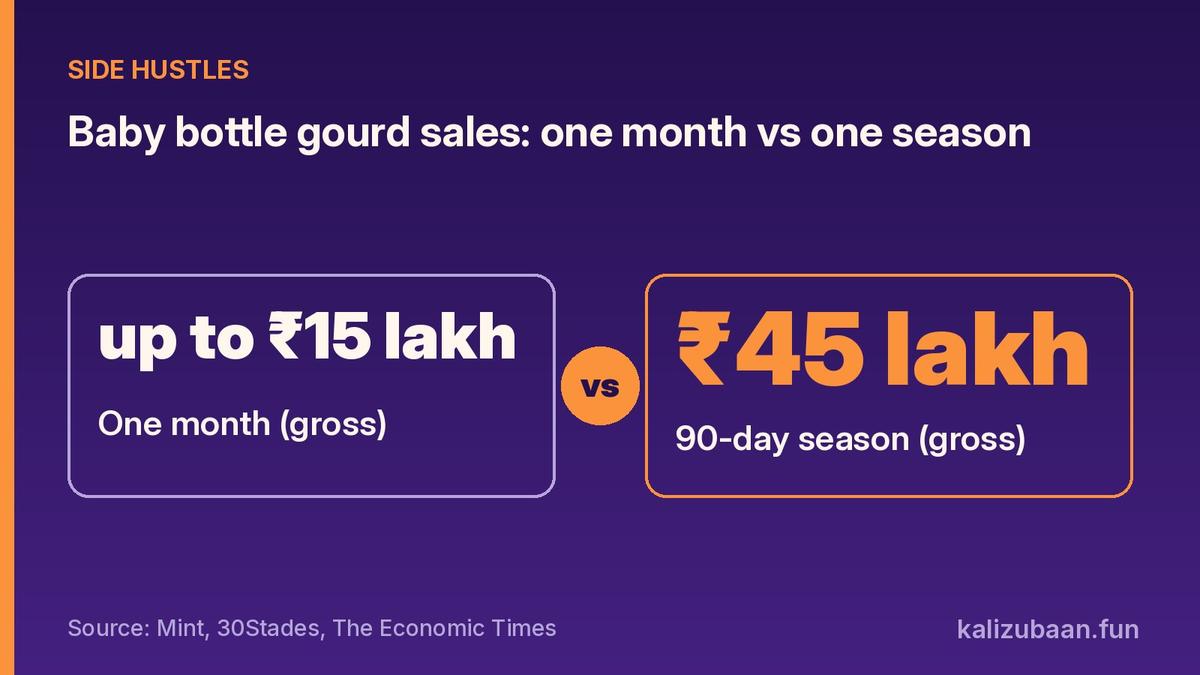
- At one tonne a day and ₹50 a kg, a day's harvest is worth around ₹50,000, or about ₹14 lakh to ₹15 lakh a month.
- Over a 90-day harvest, that adds up to roughly ₹45 lakh in gross sales, before costs, not profit.
- The idea behind the model, finding a buyer with a specific need, applies well beyond farming. Results vary; nothing here is a promise of income.
Who Karigowda is and what he grows
Karigowda comes from a farming family. His grandfather and father were farmers, and he chose to keep farming after finishing his degree.
The family grew maize, tomato and brinjal. Getting the right price for that produce was a recurring problem, and market swings could hit an entire season's returns.
So he went looking for a crop with demand outside India. He settled on baby bottle gourd after hearing about its demand overseas. He uses the Swikar 045 F1 variety.
The numbers behind ₹50,000 a day
Karigowda told 30Stades the maths himself. At one tonne a day and Rs 50 a kg, a day's harvest is worth around Rs 50,000, or about Rs 14 to Rs 15 lakh a month.
Over a 90-day harvesting period, the reports put total sales at about ₹45 lakh.
Source: Mint, 30Stades, The Economic Times
Here is the part that viral headlines tend to skip. Mint, The Economic Times and Asianet Newsable all point out that these figures are gross revenue, not net profit.
Seeds, labour, fertilisers, irrigation, packaging and transport all have to come out before you know what he actually earns. The Economic Times also notes that prices and yields can vary, so these are reported seasonal estimates, not guaranteed returns.
Why small gourds sell for export
The trick is size and timing. A conventional bottle gourd can grow much larger, but buyers want fruits of about 500 grams.
Smaller gourds suit households that want to use a whole vegetable in one meal, instead of cutting a large one and storing the rest. Karigowda says younger gourds have soft, thin skin and very few seeds, and taste sweeter and milder.
Timing is tight. Leaving them for a few extra hours can add around 100 grams, he says, and a fruit meant to be half a kilogram can reach 800 to 900 grams, which does not work for export.
How the farm runs
The cycle starts with sowing in June and July. The first harvest comes about 70 days later, around September, and the season runs through December. Once plants start producing, gourds are harvested repeatedly.
He uses drip irrigation, mulching, a trellis to train vines upward, and a mix of cow dung, organic manure, neem cake and DAP fertiliser. He keeps around 4 feet by 8 feet between rows and plants 3 to 4 feet apart, giving each plant 24 to 32 sq ft.
Packing matters too. The gourds are wrapped in paper and packed in cartons, because careless packing can damage the skin and cut their value.
Crucially, he does not export himself. Brokers buy at the farm gate and handle the shipping, so he can focus on meeting the buyer's size and quality specifications.
What a side hustler can take from this
You do not need a farm to use the same logic.
- Start from the buyer's spec. Karigowda grows to a size an overseas buyer wants, not the size the local market is used to.
- Use a middleman when it saves you work. Brokers connect his farm gate to the export chain. A platform, agency or reseller can do the same for a freelancer.
- Separate revenue from profit. ₹45 lakh in sales says little until costs are subtracted. Do the same with any hustle's gross numbers.
- Diversify. Outside the gourd season he grows brinjal and tomato and sells them in the Hosur market in Tamil Nadu, where he gets around ₹45 per kg for brinjal.
Mistakes to avoid
Do not copy the headline number. The ₹45 lakh assumes the same daily harvest and price for the whole season, which the reports themselves say may not hold.
Do not ignore the skill involved. Spacing, trellising, harvest timing and packing are what make the crop export-grade.
Do not skip the costs. Every report on this story stresses that expenses decide the real earnings.
FAQs
How much does the Bengaluru farmer earn from baby lauki? He reports gross sales of around ₹50,000 a day in season, about ₹14 lakh to ₹15 lakh a month and roughly ₹45 lakh over 90 days. These are revenue figures, not profit.
Who buys the baby bottle gourds? Brokers buy them at his farm and arrange export to Qatar.
How long until the first harvest? About 70 days after sowing, which happens in June and July. Harvest runs from September to December.
What size do export buyers want? Around 500 grams per gourd. Fruits that reach 800 to 900 grams do not work for export, he says.
Would you try a niche, buyer-first idea like this in your own field? Tell us in the comments.
Results vary; nothing here is a promise of income.
Sources
- Mint: How this Bengaluru farmer makes ₹50,000 a day by growing baby bottle gourds for Qatar
- 30Stades: From Bengaluru to Qatar, how this farmer turned baby bottle gourd into an export crop
- The Economic Times: ₹45 lakh in 90 days from small lauki for Qatar buyers
- Asianet Newsable: How baby bottle gourds for Qatar bring Rs 15 lakh a month
Tagged Topics
Keep reading



Thanks for reading Kali Zubaan
Explore more articles in Side Hustles or return to the main publication feed.


