24% Less Gut Diversity: Why Sugar and Antibiotics Don't Mix
A Nature study of 173 hospital patients found that every extra 100 grams of sugar eaten on strong antibiotics was linked to a 24% drop in gut bacteria diversity. Here is what it does and does not mean for you.

Two cans of soda hold roughly 100 grams of sugar. In a new Nature study, every extra 100 grams of sugar that patients ate while on strong antibiotics was linked to a 24% drop in the variety of bacteria in their gut.
That matters because a less varied gut is easier for harmful bacteria to take over. And many of us reach for sweet comfort food exactly when we are sick.
Quick answer
- Researchers tracked 9,419 meals eaten by 173 hospitalised blood-cancer patients, plus more than 1,000 stool samples from 158 of them.
- While patients were on antibiotics, more sugar was linked to a sharper fall in gut bacteria diversity and more growth of Enterococcus, a germ linked to hard-to-treat infections.
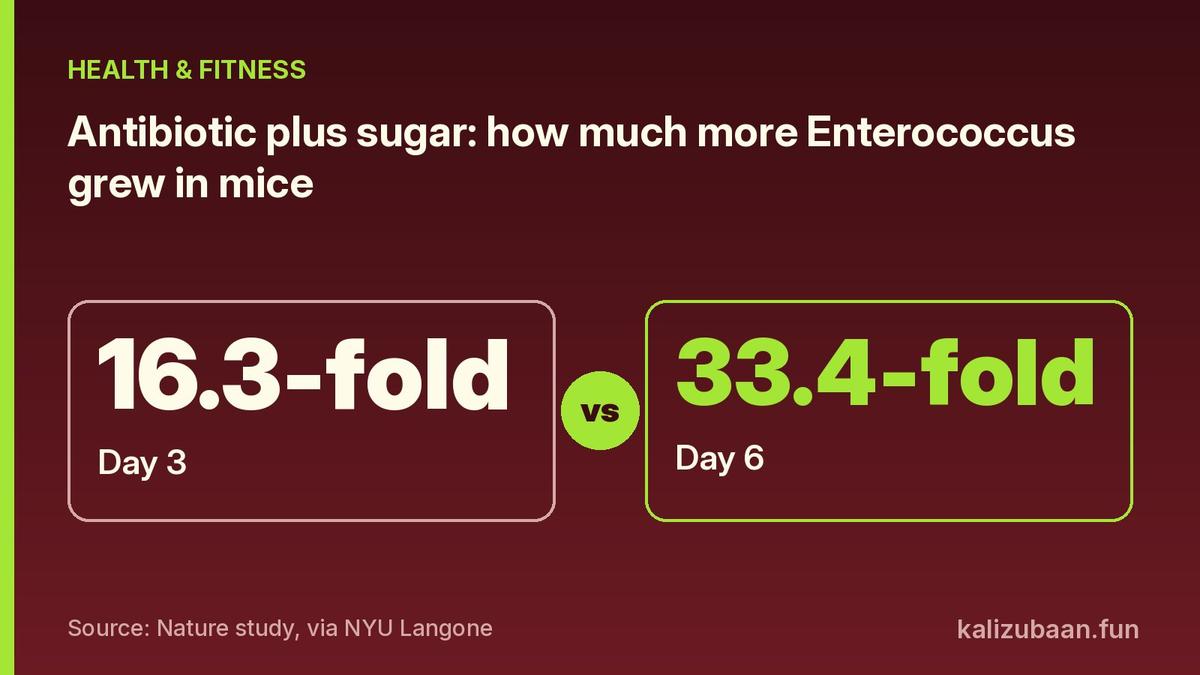
- In mice, adding table sugar to an antibiotic made Enterococcus numbers 16.3-fold higher by day 3 and 33.4-fold higher by day 6. Sugar alone did nothing.
- The study was in very sick patients, not healthy adults on a short course. Never stop or skip an antibiotic because of this.
What the researchers actually did
Studying diet and gut bacteria is hard, because most of us can't remember what we ate last Tuesday. So the team picked a setting where every bite could be counted.
They followed patients at Memorial Sloan Kettering Cancer Center in New York who were in hospital for a stem cell or bone marrow transplant. These patients stay for weeks, take a lot of antibiotics and eat from a room-service menu.
Every meal came with a printout on which patients marked what they actually ate. The researchers had the recipes and nutrition details for all of it.
All the patients got at least one antibiotic, and 80% of them were eventually moved to broad-spectrum antibiotics. These hit a wide range of bacteria, so they do the most damage to the gut's natural mix.
The study was led by teams at NYU Langone Health, City of Hope and Memorial Sloan Kettering, and published in Nature on September 30, 2026.
The sugar signal nobody was looking for
The researchers were not hunting for sugar. It simply stood out.
For each stool sample, they looked at the food and medicines from the previous two days. While patients were on antibiotics, gut diversity fell by 24% for every 100-gram rise in sugar, according to Memorial Sloan Kettering. A separate analysis by nutrients, reported by NYU Langone, found an extra 21 percent fall in diversity per 100 grams of sugar eaten in the 48 hours before.
The first author, computational biologist Anqi Dai, said her first thought was that sicker patients were simply eating more sweets. The team adjusted for how ill patients were and how harsh their treatment was. The link did not go away.
The sugars involved included sucrose, which is ordinary table sugar, and fructose, which is found naturally in many fruits.
What happened in the mice
To test the idea, the team gave mice an antibiotic called biapenem, with or without extra sucrose in their food.
Source: Nature study, via NYU Langone
Compared with the antibiotic alone, mice given the antibiotic plus sugar had 16.3-fold more Enterococcus on day 3 and 33.4-fold more on day 6.
Here is the key detail. In mice given sugar without an antibiotic, Enterococcus did not rise. Sugar on its own was not the problem.
The team also checked whether the sugary mice were simply eating less fibre-rich chow. That did not explain the effect.
How it works, in plain words
Your gut holds trillions of microorganisms that help with digestion, metabolism and immunity. A healthy gut is not just about "good bacteria". It is about balance and variety, with many species competing for food and space.
Antibiotics cannot tell friend from foe. They wipe out many of the competitors, and tougher species like Enterococcus survive.
Study author William Jogia of NYU Langone put it this way: the harmful bacteria that survive the antibiotics probably benefit from the dietary sugars they can use to grow. Writing in The Hindu, Dr Biju Dharmapalan described sugar as less of an independent villain and more of an amplifier of the damage antibiotics already do.
The team says it is still not clear whether sugar directly feeds Enterococcus, weakens its rivals, or works some other way.
The surprise for hospital food
One finding stung. The foods often encouraged for sick patients, such as nutrition shakes, smoothies and sports drinks, seemed to cause the most damage, perhaps because they are so high in sugar.
Dr Jonathan Peled of Memorial Sloan Kettering said doctors often suggest these drinks so that weak patients at least get fluids, protein and electrolytes. Combined with antibiotics, he said, the result can be toxic to the microbiome.
What this means for a regular Indian household
Be careful here. The patients in this study were seriously ill and also getting chemotherapy and radiation. They were not healthy adults taking a few days of antibiotics for a sore throat or a urinary infection.
Dr Peled himself said there is not yet evidence that everyone taking antibiotics should avoid sugar. The authors are calling for clinical trials.
Still, he made a practical point. Cutting back on sugar while on antibiotics should be feasible for most patients without adding any risk to their health.
If you want to act on that, the low-risk version looks like this:
- Finish your course. Take the antibiotic exactly as your doctor prescribed. This study is no reason to stop early.
- Go easy on the obvious sugar. Extra-sweet chai, mithai, packaged juices and cold drinks are easy places to cut back during a course.
- Read the label on "health" drinks. The study flagged nutrition shakes and smoothies, perhaps because of their high sugar content, so check what is in yours.
- Don't crash-diet when you are ill. You still need fluids and food. Just lean towards unsweetened options like plain water and simple home-cooked meals.
- Ask your doctor. Especially if you are diabetic, pregnant or recovering from a serious illness.
Who should be most careful
People with cancer, transplant patients and anyone in hospital on strong antibiotics should not change their diet on their own. Their nutrition is planned for a reason, and the study's authors warn against imposing restrictive diets on vulnerable patients without medical supervision.
People with diabetes should already be watching sugar, and should talk to their doctor before any change while on medication.
FAQs
Should I stop eating sugar when I take antibiotics? The study does not prove that for healthy people. It found a link in very sick hospital patients and a clear effect in mice. Cutting back on added sugar during a course is a low-risk choice, but talk to your doctor first.
Is fruit a problem too? The sugars studied included fructose, which is found in fruit. But the study did not test whole fruit against sweets in healthy people, so it can't tell you to avoid fruit.
Do probiotics fix the damage? Dr Peled said there isn't strong evidence that probiotics help either, even though many people take them.
Does sugar alone harm gut bacteria? In the mice, sugar without an antibiotic did not raise Enterococcus. The harm showed up only when the two were combined.
This article is for information only and is not medical advice. Talk to a doctor before changing your diet or training.
Sources
- The Hindu: Is a sugar-rich diet while on antibiotics a threat to the gut microbiome?
- Memorial Sloan Kettering: Study suggests sugar can worsen common intestinal side effect of antibiotics
- NYU Langone: Sugar amplifies damage done to gut health by antibiotics
- EurekAlert: Sugar amplifies damage done to gut health by antibiotics
- Wikipedia: Gut microbiota
Tagged Topics
Keep reading



Thanks for reading Kali Zubaan
Explore more articles in Health & Fitness or return to the main publication feed.


