2.3 kg vs 2.6 kg: Weight Loss Tips on Meal Timing, Tested
Eating in a 10-hour window is one of the most shared weight loss tips. Two clinical trials found it barely beat normal eating when calories were the same. Here is what that means for an Indian diet.
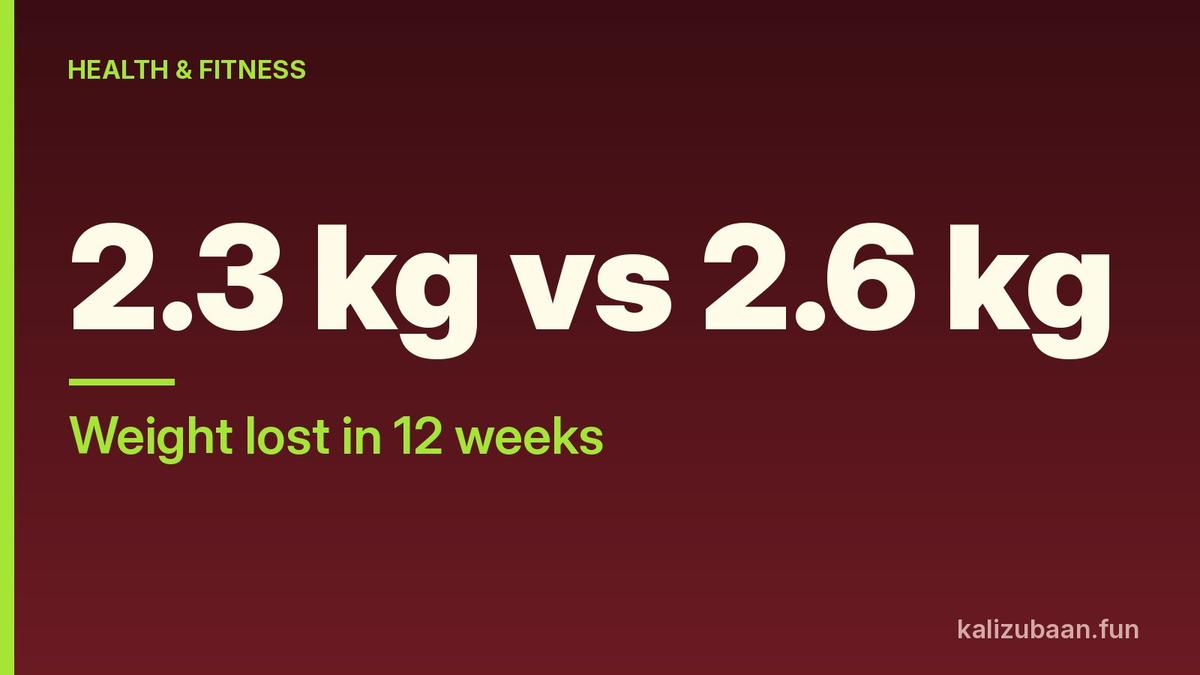
One group ate all their food inside a 10-hour window. The other ate across a day of up to 16 hours, with most of their calories after 5 p.m. After 12 weeks, the early eaters had lost 2.3 kg. The late eaters had lost 2.6 kg.
That result, from a randomised trial of adults with obesity, cuts against one of the most popular weight loss tips online: that when you eat matters more than how much you eat. A new trial published this month points the same way. Here is what the research actually says.
Quick answer
- Time-restricted eating, such as eating only within a 10-hour window, can help some people lose weight, mainly because it often makes them eat less.
- In a trial where both groups ate the same calories, the time-restricted group lost 2.3 kg and the usual-eating group lost 2.6 kg in 12 weeks, with no real difference.
- A new trial in people with severe obesity found similar weight loss with or without an eating window when calories were cut.
- The most reliable weight loss tip is still a steady calorie deficit you can stick to. Meal timing is a tool to help with that, not magic.
The weight loss tip everyone shares
Time-restricted eating is a type of intermittent fasting. Wikipedia describes it as eating only during a set number of hours each day, often within an 8–12-hour window.
The idea is popular because it feels simple. You do not count every roti. You just stop eating after a certain time.
Fasting is also familiar in India. Wikipedia notes that fasting is part of many religious practices, including Hinduism, Jainism and Islam. So the habit of skipping meals for some hours is not new for many Indian families.
The real question is whether the clock itself burns extra fat, or whether people simply eat less.
Trial one: same food, different timing
Researchers set up a careful test. All 41 participants were adults with obesity and either prediabetes or diet-controlled diabetes. Their average age was 59 years, and 93% were women.
They were split into two groups for 12 weeks:
- Time-restricted eating: a 10-hour eating window, with 80% of calories eaten before 1 p.m.
- Usual eating pattern: a window of up to 16 hours, with at least half of calories eaten after 5 p.m.
Here is the crucial detail. Both groups ate food with the same nutrients and the same total calories. Only the timing changed.
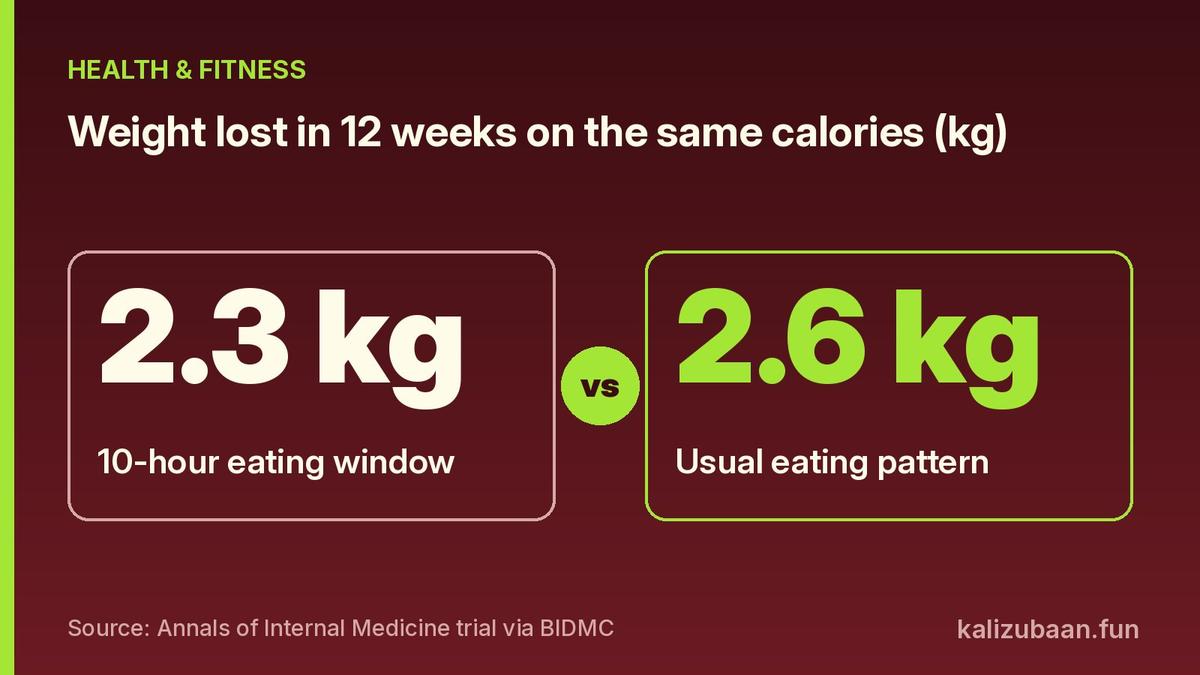
Source: Annals of Internal Medicine trial via BIDMC
The time-restricted group lost 2.3 kg. The usual-eating group lost 2.6 kg. The average difference was just 0.3 kg, which the researchers did not count as a real effect. Blood sugar measures also did not differ between the groups.
The authors concluded that when calories stay the same, time-restricted eating did not reduce weight or improve blood sugar control. Their reading is that weight loss seen in earlier studies may come from people eating fewer calories.
The trial was small and run at a single site, and the groups started at different weights. So it is not the final word. But it is a clean test of the timing idea.
Trial two: a new study this month
A trial published online on 15 October 2026 in the British Journal of Nutrition looked at adults with severe obesity, all with a BMI above 40.
One hundred people aged 20–60 were split into two groups for 12 weeks. Both diets gave 60 % of each person's daily energy needs, so both groups were cutting calories.
- One group ate inside a window from 10 am–6 pm.
- The other cut calories without any eating window.
Both groups lost weight, body fat and belly fat. The weight loss was similar: 4·3 kg in the eating-window group and 3·8 kg in the other group, a gap the researchers did not find meaningful.
The eating-window group did lose a little more fat mass, 3·5 kg versus 2·4 kg. But their resting metabolic rate fell more too. The authors said this suggests limited long-term benefit of the eating window for people with severe obesity.
What this means for weight loss tips on an Indian diet
Put the two trials together and a clear message appears. The calorie deficit does most of the work. The eating window mainly helps if it makes you eat less.
That can still be useful. Many Indian households eat a heavy dinner late at night, plus snacks after. If an eating window stops late-night snacking, you will probably eat less overall.
Some practical, low-risk ways to use this:
- Use a window as a fence, not a fast. Pick a window you can keep, such as finishing dinner earlier, and use it to cut mindless late-night eating.
- Watch the plate, not just the clock. A big portion of rice, puri or sweets inside your window still adds up.
- Do not overeat to make up for it. Eating extra because "the window is closing" cancels the benefit.
- Track your weight weekly. If nothing changes after a few weeks, the timing is not helping you and portions need a look.
- Keep it sustainable. The best plan is the one you can follow for months, not the strictest one.
Who should be careful
Wikipedia notes that New Zealand's Ministry of Health does not recommend intermittent fasting for people with insulin-dependent diabetes, and that it can cause low energy and hunger. The US National Institute on Aging says the research is limited and does not recommend it to the general public.
If you have diabetes, take medicines for blood sugar or blood pressure, are pregnant, have PCOS or kidney disease, or have a history of eating disorders, speak to a doctor before trying any fasting plan.
FAQs
Does time-restricted eating help you lose weight? It can, mainly by helping you eat less. In a trial where calories were kept the same, the 10-hour window group lost 2.3 kg against 2.6 kg for usual eating over 12 weeks.
Is eating dinner early a good weight loss tip? Finishing dinner earlier can help if it cuts late-night snacking and total calories. The research does not show that timing alone burns extra fat.
What did the new October 2026 study find? In adults with severe obesity on a calorie-cut diet, an eating window of 10 am–6 pm gave similar weight loss to cutting calories alone, with slightly more fat loss but a bigger drop in resting metabolic rate.
What is the most reliable weight loss tip? A calorie deficit you can sustain, built from foods you enjoy, with regular activity. Meal timing is only one optional tool for getting there.
This article is for information only and is not medical advice. Talk to a doctor before changing your diet or training.
Sources
- Cambridge Core (British Journal of Nutrition): Time-restricted eating with energy restriction modestly improves fat mass loss in severe obesity, the MACRO randomised clinical trial
- BIDMC General Medicine Research: Effect of Isocaloric, Time-Restricted Eating on Body Weight in Adults With Obesity, a Randomized Controlled Trial
- Wikipedia: Intermittent fasting
Tagged Topics
Keep reading


Thanks for reading Kali Zubaan
Explore more articles in Health & Fitness or return to the main publication feed.


