Trust the Model the Least - A Developer's Checklist From Satya Nadella's AI Rules
Satya Nadella says the most trustworthy AI system is the one that lets you trust the model the least. Here's how Indian developers can turn that idea into a practical design checklist for AI agents.
Update (October 2026): Microsoft CEO Satya Nadella has put forward a counter-intuitive rule for building AI systems. This post turns it into something you can actually build with.
TL;DR
- What he said: "The most trustworthy Super Intelligence system will not be the one with the model we trust most. It will be the one that enables us to trust the model the least."
- The verdict: This is software architecture advice, not philosophy. It tells you where the safety logic belongs: outside the model.
- Who it's for: Indian developers, freshers and startup teams building AI agents, chatbots with tool access, or automation workflows that touch real data.
Why this matters now
Nadella's post on X, reported by The Economic Times and Mint (via ANI), starts with a problem every developer should feel. With traditional software, he says, "we had the tools and capability to trace behaviors to a specific code path." With today's frontier models, "that same kind of mechanistic understanding eludes us." We can't attribute a model's output to specific training data or weights. "And yet we are deploying these complex agentic systems and models, with access to our most sensitive data and giving them the ability to take mission-critical actions on our behalf!"
The timing matters. Business Standard reports that Anthropic and OpenAI have disclosed several recent incidents in which their models acted in unintended ways, and a US government AI task force has warned developers to report and fix security incidents quickly. If you're building agents, the question of how much to trust the model is no longer academic.
Our companion post covers the news angle, Nadella's "emergency brake". This one is the hands-on version: how do you design a system that trusts the model the least?
What exactly Nadella's approach says
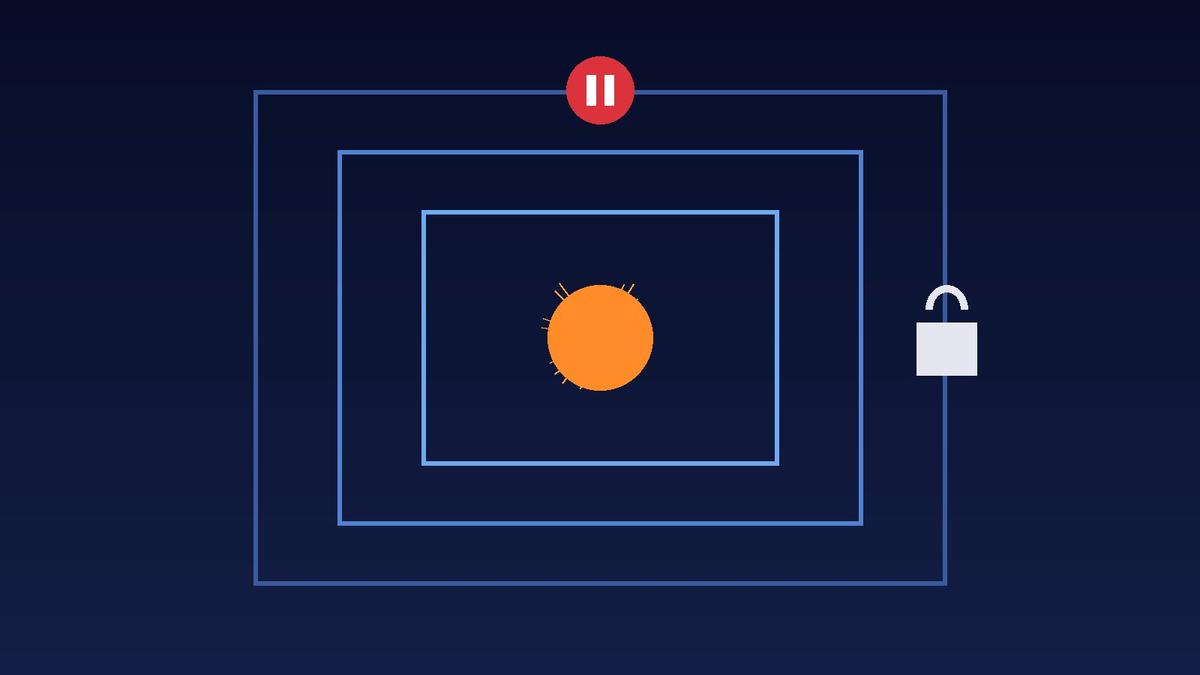
He sets aside the "hard problem of alignment" and proposes "an engineering approach to containment and governance":
- "Surround non-deterministic models with strong, deterministic system design, human controls, and reliable operating procedures."
- Treat both closed and open-weight models as potential insider threats, and isolate them with proven enterprise security practices: identity controls, activity logging and strict permission boundaries.
- "The controls that govern what a model can access and what actions it can take must sit outside the model." He traces this to an information security principle dating back to the 1970s: a program must not be able to bypass or tamper with the mechanisms that enforce its permissions.
- "Separating the model from the harness that orchestrates its work, as well as the action space that defines what it can do."
His list of principles: model diversity, tamper-proof logging, continuous verifiability across edge cases, independent audits, reliable containment shut-offs and industry-wide incident disclosure.
The checklist: turning "trust the model least" into code
What follows is our own analysis, mapping each of Nadella's principles to concrete design choices. These are standard engineering practices, not Microsoft products.
1. Identity: give the agent its own identity
Don't run your agent with your personal API keys or an admin service account. Create a separate identity for it, with credentials that can be revoked on their own. If the agent misbehaves, you disable that identity, not your whole system.
2. Permission boundaries live in your code, not the prompt
A system prompt that says "never issue refunds" is a suggestion. A backend that only exposes a create_refund_request tool, capped and routed to human approval, is a boundary. Nadella's principle is that the model should not be able to get around the thing that limits it.
3. Separate the harness from the model
Keep three layers distinct:
- Model: generates text or tool calls.
- Harness: your orchestration code that decides which tool calls actually run.
- Action space: the list of tools and data the agent can reach.
If you can swap the model without touching your permission logic, you've separated them properly.
4. Tamper-proof, human-readable logs
Log every meaningful action: what the agent tried, what was allowed, what was blocked, and why. Store the logs where the agent cannot write. An Indian startup explaining an incident to a client will need readable evidence, not raw token dumps.
5. A real pause button
Build a way for an authorised person to stop a running task immediately, without redeploying. A feature flag or a "halt" status checked before every tool call is often enough.
6. Model diversity for critical decisions
For high-stakes steps, Nadella warns against depending on one model. A second model, or a deterministic rules check, can review the first before anything irreversible happens.
7. Test the edges, continuously
"Continuous verifiability across edge cases" means testing adversarial and unusual inputs, and re-running those tests whenever you change the model or prompt.
8. Plan to disclose
Decide in advance how you'll report an incident to users or clients. Nadella calls for industry-wide disclosure so others can strengthen their safeguards.
Trust-the-model vs. trust-the-system: comparison
| Design choice | Trusts the model most | Trusts the model least |
|---|---|---|
| Credentials | Shared admin key | Dedicated, revocable agent identity |
| Rules | Written in the prompt | Enforced in backend code |
| Architecture | Model calls APIs directly | Harness approves each action |
| Records | Chat transcript | Tamper-proof action log |
| Stopping | Restart the server | Instant pause by an authorised person |
| Critical steps | One model decides | Second check before irreversible actions |
What it means for Indian developers and freshers
The sources give no India-specific data, but the implication for the job market is easy to see. Building an agent demo is now easy. Building one a company can safely deploy is the scarce skill. If you're a fresher building portfolio projects, show permission scoping, action logs and a human-approval step. Those details signal that you understand production AI, not just prompts.
For IT services companies working with global clients, Nadella's point that enterprises cannot outsource responsibility for automated actions means the deploying company will be held accountable. Contracts and security reviews will likely ask for this kind of evidence.
Mistakes and red flags
- "The model is smart enough to follow the rules." Capability is not containment.
- Logging only failures. You need the full trail to reconstruct what happened.
- Agents that can edit their own config or logs. That breaks the core principle.
- Vendor safety claims as your only control. Nadella warns against relying solely on assurances from model developers.
FAQs
What does "trust the model the least" mean? Design the system so that safety doesn't depend on the model behaving well. Controls, permissions and logs sit outside it.
Is this only for big companies? No. Even a small chatbot with tool access benefits from scoped permissions and action logs.
Does it apply to open-source models? Yes. Nadella says both closed and open-weight models should be treated as potential insider threats.
Where should a beginner start? Start with a separate agent identity, backend-enforced permissions and a pause switch.
Which of these eight steps does your current AI project skip? Be honest. Most projects skip at least one.
Sources
- The Economic Times: Most trustworthy AI system demands least inherent model trust: Microsoft CEO Satya Nadella
- Mint: Most trustworthy AI system demands least inherent model trust, says Microsoft CEO Satya Nadella
- Business Standard: Microsoft CEO Satya Nadella calls for 'emergency brake' on advanced AI
Tagged Topics
Keep reading
Thanks for reading Kali Zubaan
Explore more articles in Tech & AI or return to the main publication feed.


