900 Million SMS Tips: How Google's AI Is Helping Indian Farmers
Google's farm AI models powered over 900 million SMS advisories for Gujarat farmers in a year. Here is what Google just announced for farmers, teachers, small businesses and developers in India.
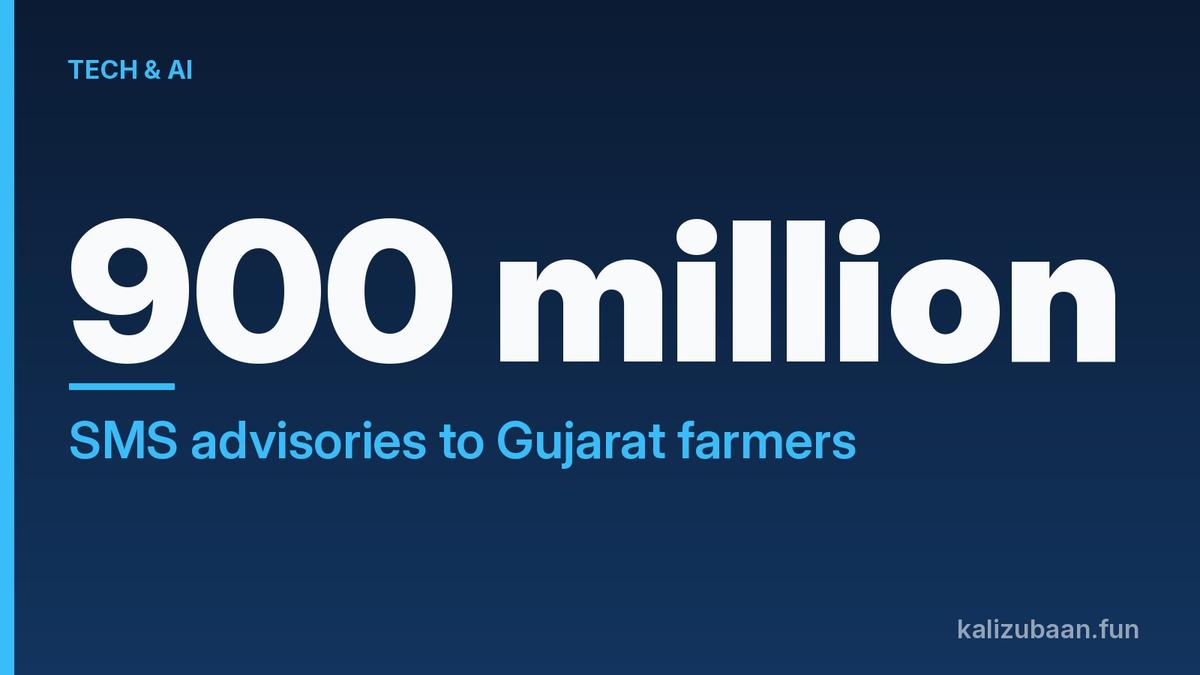
Over 900 million SMS messages. That is how many crop, soil, pest and weather advisories Google's agricultural AI models helped send to farmers in Gujarat in just the last year.
They reached more than 600,000 farmers across over 14 million hectares of land. No chatbot, no app download, just a text message on a basic phone. That one number says a lot about where Google now thinks AI matters most in India.
Quick answer
- Google has announced new AI projects in India across crop science, farming, teacher training and small businesses.
- Its farm AI models, used through Gujarat's Krushi Pragati platform, supported over 900 million SMS advisories in a year.
- Google.org is giving $15 million to The/Nudge to build AI tools for India's MSMEs.
- Developers can now try Google's Agricultural Understanding models in public preview through an API.
Why this matters now
When most of us hear "AI", we think of Gemini or ChatGPT on a phone or laptop. Google's latest India announcements point somewhere else: farms, classrooms and small shops.
In a blog post, Google's India country manager Preeti Lobana and Google DeepMind's Chief AI Readiness Officer Lila Ibrahim called India "the epicenter of applied innovation". The pitch is simple. Frontier research is only useful if it reaches people at population scale.
Hindustan Times summed it up well: the AI conversation in India is moving beyond chatbots towards solving everyday problems. It also added a fair warning that it is still early days for several of these projects, and their actual impact remains to be seen.
How the farm AI actually works
The farm piece comes from Google's AnthroKrishi team. It built India-first Agricultural Understanding models, which now also provide insights for 11 countries.
Google does not text farmers itself. A company called Amnex plugged Google's agri model APIs into the Government of Gujarat's Krushi Pragati crop intelligence platform. The state's system then sends the advisories.
Those messages cover four kinds of advice:
- crop and soil health
- pest and disease management
- weather pattern observations
- field-level guidance that supports productivity and farmer livelihood
Do the rough maths on 900 million messages for 600,000 farmers and it works out to more than a thousand advisories per farmer in a year. That is not a pilot. That is a farmer's daily information feed.
A second group, OpenAgriNet, a global coalition seeded and led by the EkStep Foundation, already uses the same APIs for an analytics dashboard for agricultural administrators. It is now exploring a full app that brings scattered farm information onto one platform, in the farmer's own language.
Jowar gets a genetic atlas
The most ambitious part is about sorghum, better known in India as jowar. It is a climate-resilient, nutrient-rich crop that matters a lot in dryland areas.
Google DeepMind and Google.org, through the AI Collaborative for Food Security, are working with Hyderabad-based ICRISAT, the HudsonAlpha Institute for Biotechnology and the University of Washington's Department of Genome Sciences.
Together they will build an open-access genetic atlas of sorghum. It will draw on a representative sample from ICRISAT's genebank, which holds over 44,000 distinct seeds from over 90 countries, including India.
Machine learning will then help spot the most promising plant combinations. The goal is to help breeders develop tougher, more productive varieties faster than traditional methods, which can involve decade-long trial and error.
Google DeepMind will also fund a three-year postdoctoral fellowship at ICRISAT. Google says it is its first such fellowship in India and its first outside the UK. The fellow will build tools for other key crops like chickpea, groundnut and pigeon peas (arhar or tuar dal).
$15 million for India's small businesses
Google.org is providing $15 million to The/Nudge, a non-profit, to speed up the growth of India's micro, small and medium enterprises. Google points out how big that sector is.
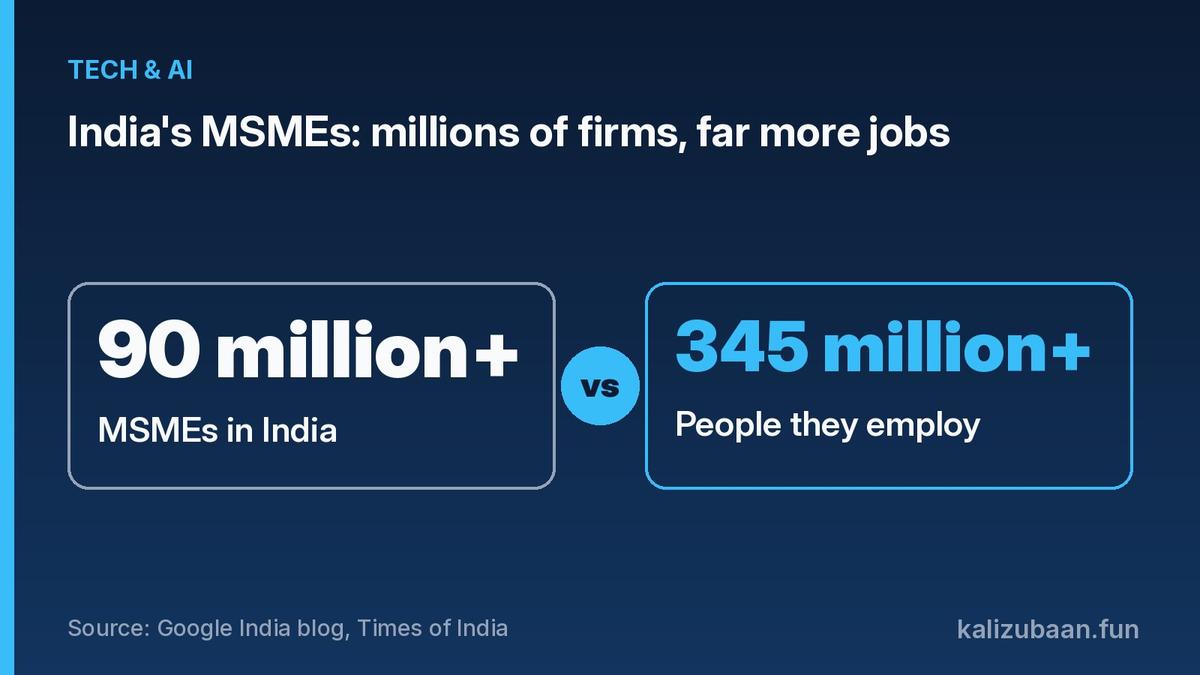
Source: Google India blog, Times of India
The money will fund scalable AI tools that make it easier for small firms to:
- get formal credit
- find new markets
- handle compliance
There will be an open call for proposals. There is also a plan for a multilingual, voice-led platform that trains local talent in Tier 3 and 4 towns with job-ready skills and connects them directly with small businesses.
For a kirana owner or a small manufacturer who has never filed paperwork online, a voice-first tool in their own language could matter more than any chatbot.
What it means for Indian teachers, students and developers
Teachers: Google launched its AI Educator Series in India this May with five state and regional partners. It says it has already trained over 80,000 educators since then. The course teaches Gemini and Gemini Notebook for lesson plans, learning aids and daily prep.
The programme is now expanding through new partnerships with Bihar, Madhya Pradesh, Sikkim and the Ministry of Skill Development and Entrepreneurship. There is also a free, self-paced online version aligned with NEP 2020. It is in English now, with Hindi, Marathi, Telugu, Assamese, Odia and Punjabi versions due later this month.
Schools and labs: Google is supporting educators across 100 Atal Tinkering Labs through ATL Saathi, a Gemini-powered desktop app for STEM curricula. It is also working with IIT Bombay and the Office of the Principal Scientific Adviser on educational AI research.
Developers and startups: This is the part I find most interesting as a developer. The Agricultural Understanding models are now in public preview through an API. That means Indian startups and students can build hyperlocal farm tools on top of the same models that power Gujarat's advisories.
Red flags to keep in mind
- Impact is not proven yet. The 900 million figure measures messages sent, not extra crop yield or income. Treat it as reach, not results.
- Most numbers come from Google. Media reports so far largely repeat Google's own blog post. Independent data on outcomes will matter more.
- Preview means change. An API in public preview can change or come with limits, so do not build a paid product on it without a backup plan.
- Language rollout is staged. The Hindi and regional versions of the teacher course are still to arrive.
FAQs
What is Krushi Pragati? It is the Government of Gujarat's crop intelligence platform. Amnex integrated Google's agri model APIs into it, and it has supported over 900 million SMS-based advisories for more than 600,000 farmers in the last year.
Can I use Google's Agricultural Understanding models? Yes. Google says they are now available in public preview through an API for developers, startups and researchers.
Who gets the $15 million? Google.org is giving it to The/Nudge to fund AI tools that help Indian MSMEs with credit, markets and compliance, plus skills training in Tier 3 and 4 towns.
Is the AI teacher training free? Google is launching the AI Educator Series as a free, online, self-paced course. It is in English now, with more Indian languages coming later this month.
Sources
- Hindustan Times: How Google is giving Indian farming an AI upgrade to help grow better crops
- Google India Blog: From lab to impact, advancing AI for real-world progress in India
- Times of India: Google announces new AI initiatives in India across crop science, agriculture, education and small business
Tagged Topics
Keep reading

Thanks for reading Kali Zubaan
Explore more articles in Tech & AI or return to the main publication feed.