80 Lakh CRM: Indian Firm Built It With OpenAI Codex
OpenAI India lead Pragya Misra says the next AI phase is outcomes, not experiments. Cars24 and a healthcare CRM build show what that looks like in Indian boardrooms.
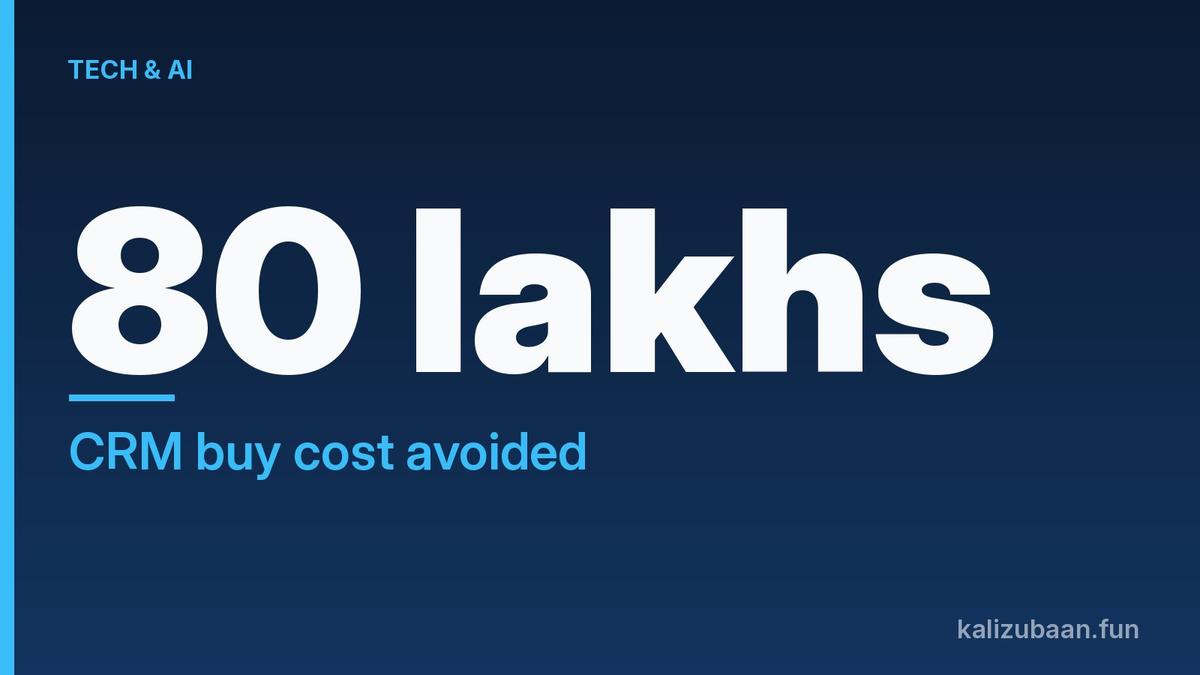
Close to 80 lakhs of rupees. That was the buy price for a CRM that one of India's leading healthcare companies was staring at. About three weeks into an OpenAI Codex pilot, the CIO chose to build instead.
OpenAI's head of public policy and strategy for India, Pragya Misra, told that story at the Bloomberg New Economy Forum 2026. Her larger point was blunt: the next phase of AI is about driving outcomes, not running more experiments.
Quick answer
- Misra says firms should define specific problems, measure how much AI helps solve them, and put those results in shareholder reports.
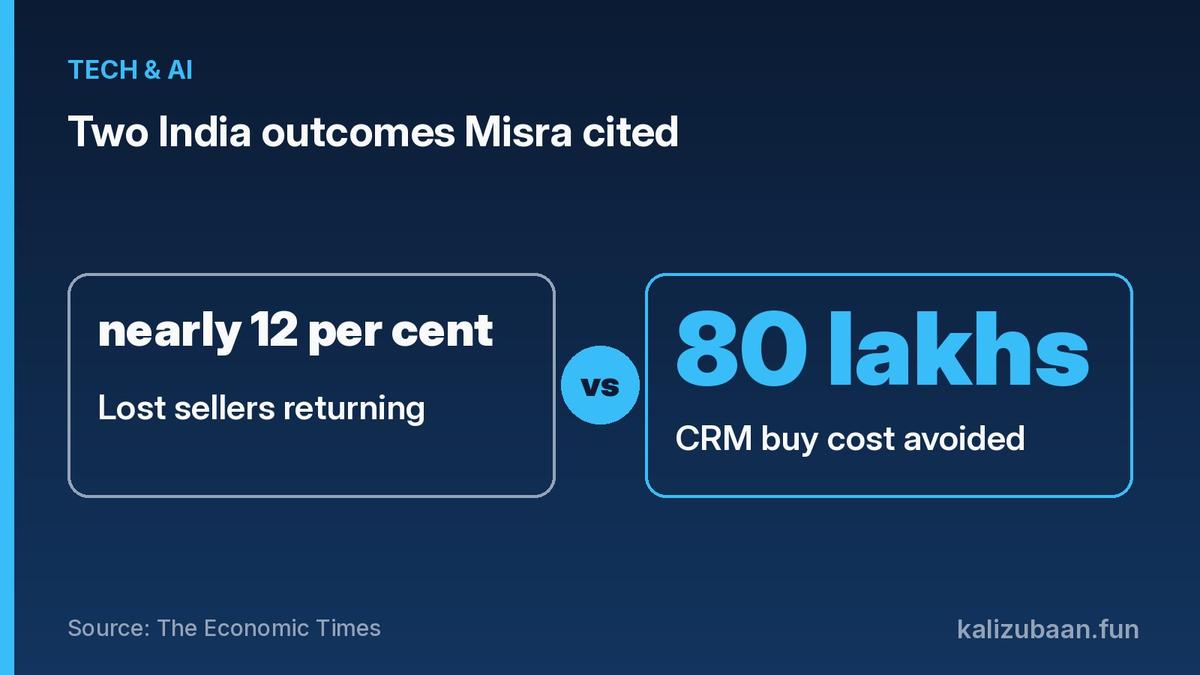
- Cars24 used OpenAI models for nearly a million conversation minutes a month via a seller-listing agent, and reports that nearly 12 per cent of lost sellers are returning because of it.
- A leading Indian healthcare company built its CRM with Codex after roughly a week of engineers prioritising the work, instead of buying a system that was costing close to 80 lakhs of rupees.
- OpenAI offers data residency and local inferencing in India, and has made its models available on Amazon Web Services (AWS).
Outcomes over experiments
Misra's message, reported by The Economic Times, Business Standard and ETEnterpriseai, is that deploying ChatGPT at scale is no longer the finish line.
She said the work now is going to a company's board and CEO, asking what the hardest problems they are trying to solve are, and working with them on those specific problems so they can report results to shareholders and investors.
"It's really something that you can put down in your shareholder report and say, here is how I've been able to move the needle, right from the top," she said, according to the same reports.
That framing matters for Indian enterprises that have spent the last two years on pilots. Misra's claim is that the next phase is proof: defined problems, measured contribution, board-ready numbers.
Cars24: nearly 12 per cent of lost sellers back
The first India example Misra cited was Cars24.
The online car marketplace used OpenAI's models for nearly a million conversation minutes a month through a customer agent that helps sellers list their cars. It now reports that nearly 12 per cent of its lost sellers are returning because of that agent, according to The Economic Times, Business Standard and ETEnterpriseai.
That is the kind of outcome Misra says boards want to hear. Not "we launched a chatbot," but "lost sellers are coming back, and here is the share."
Nearly a million conversation minutes a month is also a useful scale mark. It shows the agent is not a weekend demo. It is sitting in a real sales funnel, month after month.
The 80 lakhs CRM decision
Source: The Economic Times
Misra's second example lands closer to the CIO budget meeting.
One of India's leading healthcare companies was deciding whether to buy a customer relationship management (CRM) system or build its own. About three weeks into a pilot of OpenAI's Codex coding tool, its chief information officer decided to build it in-house.
"That was costing them close to 80 lakhs of rupees. And they decided to build their CRM solution using Codex with all of their engineers prioritising this for like a week," she said, as quoted across the Economic Times reports and Business Standard.
She added that the company is now using the CRM it built itself, and that it is being adopted across the organisation.
Two details sit next to each other. The buy path was close to 80 lakhs of rupees. The build path used Codex and about a week of engineer focus after a three-week pilot. Misra presents that as an outcome story: a concrete cost avoided, a working system, organisation-wide adoption.
She did not name the healthcare company in the reports. The takeaway she pushed is the decision pattern: pilot, measure, then choose build when the tool makes build realistic.
Cheaper models and India data concerns
Misra tied outcomes to cost. OpenAI's mission, she said, is for artificial general intelligence (AGI) to benefit all of humanity, and that requires the cost of serving AI to keep falling.
She said Luna, the cheapest of the GPT-5.6 models OpenAI launched alongside Sol and Terra, was almost as cheap to serve as open-source models. The electricity comparison she used: AI should be as available as electricity, with intelligence available really to everyone.
Enterprise buyers, she said, still worry about accountability, audit trails and where their data sits. To address that, OpenAI offers data residency and local inferencing in India and has made its models available on Amazon Web Services (AWS), according to the same coverage.
For Indian CIOs, that package is the other half of the outcomes pitch. You can measure Cars24-style returns or Codex-style build savings only if the compliance story does not kill the project first.
What Indian boards can take from this
Misra's speech is marketing as well as analysis. It is still useful as a checklist for Indian firms that are past the "try ChatGPT" stage.
- Name the problem. She wants boards to start from hardest business problems, not from a model catalogue.
- Demand a metric. Cars24's nearly 12 per cent lost-seller return is the template: one number tied to one workflow.
- Price the alternative. The healthcare CRM example turns on close to 80 lakhs of rupees as the buy option the CIO walked away from.
- Ask about data location. Misra herself flags accountability, audit trails and data residency, with India local inferencing and AWS availability as OpenAI's answer.
None of that replaces a proper vendor review. It does explain why OpenAI's India policy lead is talking about shareholder reports instead of demos.
FAQs
Who is Pragya Misra? OpenAI's head of public policy and strategy for India. She spoke at the Bloomberg New Economy Forum 2026, as reported by The Economic Times, Business Standard and ETEnterpriseai.
What did she say the next phase of AI is? Driving outcomes rather than experiments, with firms defining specific problems and measuring how much AI contributes to solving them.
What is the Cars24 figure? Cars24 used OpenAI models for nearly a million conversation minutes a month through a seller-listing agent, and reports that nearly 12 per cent of its lost sellers are returning because of it.
What is the 80 lakhs story? A leading Indian healthcare company was looking at buying a CRM that was costing close to 80 lakhs of rupees. After about three weeks with Codex, the CIO chose to build in-house; engineers prioritised the work for like a week, and the self-built CRM is now used across the organisation.
Would your company rather buy a CRM for close to 80 lakhs, or spend a week building with Codex? Tell us what your team would pick.
Figures and quotes are as reported by the publications below from Misra's Bloomberg New Economy Forum 2026 remarks and may be updated by later company disclosures.
Sources
Tagged Topics
Keep reading
Thanks for reading Kali Zubaan
Explore more articles in Tech & AI or return to the main publication feed.


